

As a Shopify merchant, you see PayPal as a necessary tool to get paid. But those merchant charges you see on your statement are only half the story. The predictable transaction fees are one thing, but it’s the sneakier, more unpredictable costs that can really do a number on your profit margins.
Let's break down what PayPal is really costing your business. We've helped over 100,000 merchants recover more than $2.8 million from disputes, so we know exactly where the hidden costs are.
Understanding the Real Cost of PayPal Merchant Charges
When you look at your PayPal account, you see the standard fees deducted from each sale. It’s easy to think of these as just the cost of doing business. But the true cost is often buried deeper, silently eating away at your bottom line.
Think about it like this: PayPal’s fee structure has two sides. First, you have the transaction fees you see every day. You can plan for these, build them into your pricing, and treat them as a regular business expense.
Then there’s the second side: the unpredictable and far more damaging dispute and chargeback fees. These pop up without warning and can instantly turn a profitable sale into a painful loss.
The Predictable Part: Transaction Fees
For most Shopify store owners, every single sale processed through PayPal comes with a fee. This isn’t just one simple percentage; it’s a combo of a percentage of the total sale plus a fixed fee. While that percentage gets all the attention, the small fixed fee can add up incredibly fast, especially if you sell a lot of lower-priced items.
For example, the standard rate for PayPal Checkout (where customers use their PayPal wallet or Venmo) is a steep 3.49% + $0.49 per transaction. For guest checkout with a credit or debit card, it's a bit lower at 2.99% + $0.49.
Imagine you sell fashion accessories with a $25 average order value. If you make 1,000 sales a month, that $0.49 fixed fee alone costs you $490. The 3.49% takes another $872.50. All in, you're paying PayPal over $1,362, which is a massive 5.45% chunk of your gross revenue.
Keep in mind, these standard fees are non-refundable. If a customer files a chargeback and you lose—or even if you just issue a full refund—PayPal keeps the original transaction fee. It’s a cost you can never get back.
To give you a clearer picture, here’s a quick breakdown of what you can expect to pay for domestic online sales.
PayPal Standard Domestic Fees for Shopify Merchants (2026)
This table outlines the common transaction fees for US-based merchants.
As you can see, even on a modest $50 order, the fees can vary. And when you process hundreds or thousands of orders, these differences really start to matter.
The Unpredictable Part: Dispute and Chargeback Costs
This is where the real financial pain kicks in. While transaction fees are a known quantity, dispute and chargeback fees are like financial landmines. When a customer disputes a charge, you’re not just at risk of losing the original sale amount—you also get hit with additional, non-refundable fees from PayPal. We'll dive deeper into those later.
These are the situations where Shopify merchants truly lose money. It's not just the lost revenue and fees; it's also the countless hours and resources wasted manually fighting claims you're likely to lose anyway.
This is exactly why we built ChargePay. We’ve automated the entire dispute response process for Shopify merchants. We've handled over 100,000+ disputes and recovered more than $2.8 million for businesses just like yours. Our AI-powered system delivers a 92.4% win rate, turning a process that drains your time and money into a solved problem.
Want to see how much you could be saving? Check out our handy guide on how to calculate PayPal transaction fees and run the numbers for yourself.
To fully grasp what you're spending, it helps to see how PayPal's fees stack up against others. For instance, when you're comparing payment gateways like Stripe and PayPal for recurring payments, you start to see the nuances that affect your bottom line.
Don't let hidden fees and lost disputes sink your business. Install ChargePay from the Shopify App Store and start protecting your revenue today.
How International Sales Inflate Your PayPal Fees
Expanding your Shopify store to a global audience feels like a major win. New markets, more customers, and growing revenue—it’s the dream. But if you’re using PayPal, those exciting international sales come with a hidden cost that can quietly erase your profits.
The standard PayPal merchant charges are just the beginning. When you sell across borders, PayPal layers on additional fees that make each transaction significantly more expensive than a domestic one. Understanding these fees is the first step to protecting your margins.
The Cross-Border Fee
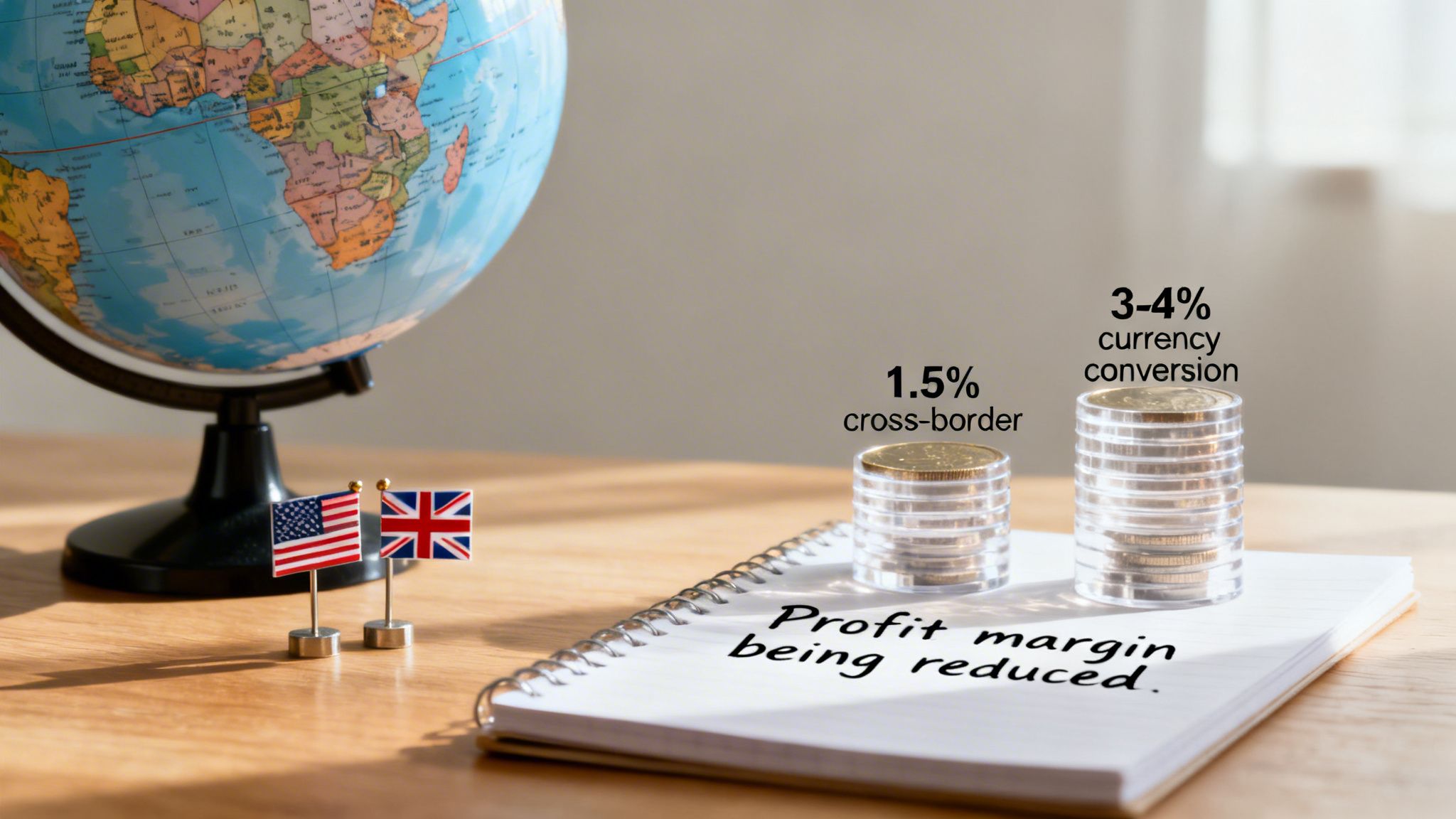
The most direct international charge is the cross-border fee. Think of this as a tax PayPal adds just for the transaction crossing a border. For US-based merchants, this fee is a flat 1.5% tacked right on top of your standard transaction rate.
So, if your domestic rate for a credit card payment is 2.99% + $0.49, an international sale immediately jumps to 4.49% + $0.49. Just like that, your fee has shot up by over 50%—and we haven't even talked about currency conversion yet.
This extra charge kicks in whenever the buyer's PayPal account or payment card is registered in a different country from yours. It doesn’t matter if they pay in your store’s currency; the fee is based purely on the geography of the buyer and seller.
The Currency Conversion Spread
The second, and often more costly, international charge is the currency conversion spread. If you sell to a customer in the UK and they pay in British Pounds (GBP), but your account is set to receive US Dollars (USD), PayPal has to convert the currency. This is where they make a serious chunk of change.
Imagine it like the currency exchange kiosk at an airport. It's convenient, sure, but you know you’re getting a terrible exchange rate compared to the real market rate. PayPal’s currency conversion works the same way.
PayPal typically applies a 3-4% markup on the wholesale exchange rate. This isn't a transparent fee you see on your statement; it’s baked into the conversion rate itself, meaning you simply receive less money than you should.
This markup is a pure profit center for PayPal, taken directly from your sale. It’s a sneaky cost that can easily turn a profitable international order into a loss if you aren't accounting for it.
A Real-World Example
Let's see how these layered fees impact a real sale. Suppose your US-based Shopify store sells a product for $100. A customer in the UK buys it, and the equivalent price is £80.
Here’s the fee breakdown:
- Standard Transaction Fee: You pay the base rate, let's say 2.99% + $0.49.
- Cross-Border Fee: Because the sale is international, you add another 1.5%. Your total percentage fee is now 4.49%.
- Currency Conversion Fee: The customer paid £80. When PayPal converts this to USD for your account, they'll take their 3-4% cut off the top through the exchange rate.
International transactions via PayPal pack a serious punch. For example, a supplements brand with 20% of its sales coming from international customers at a $50 average order value could see its fees jump from $1.74 on a domestic order to $2.72 on an international one.
That’s a 56% increase in fees per order, which could add up to nearly $10,000 in extra PayPal merchant charges annually on 10,000 orders. To learn more about how these fees compound, you can discover more insights about PayPal's fee structure on MerchantInsiders.com.
The higher costs of international sales are made worse by another factor: disputes. International orders carry a higher risk of chargebacks, which are more difficult and time-consuming to fight manually due to complexities like language barriers and shipping documentation.
Losing money on fees is one thing; losing the entire sale amount plus a penalty fee to a dispute is even more painful. This is where an automated solution becomes essential. ChargePay was built to handle every dispute—domestic or international—protecting your revenue on every sale. We’ve recovered over $2.8 million for merchants by managing more than 100,000 disputes with a 92.4% win rate. Our AI platform handles the entire process, saving you from the financial drain of both inflated fees and lost chargebacks.
If you are expanding globally, check out our guide on navigating the challenges of cross-border e-commerce.
Don't let complex fees and international disputes threaten your growth. Install ChargePay from the Shopify App Store and let our powerful AI protect your profits.
The Hidden Costs of PayPal Disputes and Chargebacks
Predictable transaction fees are one thing. You can bake those into your Shopify store's pricing model, plan for them, and move on. You know they're coming. But the real financial gut-punch for merchants comes from a completely different, much more painful source: the hidden costs of PayPal disputes and chargebacks.
These aren't predictable. They're financial bombshells that can flip a profitable sale into a major loss in an instant, catching even seasoned store owners off guard. Getting a handle on these costs is absolutely critical because they're a direct threat to your bottom line.
The Inescapable Dispute Fee
The moment a customer files a claim against one of your sales, PayPal automatically hits you with a Dispute Fee. This is a non-refundable penalty you have to pay just for the "privilege" of defending yourself.
Think of it like a mandatory legal fee for a court case you never wanted to be part of. Even if you provide flawless evidence and win the dispute hands-down, PayPal keeps this fee. It's their charge for playing middleman in the disagreement.
The Standard Dispute Fee is $15, but this can double to a $30 High Volume Dispute Fee if your store gets a lot of claims. Winning the case gets your original sale funds back, but that fee is gone for good.
This system puts merchants in a tough spot. You lose money on the fee even when you prove you did everything right. For a small Shopify store, just a handful of these disputes a month can add up to hundreds of dollars in pure, unrecoverable loss.
The Even More Painful Chargeback Fee
Things get even more expensive if a dispute escalates. A chargeback is what happens when a customer skips PayPal's internal system and goes straight to their credit card company to force a refund. If you lose this fight, the consequences are severe.
Not only do you lose the original sale amount and the product you shipped, but PayPal also slaps you with a separate Chargeback Fee, which is currently $20 in the US. This is a punitive fee, totally separate from the initial dispute fee, charged because the issue got kicked up to the card network level.
Let's quickly break down the two main fees you'll run into:
- PayPal Dispute Fee: This is for claims handled inside PayPal's Resolution Center. You'll pay this $15-$30 fee no matter the outcome.
- Chargeback Fee: This is for claims escalated to the credit card issuer. You pay this $20 fee if you lose the chargeback.
It's easy to see why so many merchants feel trapped. For a deeper dive on these costs, our complete guide to chargeback fees breaks down exactly how they can pile up.
The True Cost Is Your Time
Beyond the hard-dollar costs, the manual work involved in fighting a dispute is a massive drain on your time and energy. The whole process is frustrating and pulls you away from what you should be doing—growing your business. You have to drop everything to:
- Receive the Notification: Get an alert from PayPal that your funds are frozen.
- Gather Evidence: Scramble to dig up tracking numbers, shipping confirmations, customer emails, and screenshots of your product pages.
- Write a Rebuttal: Craft a convincing response explaining why the customer's claim is invalid.
- Submit and Wait: Upload all your documents to the Resolution Center before the strict deadline and cross your fingers.
This whole song and dance can take hours for a single dispute. Now, multiply that by how many disputes you get each month. This is where the value of a tool like ChargePay becomes crystal clear.
We built our platform to completely eliminate this workflow. As a Built for Shopify app with a 4.9-star rating, ChargePay automates the entire fight for you. Our AI has successfully handled over 100,000+ disputes, recovering more than $2.8 million for merchants with an incredible 92.4% win rate.
Instead of losing money and time, our system turns a losing battle into a solved problem. Ready to stop bleeding revenue to PayPal's fees and lost disputes? Install ChargePay from the Shopify App Store and let our AI start protecting your bottom line.
A Real-World Example of One PayPal Chargeback
Abstract numbers on a fee schedule don't always hit home. It’s one thing to read about PayPal merchant charges in a table; it’s another to see real money actually disappear from your Shopify account. Let’s walk through a concrete, step-by-step financial breakdown of a single fraudulent chargeback to show just how damaging it can be.
Imagine you sell a popular product for $100. A customer buys it, you ship it out, and everything seems fine. Then, a few weeks later, you get that dreaded notification: the customer has filed a chargeback, claiming the item never arrived.
Suddenly, that profitable sale starts to unravel.
Itemizing the Total Loss
The initial $100 you lose from the reversed sale is just the beginning. The true cost of this one fraudulent claim is much, much higher. You have to account for every single expense tied to that order.
Let's break down the math:
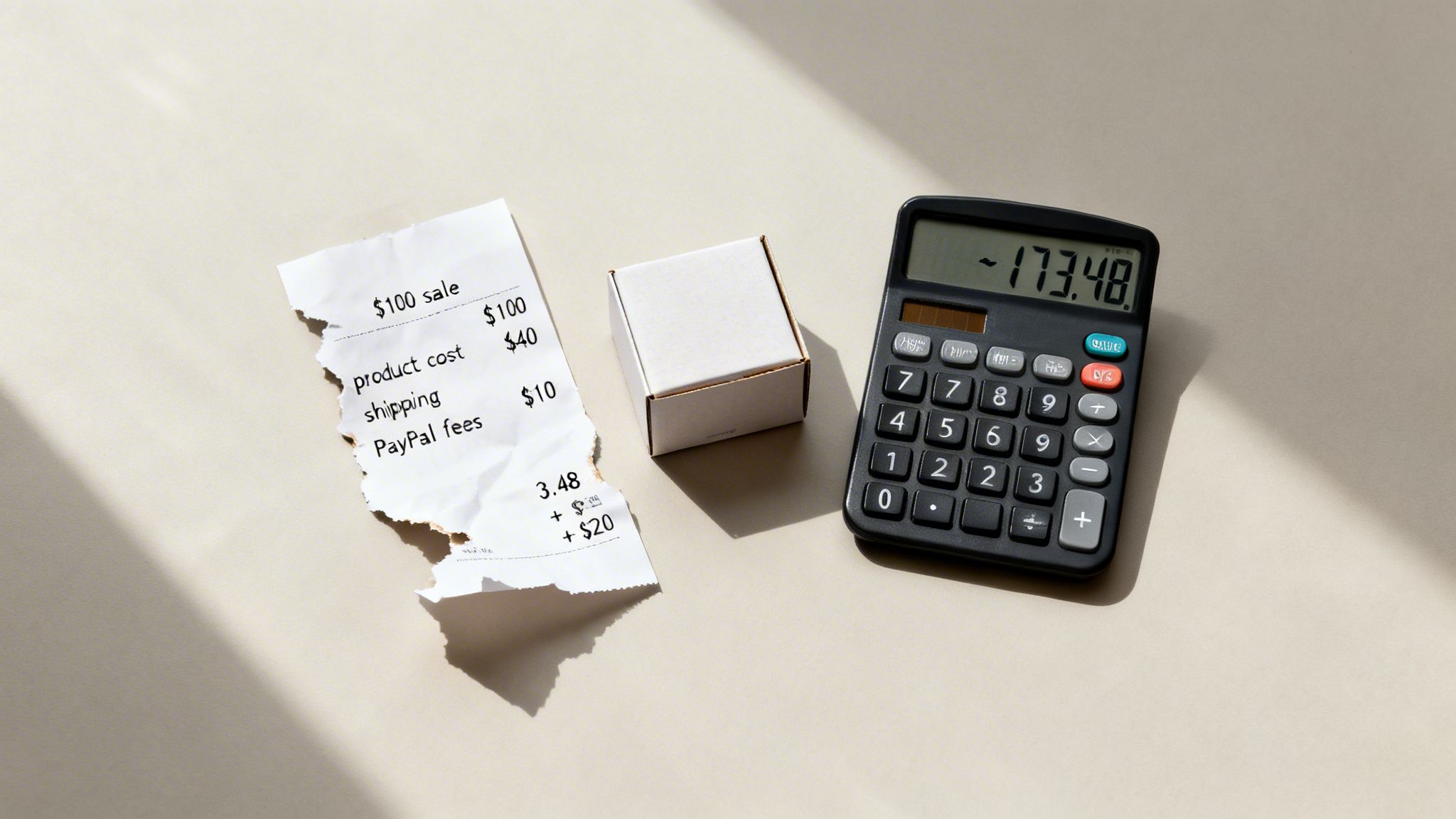
- Original Sale Amount: You lose the $100 that was reversed from your account.
- Cost of Goods Sold (COGS): Your product wasn't free. Let’s say your cost to acquire or manufacture it was $40.
- Non-Refundable PayPal Fee: PayPal still keeps its original transaction fee. At 3.49% + $0.49, that’s another $3.98 gone forever.
- Shipping & Handling: It cost you money to ship the product. We'll use a conservative estimate of $10.
Right there, your total out-of-pocket cost is $153.98. But wait, it gets worse.
The Final Insult: The Chargeback Fee
Because the customer escalated this directly to their bank, you're now on the hook for PayPal’s punitive Chargeback Fee. This is a separate penalty for losing the dispute, which currently stands at $20 in the US.
This fee is the final nail in the coffin. It's a direct penalty you pay on top of all your other losses.
A single fraudulent chargeback on a $100 sale doesn’t just cost you the $100. When you add up the lost revenue, product cost, shipping, transaction fee, and the chargeback penalty, your total loss is a staggering $173.98.
Let that sink in for a moment. A single dishonest claim forced you to lose nearly double the product’s selling price. Now, imagine this happening five, ten, or twenty times a month. The financial damage quickly becomes unsustainable for any Shopify business. Trying to fight these manually is a high-effort, low-reward battle that drains your resources and profits.
The ChargePay Outcome: How You Win It Back
This is precisely the scenario ChargePay was built to solve. Instead of just accepting that $173.98 loss, our AI-powered platform takes over the moment the dispute is filed. We've handled over 100,000+ disputes, recovering more than $2.8 million for merchants just like you.
With our 92.4% win rate, we don’t just fight the dispute—we win it. Our AI automatically builds and submits the evidence package needed to prove you fulfilled the order. When we win, that $100 is returned to your account. You're still out the operational costs, but you've avoided the devastating one-two punch of losing the sale and paying the extra chargeback fee.
The message is simple: automated recovery is the only scalable way to protect your business from the crippling costs of PayPal chargebacks. Don’t let fraudulent claims bleed your business dry.
Ready to turn your chargeback losses into recovered revenue? Install ChargePay from the Shopify App Store and let our AI start fighting for you today.
How to Fight PayPal Chargebacks and Win Back Your Money
So, you’ve been hit with a PayPal dispute. That sinking feeling is all too familiar for Shopify merchants. One minute everything is fine, and the next, your money is frozen while you're pulled into a process that feels stacked against you. You really have two choices: fight it the hard, manual way or fight it the smart, automated way.
Let's be direct—fighting back is non-negotiable if you want to protect your profits from piling-up PayPal merchant charges. But how you fight is what really makes the difference.
The Exhausting Manual Way to Fight a Dispute
Fighting a PayPal chargeback on your own is a high-effort, low-reward battle. It's a massive distraction from what you should be doing: running your business. The second you get that dispute notification, PayPal’s strict deadline clock starts ticking.
Here’s what that manual scramble usually looks like:
- Dig for Evidence: You have to immediately start digging through your records. That means hunting down the Shopify order details, finding the proof of delivery with a valid tracking number, and pulling up every email you might have exchanged with the customer.
- Write a Rebuttal: Next up, you have to write a compelling rebuttal letter. This document needs to clearly and concisely argue why the customer's claim is wrong, all while referencing the scattered pieces of evidence you just collected.
- Submit and Hope: Finally, you upload everything to PayPal’s Resolution Center, cross your fingers, and just wait. The whole thing is time-consuming, stressful, and gives you zero guarantee of success.
Even with perfect evidence, one small mistake in your submission or a missed deadline means an automatic loss. You're out the product, the original sale, the shipping cost, and you get stuck paying PayPal’s penalty fees. It’s a frustrating cycle that drains both your time and your bank account.
The Smart, Automated Path with ChargePay
Now, let's look at the alternative. Instead of manually wrestling with every single dispute, you can automate the entire headache with a tool built specifically for Shopify merchants like you. This is where ChargePay completely changes the game.
We’ve handled over 100,000+ disputes and recovered more than $2.8 million for businesses by turning this frustrating manual chore into a solved problem. Our AI-powered platform plugs directly into your Shopify and PayPal accounts, giving you a powerful, automated defense system.
With a 92.4% win rate, ChargePay doesn't just respond to disputes—it wins them. We transform what was once a guaranteed revenue loss into recovered profit, protecting your bottom line from the financial damage of chargebacks.
The diagram below shows a clear comparison of the two approaches.
This visual says it all: the manual path is a chaotic, multi-step struggle. The ChargePay way is a single, automated flow that gets results without you lifting a finger. Our AI handles all the evidence gathering, response generation, and submission for you.
How ChargePay Fights for You
As a Built for Shopify app with a 4.9-star rating in the Shopify App Store, ChargePay is the trusted solution for merchants who are tired of losing money to chargebacks. Our process is simple but incredibly powerful:
- Instant Detection: Our system immediately detects when a new PayPal dispute is filed against your store.
- AI-Powered Evidence Building: The AI instantly gets to work, pulling all the necessary data from Shopify and other integrated sources to build a comprehensive and compelling evidence package.
- Automated Submission: The system generates a winning response tailored to the specific dispute reason code and submits it on your behalf, well before the deadline.
This isn’t just about saving time. It's about using powerful technology to seriously increase your chances of winning. To get a better grasp of the tactics involved, you can learn more about how to fight a chargeback effectively in our detailed guide.
Fighting PayPal chargebacks manually is an uphill battle that merchants rarely win. It’s a drain on your resources and a constant threat to your profitability. With ChargePay, you get an expert system that fights—and wins—for you 24/7.
Stop letting disputes and fees eat away at your revenue. Install ChargePay from the Shopify App Store and let our AI turn your chargeback problem into recovered cash.
Answering Your Top Questions About PayPal Fees and Disputes
If you're a Shopify merchant using PayPal, you've probably felt the sting of confusing fees and unexpected disputes. It can feel like navigating a maze blindfolded. You've got questions, and we've heard them all. Let's tackle them head-on with some straight answers.
We often see merchants battling disputes the old-fashioned way—manually. But there's a better approach. This quick comparison shows you the difference between going it alone and having an automated partner in your corner.
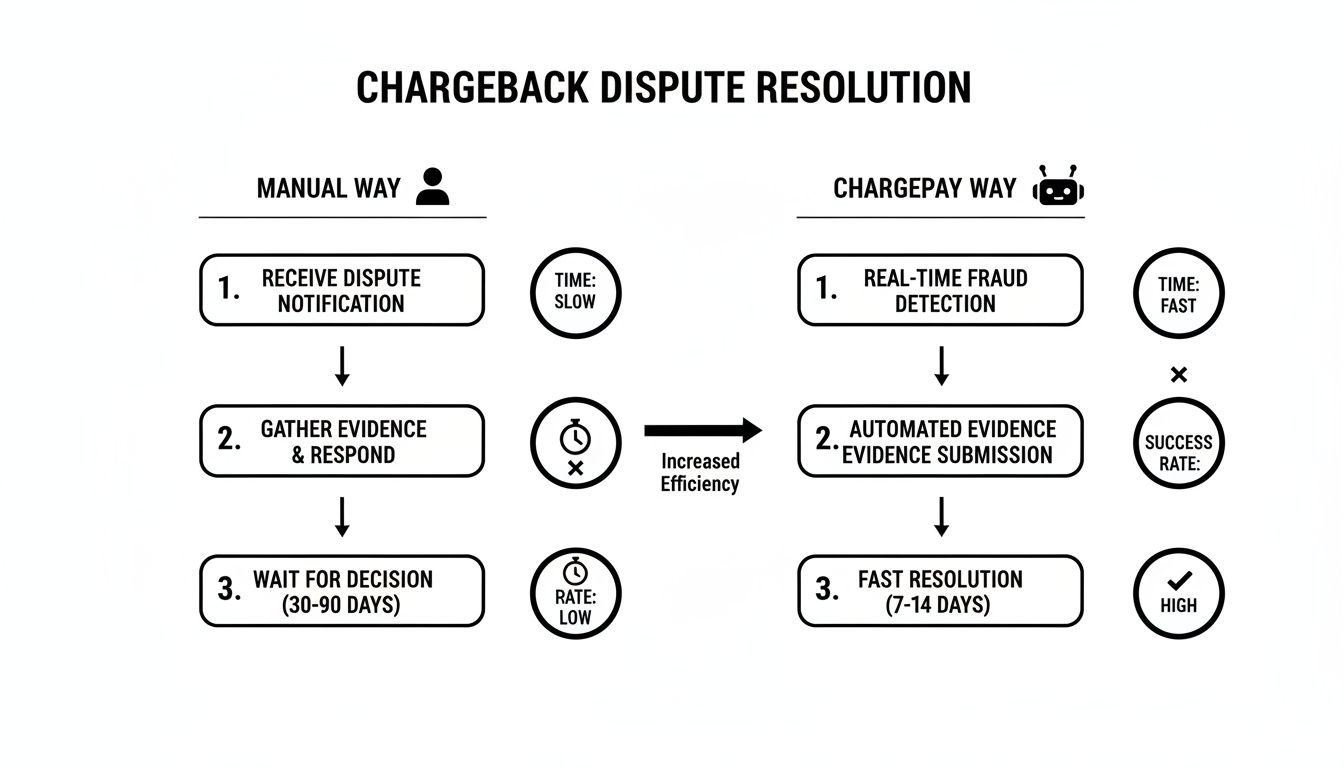
The takeaway is simple: the manual route is a messy, time-sucking headache. The ChargePay way is a clean, efficient process built from the ground up to win back your money.
Can I Get the PayPal Dispute Fee Refunded If I Win?
This is one of the most common—and painful—points of confusion for merchants. The short answer is a hard no.
When a customer files a dispute, PayPal hits you with a non-refundable Dispute Fee. This is either $15 for their Standard rate or $30 if you're on their High Volume rate. Think of it as PayPal's fee for stepping in to mediate the argument.
Even if you assemble a perfect case, provide flawless evidence, and win the dispute, that fee is gone for good. You'll get the original transaction funds back, but the dispute fee itself is a sunk cost. It's a critical detail to remember: this is a fixed cost you pay just for being dragged into a dispute, win or lose.
While PayPal's Seller Protection policy might cover the transaction amount in some cases, it never refunds the dispute fee.
Is PayPal's Micropayments Rate Good for My Store?
For shops selling lots of low-cost items, PayPal's Micropayments rate can look pretty tempting. A standard rate like 3.49% + $0.49 can be brutal on a $5 sale, eating up a huge chunk of your revenue. The Micropayments rate flips the script to 4.99% + $0.09.
Let's run the numbers on a $5 sale to see why that matters:
- Standard Rate: ($5 * 0.0349) + $0.49 = $0.66 in fees
- Micropayments Rate: ($5 * 0.0499) + $0.09 = $0.34 in fees
On that tiny sale, you're saving almost half on fees—a huge difference. But there's a catch. The break-even point is right around $12. For any sale over that amount, the higher percentage on the Micropayments rate actually makes it more expensive than the standard one.
You also have to apply and get approved for this rate, so it's not automatic. Before you jump in, take a hard look at your average order value to see if it really makes sense for your store.
How Does ChargePay Work with PayPal Seller Protection?
PayPal Seller Protection acts as a safety net, but it's a net with some very specific—and very large—holes in it. It only covers certain dispute types, like "unauthorized transaction" or "item not received" claims. Even then, you have to follow their rules to the letter, like shipping only to a confirmed address and having perfect proof of delivery.
Crucially, Seller Protection offers zero help for one of the most common dispute reasons: "significantly not as described."
This is where ChargePay creates a powerful advantage. Our AI fights every single dispute, including the many claims that fall right through the cracks of Seller Protection's narrow coverage. We don’t just cross our fingers and hope PayPal's policy applies; we build a comprehensive, evidence-backed case to win back your money on its own merits.
We've seen countless merchants lose revenue because their dispute didn't tick the right boxes for Seller Protection. ChargePay was built to fill that exact gap. With a 92.4% win rate across more than 100,000+ disputes handled, our AI maximizes your revenue recovery by fighting—and winning—the battles that Seller Protection won't even touch.
You can get a deeper look at this strategy in our complete guide to managing PayPal disputes.
Stop losing money to confusing rules and claims that leave you unprotected. ChargePay turns the complex and frustrating world of PayPal disputes into a solved problem. As a Built for Shopify app with a 4.9-star rating, we are the trusted choice for Shopify merchants serious about protecting their revenue. Install ChargePay from the Shopify App Store.


.svg)



.svg)


.svg)
.svg)
.svg)