

Refund abuse isn’t a minor annoyance. It’s a direct hit to margin.
In the United States, fraudulent returns caused $103 billion in losses for retailers in 2024, and 15.14% of all returns were marked as fraudulent according to the Ravelin refund abuse trends report. If you run a Shopify store, that number matters because refund abuse usually shows up as “customer service noise” long before you recognize it as a profit problem.
Small merchants feel this faster than big brands. You don’t have a giant fraud team, a dedicated returns analyst, or the luxury of writing off bad claims as overhead. When a dishonest customer gets a refund they shouldn’t get, you lose product, shipping, staff time, and often the chance to resell inventory at full price.
Most stores already have enough on their plate. Paid acquisition is expensive. Inventory is tight. Cash flow matters every week. That’s why refund abuse deserves direct attention. If you don’t tighten this area, dishonest buyers will keep treating your store like free inventory.
Your Store Is Leaking Money Through Refund Abuse
Fraudulent returns already account for a meaningful share of retail losses in the U.S. For a small Shopify store, that pressure shows up fast in cash flow, support workload, and inventory you cannot resell at full price.
Refund abuse slips through because it rarely looks dramatic. It looks routine. A customer says the package never arrived. Another says the item was damaged, but sends no proof. Someone claims the wrong product showed up, even though your pick and pack records are clean.
On paper, each case looks small. On your P and L, they stack up.
What it looks like in a Shopify business
Small merchants get hit harder than large retailers because every bad refund has multiple costs attached to it. You are not just giving back revenue. You are eating shipping, payment fees, support time, and inventory loss at the same time.
That is why refund abuse deserves the same attention you give checkout fraud. If you only screen risky orders before purchase and ignore bad claims after delivery, you are leaving an obvious hole in your operation.
It often shows up in patterns like these:
- “Item never arrived” after confirmed delivery
- “Not as described” on a product page that was accurate
- “Received damaged” with no photo evidence
- “Wrong item sent” when your fulfillment records show otherwise
These requests create pressure to refund fast and move on. That reaction is exactly what repeat abusers want.
Practical rule: If your team issues refunds before checking tracking, photos, order history, and fulfillment notes, you are teaching abusive buyers that your store is easy to exploit.
A lot of this overlaps with what merchants already recognize as friendly fraud. The buyer keeps the product, gives a convenient story, and your store absorbs the loss.
Why small stores lose more than they think
Enterprise brands can hide some of this waste inside bigger budgets. You cannot. A few bad claims per week can erase the profit from a strong sales day, especially if you sell products with tighter margins or higher shipping costs.
Policy design makes the problem worse. Broad refund promises, weak evidence requirements, and careless use of returnless refund policies can turn a customer-friendly process into an open invitation to abuse. Big retailers may accept that tradeoff. Small Shopify merchants should not copy it without controls.
Ignore this, and buyers notice. They test your limits, repeat the behavior, and sometimes reorder under new emails or slight variations of the same name. The stores that lose the most money are usually the ones treating every refund request like a simple service task instead of a repeatable abuse pattern.
You do not need an enterprise fraud team to stop this. You need tighter rules, better evidence checks, and a process your staff follows every time.
What Refund Abuse Actually Is And Is Not
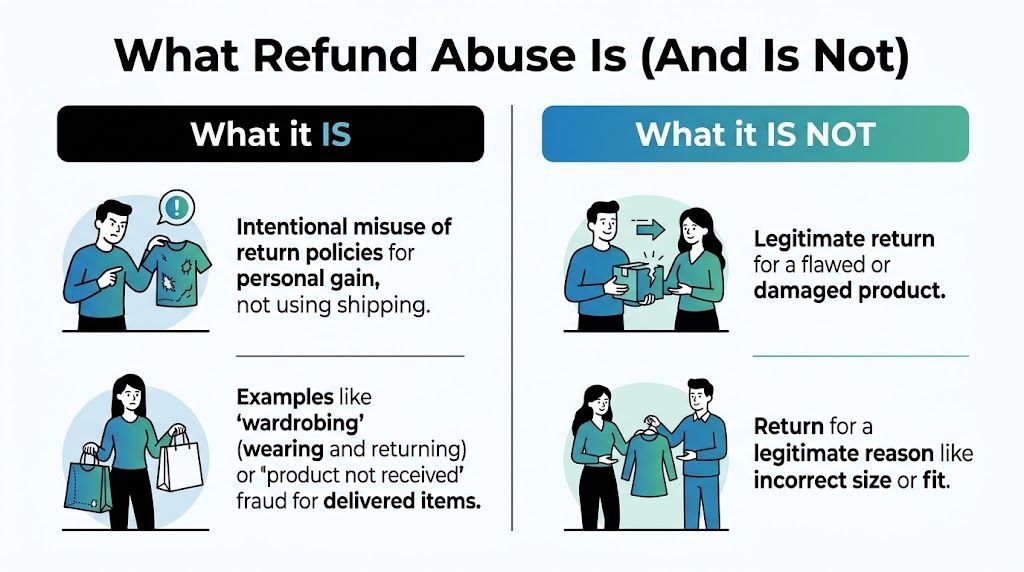
Refund abuse is intentional misuse of your return or refund policy for personal gain.
That’s the simplest definition. A legitimate customer has a real problem and wants a fair resolution. An abusive customer uses your policy as a loophole.
A clean analogy helps. If a restaurant serves undercooked food and the customer sends it back, that’s normal. If someone eats the whole meal and then invents a complaint to avoid paying, that’s abuse.
Common forms of refund abuse
Some forms are obvious. Others look like normal returns until you review the pattern.
Bracketing is when someone orders multiple sizes, colors, or versions with the intention of returning most of them.
Wardrobing is when a buyer purchases an item, uses it, then sends it back as if it were still new.
Policy manipulation is broader. It includes buyers who learn your rules and shape their claims to fit them.
According to Loop Returns, common abuse tactics include bracketing, wardrobing, and policy manipulation, and 30% of people who engage in wardrobing do so at least once per week. That weekly behavior matters because it tells you some refund abuse is habitual, not occasional.
What refund abuse is not
Not every return is suspicious. Merchants get into trouble when they overcorrect and treat good customers like criminals.
Refund abuse is not:
- A damaged item claim with clear proof
- A fit issue on apparel
- A shipment problem backed by carrier evidence
- A real fulfillment error from your warehouse
That distinction matters because your policy should protect margin without punishing honest buyers.
If you’re reviewing whether a no-return option makes sense for low-cost items, this guide on returnless refund policies is useful context. It won’t solve abuse by itself, but it helps merchants think more clearly about when requiring a physical return is worth it.
Dispute types at a glance
| Dispute Type | Customer Intent | Example | How to Think About It |
|---|---|---|---|
| Legitimate return | Resolve a real issue | Wrong size, damaged item, fulfillment mistake | Customer service problem |
| Refund abuse | Keep product or gain money through policy misuse | Worn item returned as new, false damage claim, repeated “missing item” reports | Policy enforcement and fraud problem |
| Friendly fraud | Reverse a valid transaction after receiving the order | Customer files a payment dispute instead of working with you | Payments and evidence problem |
| Operational error | Your team made a mistake | Duplicate refund, wrong SKU shipped, delayed processing | Process problem |
A lot of merchants blur refund abuse and friendly fraud together. They’re related, but they don’t always start in the same place. This breakdown on what is friendly fraud is worth reading if you want to separate refund misuse from chargeback misuse.
A customer with a valid issue wants a fix. A customer committing refund abuse wants your product, your money, or both.
The True Cost of Refund Abuse for Shopify Stores
For a small store, refund abuse hurts more than the refund amount itself.
That’s the part many merchants miss. The visible loss is the money you send back. The hidden loss is everything wrapped around it.

Why small stores feel it harder
Large retailers can spread losses across huge order volume. Most Shopify brands can’t.
That’s one reason this issue lands harder on DTC merchants. Existing coverage often focuses on enterprise retail, but it rarely addresses how badly refund abuse strains smaller operations. A 2024 Loop survey highlighted by iDenfy found that nearly 4 in 10 U.S. consumers admit to or know someone engaging in returns abuse in the past year, and that kind of behavior scales badly for stores with lean teams.
When you’re small, one abusive customer can trigger work across support, ops, fulfillment, and finance. The same case that’s annoying for a large retailer can become your team’s afternoon.
The hidden bill behind one bad refund
When a dishonest refund gets approved, the losses stack up fast:
- You lose the sale because the revenue disappears.
- You may lose the product if the item isn’t returned, is returned used, or comes back damaged.
- You absorb shipping costs going out, and sometimes on the return as well.
- Your staff spends time on emails, investigation, tracking checks, and manual review.
- Inventory planning gets messier because fake returns distort what’s sellable.
If the item comes back opened, worn, substituted, or incomplete, the damage gets worse. You’re not just refunding an order. You’re eating operational friction.
Why “just refund it” is expensive
A lot of support teams choose the fastest path because they want to avoid friction, protect reviews, and move on. That’s reasonable when the customer is honest. It’s expensive when the customer isn’t.
Fast refunds are good customer service only when the claim is real. When the claim is abusive, speed becomes a subsidy for repeat behavior.
This is why refund abuse shouldn’t sit only with support. It belongs in operations and risk too. If your store doesn’t review patterns, track repeat claim types, and hold questionable refunds for evidence checks, dishonest buyers will keep winning the easy cases.
The ultimate cost isn’t one refund. It’s the precedent.
How to Spot Refund Abuse Patterns in Your Store
You don’t need a giant fraud team to catch refund abuse early. You need pattern recognition.
Most abusive claims don’t stand out as a single dramatic event. They show up as repeated behavior across customers, addresses, devices, products, and reasons for return.

Start with the obvious repeats
Review the refund requests that keep showing up with the same storyline.
Look for customers who:
- Report non-delivery more than once despite completed tracking
- Claim damage repeatedly but avoid sending usable photos
- Buy the same category in bursts and then return most of it
- Open multiple accounts with similar names, addresses, or phone details
- Push for immediate refunds before your team verifies the facts
You should also watch product-level patterns. If one SKU attracts a strange amount of “not as described” claims while your listing and fulfillment records look clean, that may be abuse rather than merchandising failure.
Watch for linked identities, not just bad orders
Advanced refund abuse often hides behind account switching. That’s why account-level review alone isn’t enough.
According to Rapyd, detection methods include device fingerprinting such as canvas data, fonts, and IP ranges, address clustering for parcel lockers, and risk scoring on repeated PDF metadata edits. Those signals help merchants identify connected activity across different accounts. The same source notes that serial refund abuse involving high-value electronics can yield up to $3,200 per incident.
That matters because one person can look like several “different” customers unless you connect the dots.
A practical review checklist
Use this as a working checklist inside Shopify and your returns workflow.
- Customer history: Has this person requested refunds or exceptions before?
- Order pattern: Did they order unusually high quantities, multiple sizes, or repeated variants?
- Claim timing: Did they report the issue immediately after delivery, or only after using the item?
- Evidence quality: Are their photos vague, cropped, inconsistent, or missing?
- Return behavior: Do they resist returning the product but still demand a refund?
- Address behavior: Is the shipment tied to a forwarding location, parcel locker, or a pattern you’ve seen before?
- Document oddities: Do invoices, screenshots, or attachments look edited or reused?
A lot of stores can improve results just by making these checks standard instead of optional.
For merchants trying to tighten post-purchase risk review, this guide to transaction monitoring solutions is a useful next read because the same logic applies here. Don’t only review payments. Review the behavior that happens after delivery.
Put your team on one definition of suspicious
Your support team, ops team, and founder should all recognize the same red flags. If one person flags a claim and another person auto-approves it, your process is broken.
Create simple internal tags such as:
| Flag | What it means |
|---|---|
| Repeat INR | Customer has more than one item-not-received claim |
| High-return buyer | Customer returns a large share of orders |
| Evidence mismatch | Photos, tracking, or order notes don’t align |
| Linked account risk | Shared device, address, payment clues, or contact details |
Short training goes a long way here. Your team doesn’t need a fraud manual. They need a short list of behaviors that trigger a pause.
This walkthrough gives a good visual overview of common refund fraud mechanics and review mindset:
If a claim looks ordinary but the customer pattern doesn’t, trust the pattern.
Your Playbook for Preventing and Responding to Abuse
Most stores lose money on refund abuse for a simple reason. They’re reactive.
You need two things at the same time. Stronger prevention before money leaves your account, and a disciplined response when a suspicious claim comes in.
Tighten the policy without punishing good customers
Your refund policy should be clear enough that honest buyers understand it and dishonest buyers know they’ll be checked.
Start with the basics:
Require proof for specific claim types
If someone says an item arrived damaged, ask for clear photos of the product, packaging, and label. If they claim the wrong item arrived, require images that show the SKU or identifying details.Use clear product pages
Strong descriptions, sizing details, and accurate images reduce “not as described” claims. Some customers are confused. Others are shopping for excuses. Better listing quality helps with both.Set rules for high-risk orders
For expensive products, require stronger delivery confirmation and keep tighter records on fulfillment.Don’t auto-refund under pressure
Support teams often refund because the customer is loud, angry, or threatening a dispute. That’s exactly when you need process.
Operational advice: Build a short hold step for suspicious claims. Even a brief review window gives your team time to verify evidence before money leaves.
Fix your refund data flow
A surprising amount of abuse happens because merchants can’t cleanly connect the refund to the original transaction.
Fraud.net explains unmatched refunds as cases where data silos obscure the link between a sale and a refund, enabling abuse. Their writeup notes that detection relies on matching refunds to sales using keys like card hash plus time window, and that these rules can flag ambiguities before deadlines, helping improve chargeback outcomes.
That principle is practical even for smaller Shopify stores. If your order data, payment data, return records, and support notes live in separate places, bad claims become harder to challenge.
At minimum, make sure your workflow connects:
- Order confirmation
- Fulfillment records
- Carrier tracking
- Customer communication
- Refund action history
- Any prior disputes or exceptions
This is also why chargeback prevention matters here, not just return handling. If your internal records are sloppy, bad refund claims often turn into payment disputes later. This overview of chargeback prevention is useful if you want to close that loop.
Respond like you expect to defend the case later
When a suspicious refund request lands, don’t think only about the immediate ticket. Think about the evidence trail.
A strong response workflow looks like this:
| Step | What to do | Why it matters |
|---|---|---|
| Review the claim | Compare the customer story to order, shipping, and product data | Catches contradictions early |
| Request specific evidence | Ask for photos, packaging details, or return tracking | Forces the claimant to substantiate the story |
| Check prior behavior | Review earlier refunds, disputes, and exceptions | Repeat abuse often shows up in history |
| Preserve records | Save all messages, tracking events, and internal notes | You may need them for a dispute later |
| Decide consistently | Refund, deny, or escalate based on policy and evidence | Inconsistent decisions train abusers |
Keep your language calm and factual. Don’t accuse the customer of fraud unless you’re prepared for the fallout. You don’t need drama. You need documentation.
Merchants who win these fights usually aren’t the most aggressive. They’re the most organized.
Automate Your Defense with ChargePay
Manual review works up to a point. Then it starts breaking.
The moment your order volume grows, your team runs into the same problem every Shopify merchant hits. Too many claims, too many screenshots, too many deadlines, and no reliable way to keep every case consistent.
That’s where automation helps. Small businesses don’t need more software for the sake of software. They need systems that remove repetitive work and keep decisions tight. If you’re thinking about that more broadly, this piece on AI automation for small business is a solid primer on where automation saves time.
What automation should handle
A useful system should do four things well:
- Flag risky patterns early so repeat abusers don’t slip through under new accounts
- Pull evidence together automatically from orders, tracking, customer messages, and refund history
- Prepare dispute-ready documentation without your team writing every response from scratch
- Act before deadlines so valid defenses don’t expire in a queue
That’s the practical standard. If your current workflow still depends on someone hunting through inboxes and screenshots every time a case escalates, the process is too fragile.
Where ChargePay fits
ChargePay is built for Shopify merchants dealing with chargebacks, friendly fraud, and post-purchase abuse. According to the publisher data provided for this article, it has a 92.4% win rate across 200K+ cases, has recovered $10.8M+ for merchants, carries a 4.9-star rating on the Shopify App Store, and has a Built for Shopify badge. It also uses a pay-per-win model, so merchants only pay when money is recovered.
Those details matter because the problem you’re solving isn’t theoretical. It’s operational. You need something that can identify suspicious behavior, assemble evidence, and submit responses without becoming another dashboard your team ignores.
Good fraud operations don’t depend on memory. They depend on repeatable systems.
If you’re still handling refund abuse with inbox searches, spreadsheets, and gut instinct, you’re making the job harder than it needs to be.
Turn Refund Abuse into a Solved Problem
Refund abuse won’t disappear because your policy says “we reserve the right to deny returns.” Abusers don’t care about vague language. They care about whether your store checks facts, tracks patterns, and responds consistently.
That’s the key shift. Stop treating refund abuse as random bad luck. Treat it like an operational problem with a process answer.
What smart Shopify merchants do differently
They don’t auto-approve suspicious claims.
They document everything. They connect support, shipping, and payment records. They teach their team what repeat abuse looks like. They tighten review on the cases that deserve scrutiny and keep the experience smooth for honest customers.
That balance is the goal. Not maximum strictness. Not maximum leniency. Clear rules, clean evidence, and fast action where it counts.
Your next move
If your store is losing money to refund abuse, the fix isn’t working longer hours inside support tickets. The fix is building a system that catches patterns early and helps you defend the revenue you already earned.
You can do that manually for a while. Most merchants eventually hit the limit.
The better approach is to make refund abuse boring. Standardized. Documented. Contained.
Stop letting refund abusers eat into your profits. Install ChargePay from the Shopify App Store. It has a 4.9-star rating, a Built for Shopify badge, and a pay-per-win model, so you only pay when your money is recovered.


.svg)



.svg)


.svg)
.svg)
.svg)