


Friday night. Ads are converting, orders are coming in, and your Shopify dashboard finally looks the way you hoped it would. By Monday, two customers want refunds, one package is stuck in transit, and a cardholder has filed a dispute because the charge looked unfamiliar. That swing is normal in apparel. It is also where margin disappears.
A Shopify clothing store wins on operations before it wins on branding. Good product photos and a clean theme matter, but profit is decided after checkout. Fit issues, unclear shipping expectations, slow support, and preventable disputes can turn solid sales into losses. Add in the full cost of a chargeback fee on top of the lost order, and one messy transaction can wipe out the profit from several good ones.
Fashion on Shopify is crowded. You do not need another vague growth plan. You need a store built to reduce returns, lower dispute risk, and keep support workload under control from day one.
If you are still deciding how to build, choosing a Shopify agency can make sense if the team understands more than design. The right build improves mobile product pages, policy visibility, checkout clarity, and the small trust signals that stop customer confusion before it becomes a refund request or chargeback.
A profitable store does more than generate orders. It protects revenue at every step.
Your Shopify Store Dream vs The Financial Reality
A new founder usually thinks the hard part is getting the first order. It isn't. The hard part is keeping that order profitable after payment clears, the package ships, the customer tries it on, and their bank gets involved because they didn't recognize the charge, didn't like the fit, or decided a refund was taking too long.
That's where many apparel founders get blindsided. They spend on design, ads, influencer seeding, and inventory. Then the hidden drain starts. Refund requests pile up. A few disputes land. Then more follow. You lose product, shipping, and revenue on the same order.
If you're still deciding whether to build in-house or get help, choosing a Shopify agency can be a key consideration. Not because an agency magically fixes operations, but because a solid build can reduce the sloppy mistakes that cause confusion later, especially around product pages, mobile UX, and policy visibility.
The sale is only step one
A Shopify clothing store is fragile when the founder treats post-purchase issues like customer service admin instead of profit protection.
Here's what that looks like in practice:
- A customer claims the item looked different online. That's not just a return risk. It can become a dispute.
- Tracking shows delay or delivery confusion. Now you're dealing with “item not received.”
- A shopper buys a gift in peak season. Weeks later, the cardholder sees the charge and files with the bank.
- Support replies too slowly. A refund request turns into a chargeback.
Practical rule: If your post-purchase workflow is vague, your payment risk goes up.
Chargebacks also come with extra costs beyond the refunded order. If you need a plain-English breakdown of where those costs come from, read this guide on what a chargeback fee is. Most founders learn this too late, after they've already lost the sale and paid the penalty.
Build for retention of revenue
You don't need a perfect launch. You need a store that reduces avoidable confusion from day one.
That means:
- Pick products you can describe clearly.
- Source from suppliers you can trust.
- Make sizing easy to understand.
- Set shipping expectations before checkout.
- Treat disputes as an operating system issue, not a random annoyance.
Pretty stores are common. Resilient ones are rare.
Find a Niche and Source Products to Minimize Returns
“Follow your passion” is weak advice for apparel. Passion doesn't control fit consistency, supplier quality, or shipping reliability. Those are the things that decide whether your Shopify clothing store keeps its margin.
Apparel has a structural problem. The average retail return rate was 16.9% in 2024, and apparel was higher than that average. Sizing and fit are the dominant return reasons, as noted in this apparel returns discussion. That matters because fit confusion doesn't stop at returns. It can spill into chargebacks if buyers feel the product was misrepresented.

Choose products you can explain without spin
Some clothing categories are harder to sell cleanly than others. If your item needs a paragraph of excuses about stretch, drape, fit variance, color differences, or delayed production, it's already risky.
A stronger niche usually has these traits:
- Repeatable sizing: Tees, basics, and categories with less fit variability are easier to manage than garments requiring precise fitting.
- Simple expectation setting: Customers should understand what they're buying from images and copy alone.
- Lower fulfillment complexity: Fewer customizations mean fewer chances to send the wrong item.
- Lower emotional mismatch: Occasionwear and gift-heavy products often come with higher disappointment when expectations miss.
Compare sourcing models by dispute risk
Most founders compare sourcing models by startup cost. That's incomplete. Compare them by how much control they give you over quality, lead times, and evidence when something goes wrong.
| Model | Your control | Main risk | Chargeback exposure |
|---|---|---|---|
| Print on demand | Low to medium | Print inconsistency, slower fulfillment | Harder to defend “not as described” if quality varies |
| Dropshipping | Low | Shipping delays, weak packaging, poor QC | Higher “item not received” and expectation mismatch risk |
| Private label | Medium to high | Inventory commitment | Better control if you document specs, QC, and shipping |
Private label usually gives you the best shot at consistency. Dropshipping usually gives you the least room to recover when a customer complains, because you don't control much of the experience. Print on demand sits in the middle, but only if your vendor is reliable and your mockups match reality.
If your supplier creates surprises, your customers will hand those surprises to their bank.
Source like an operator, not a hobbyist
Before you commit to any supplier, test the boring stuff:
- Order your own samples repeatedly: One sample isn't enough. Check consistency across runs.
- Stress-test shipping promises: Don't publish timelines you can't support.
- Review packaging and labels: Generic packaging causes confusion and “I don't recognize this” claims.
- Audit size grading: If sizes swing between batches, you're creating your own return queue.
One useful framework is to look at products through the lens of return causes, not just demand. This breakdown of common reasons for returns is a good reminder that many “marketing” problems are preventable operations problems.
Narrow beats broad
New stores often launch with too many SKUs. That creates more supplier dependencies, more fit profiles, and more ways to disappoint people.
Start with a tight line. A narrow collection lets you improve product copy, tighten size guidance, and spot issue patterns faster. If one item keeps driving complaints, you can fix or remove it before it becomes a dispute magnet.
The smart niche is not the one you like most. It's the one you can fulfill accurately, explain clearly, and support without chaos.
Design a Store That Converts and Builds Trust
A Shopify clothing store isn't a digital lookbook. It's a trust test. If the page leaves room for doubt, shoppers hesitate before purchase and complain after it.
The benchmark is useful here. Shopify fashion and apparel stores average around 1.9% conversion, and the top 20% convert above 3.2% according to Red Stag's Shopify conversion benchmarks. The practical takeaway is simple. Don't chase more traffic while your product pages still create uncertainty.
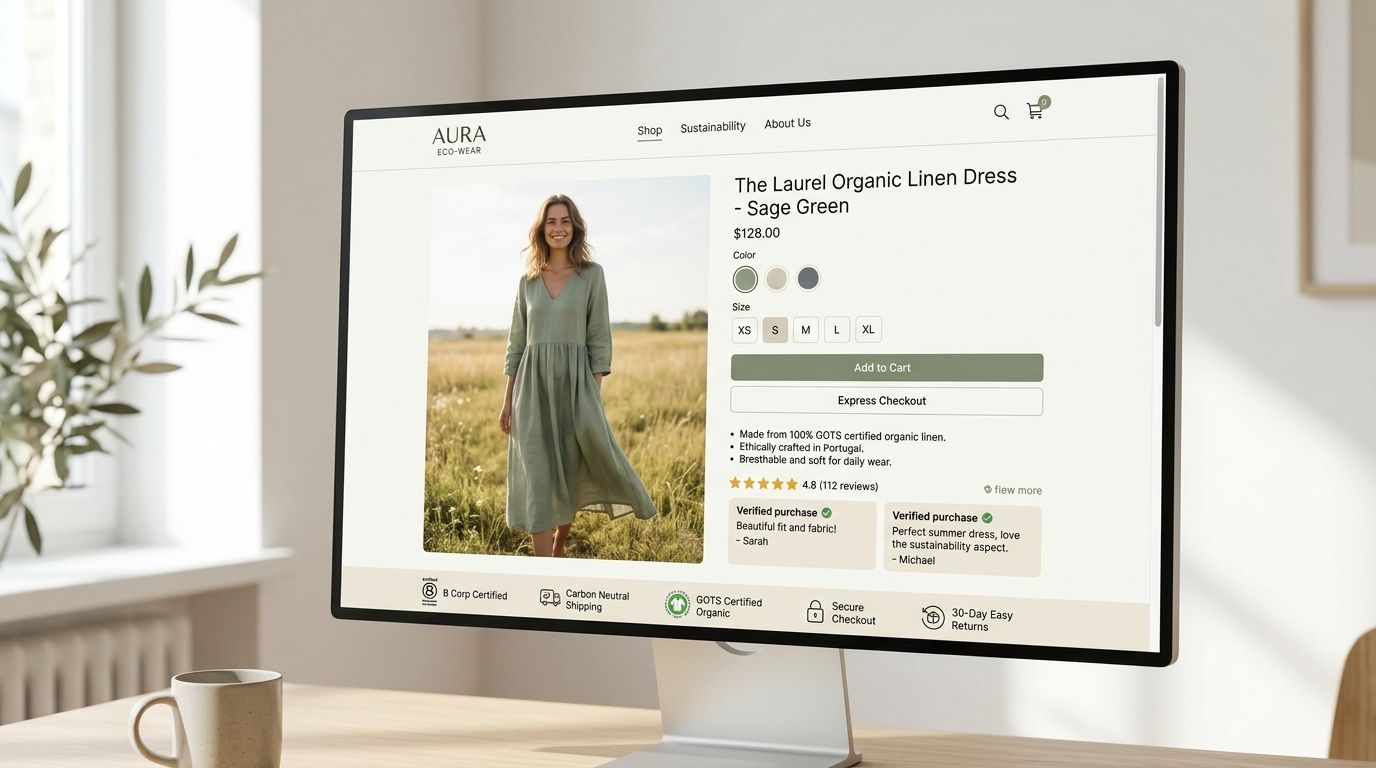
Product pages must answer objections before they form
Most fashion pages still undersell the details that matter. They show a polished hero image, then force the buyer to guess.
Fix that with clear merchandising:
- Multiple angles: Front, back, close-up fabric texture, and detail shots.
- On-body context: Show how the item sits, not just how it looks in a studio.
- Fabric and care facts: Don't make customers email you for basic material info.
- Fit notes that sound human: “Runs small in the waist” is more useful than vague sizing copy.
- Size chart near the buy box: Don't hide it in a tab no one opens.
Trust elements belong near the decision point
Trust signals are not decoration. They lower purchase anxiety and reduce the odds of a buyer later claiming they were unclear on terms.
Here's what should be visible before checkout:
Shipping timing
Put realistic delivery windows on the product page, not buried in a policy footer.Return rules
Keep the language short. Customers should know what qualifies, what doesn't, and how long they have.Contact options
An email form alone isn't enough. Make support feel reachable.Order transparency
Confirm what happens after purchase, including tracking and support steps.
Operator's view: Every unanswered question on the product page becomes a support ticket later. Some become disputes.
Audit by device, not just by page
Desktop and mobile shoppers behave differently. If a mobile visitor can't read your size chart, zoom images properly, or understand shipping timing, they either abandon or buy with uncertainty. Both outcomes hurt.
Use this quick audit:
| Store element | What to check | Why it matters |
|---|---|---|
| Product images | Pinch zoom, swipe speed, image clarity | Bad visuals increase expectation mismatch |
| Size guidance | Visibility, readability, placement | Fit confusion drives dissatisfaction |
| Policy access | Can users find shipping and returns fast | Hidden policies weaken your defense later |
| Support links | Easy to tap, easy to use | Fast answers stop avoidable escalation |
Don't optimize for aesthetics first
Fashion founders often overinvest in homepage polish and underinvest in PDP clarity. That's backwards. Most of your conversion and most of your future chargeback defense comes from product-page quality, policy visibility, and checkout expectation setting.
If you want to move from average conversion toward the stronger range, stop asking whether the store feels premium and start asking whether the buyer has enough information to buy without doubt.
Clean design helps. Clear design pays.
Build a Secure and Frictionless Checkout Process
Checkout is where revenue becomes real, and where future disputes are either prevented or invited. Treat it like a financial control point.
That matters even more in a category this large. Shopify's fashion industry research says ecommerce fashion sales are projected to reach $957.31 billion in 2026 in this fashion ecommerce outlook. In a market with that much transaction volume, even small preventable losses from chargebacks can chew through margin fast.
Security settings that should already be on
A lot of merchants still treat payment security as a fraud-team issue. It isn't. It's a checkout setup issue.
Turn on the basics:
- AVS checks: Verify billing address details where available.
- CVV checks: Add another layer before an order is accepted.
- 3D Secure where supported: Useful for shifting risk and validating cardholder intent in many cases.
- Manual review rules for obvious red flags: High-risk combinations should pause before fulfillment.
If you need the mechanics in plain English, this guide on what 3D Secure authentication is is worth reading before you finalize payment settings.
Frictionless does not mean vague
Founders hear “reduce friction” and strip away useful information. That's a mistake. A fast checkout is good. A checkout that hides key terms is expensive.
Keep the path simple, but make these points impossible to miss:
- Estimated shipping window
- Return policy summary
- Billing descriptor clarity
- Customer agreement to terms before payment
That agreement matters. If a customer later disputes a charge, clear evidence that they saw and accepted your policies can help your case.
A short, visible policy beats a long legal page no one reads.
Reduce abandonment without creating confusion
You should absolutely work on abandoned cart recovery, but don't “fix” abandonment by making the checkout less transparent. More hidden details can create more post-purchase frustration.
For practical UX ideas, TryThisFit's cart abandonment guide is a useful resource because it focuses on reducing hesitation at the decision stage. The smart move is to pair abandonment reduction with stronger expectation setting, not to trade one for the other.
Your checkout paper trail matters later
When a bank reviews a dispute, they don't care that your site looked nice. They care about evidence.
A stronger checkout gives you that evidence:
| Checkout element | What it helps prove |
|---|---|
| AVS and CVV checks | The payer entered matching card details |
| 3D Secure flow | The cardholder went through an authentication step |
| Terms acceptance | The customer had notice of key policies |
| Delivery estimate shown | You disclosed timing before payment |
Keep records. Save order confirmations, policy versions, shipment updates, and customer replies. The best time to prepare a dispute response is before the order ships.
How to Fight and Win Chargebacks in Fashion
Fashion merchants get hit from two sides. Some disputes start with actual confusion. Others are straight-up friendly fraud. In apparel, those lines blur fast.
Shopify's own clothing retail guidance points to the category-specific problem: apparel brands are uniquely exposed to chargebacks because high return behavior, gift purchases, and seasonal demand create more post-purchase confusion, and chargeback prevention for clothing depends on clear policies and strong dispute responses, not just fraud tools, as discussed in Shopify's clothing brand guidance.

The disputes you'll see most often
In a Shopify clothing store, the usual patterns are familiar:
- Item not received: Tracking gaps, stolen packages, apartment delivery confusion.
- Item not as described: Color mismatch, fit complaints, fabric expectations, quality disappointment.
- Fraud or unrecognized transaction: Gift orders, shared household cards, forgotten purchases.
- Credit not processed: The customer expected a refund faster than your process delivered it.
None of these should be treated as random. They usually trace back to some combination of weak product detail, poor communication, or weak evidence storage.
What a good evidence package actually includes
Banks don't want your opinion. They want proof.
For most apparel disputes, pull together:
Order record
Item details, variant selected, billing and shipping info, order timestamp.Product page evidence
Save the exact product description, size guidance, imagery, and policy language shown at the time of purchase.Payment verification
AVS, CVV, authentication data where available.Fulfillment evidence
Shipment date, carrier tracking, delivery confirmation.Customer communication
Emails, support tickets, refund discussions, delivery updates.
A lot of merchants lose because they respond with partial records and rushed explanations. If you need a solid overview of how to structure that response, this guide to chargeback representment covers the process well.
Here's a useful walkthrough to keep in mind before you build your process:
Manual fighting is a tax on your time
The manual process is ugly. Someone has to monitor notices, identify reason codes, collect screenshots, match tracking, write the response, submit on time, and repeat that over and over.
That workload gets worse right when the business is busiest. Holiday spikes, gift orders, delayed shipments, and product launches are exactly when founders have the least time to babysit disputes.
Hard truth: If you handle every chargeback manually, growth creates more admin, not more freedom.
Where automation earns its keep
This is one place where software should do the boring work. ChargePay is one option built for Shopify merchants. According to the publisher data provided, it has a 92.4% win rate across 200K+ cases and has recovered $10.8M+, while generating representment responses and submitting evidence before deadlines. That matters because speed and completeness often decide whether a dispute gets a real defense or a rushed one.
Use automation for the repetitive layers:
- dispute intake
- evidence collection
- deadline tracking
- representment drafting
- submission workflow
Keep humans focused on the exceptions. That's where judgment matters.
Scale Your Store by Automating Your Defenses
You hit a sales spike, then the back office starts bleeding. Support tickets stack up. Refund questions sit too long. A few delivery complaints turn into disputes. The store looks healthy from the top line while margin gets chewed up underneath.
That is what scaling looks like when your defenses stay manual.
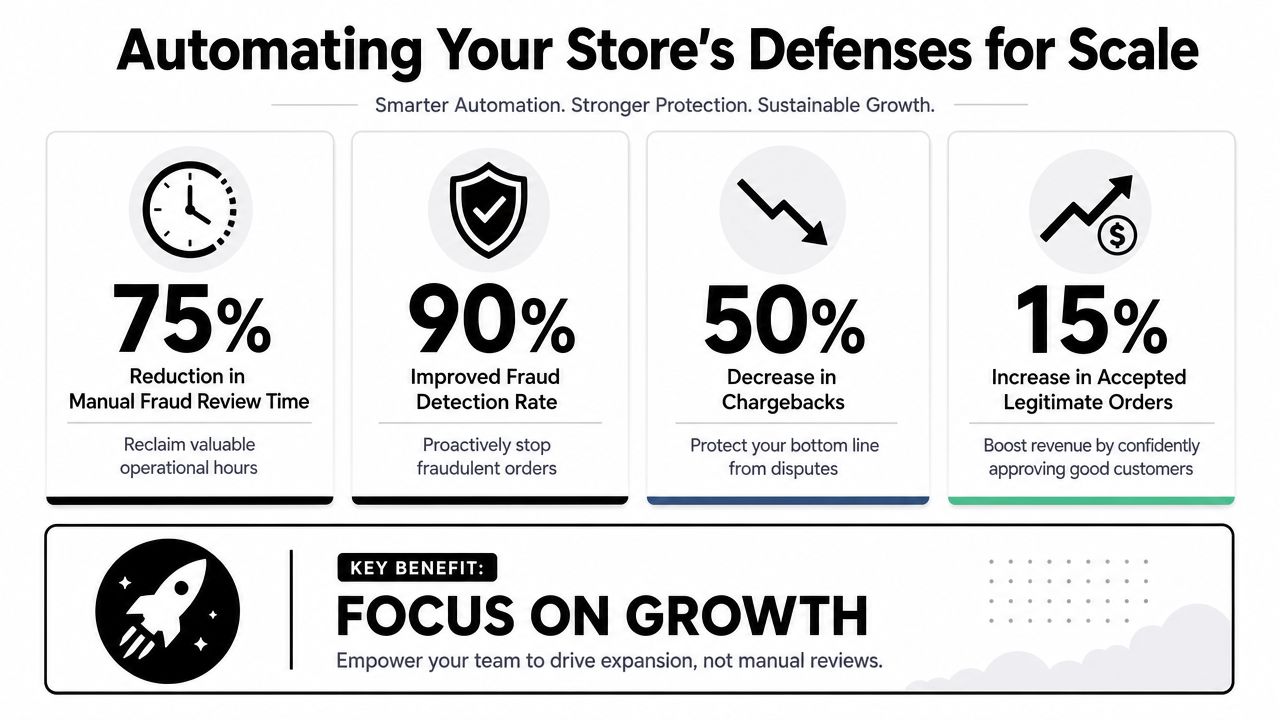
The stores that scale profitably build systems, not extra busywork
Apparel merchants do not fail because they lack orders. They fail because every new order creates more operational drag. More size questions. More WISMO tickets. More refund edge cases. More chances for a customer to skip support and go straight to the bank.
Profitable stores shut down that chain reaction early. They fix preventable service issues fast, keep order and policy records organized, and automate any task that repeats on a deadline.
Focus on these three areas:
- Pre-dispute service recovery so customers get answers before they file claims
- Centralized evidence records for orders, tracking, delivery updates, product pages, and policy snapshots
- Automated dispute workflows for intake, documentation, drafting, and submission
Do this well and growth stops adding admin faster than it adds profit.
Customer support protects revenue
In fashion, chargebacks often start as ordinary service failures. A late reply about sizing. A customer who cannot find tracking. A refund promise that never gets confirmed in writing. By the time the bank alert arrives, the actual mistake happened days earlier.
Set up support to prevent that. Use saved replies for fit, shipping, and return questions. Escalate lost-package cases the same day. Keep tracking links visible after purchase. Make sure your return policy says the same thing on product pages, checkout, and in support replies.
If your support stack is still patchy, review this guide to AI customer support for Shopify stores. Faster, clearer support lowers confusion, refund friction, and dispute volume.
Automate the work that does not need human judgment
Manual review has a place. Repetitive operational work does not.
A growing Shopify clothing store should automate tasks that are rules-based and time-sensitive. Disputes fit that description exactly. Pulling order details, collecting tracking, attaching policy records, and submitting before the deadline should not depend on whether someone on your team remembered to check an inbox.
If you are still handling representments by hand, read this guide to automated chargeback and dispute management using AI. The point is not convenience. The point is margin protection. Automation keeps your operators focused on inventory, merchandising, retention, and customer experience instead of paperwork.
ChargePay fits that model in a practical way. It has a 4.9-star rating on the Shopify App Store, carries a Built for Shopify badge, and uses a pay-per-win pricing model based on the publisher information provided. That makes it a sensible option for stores that want tighter dispute handling without creating another internal bottleneck.
A profitable Shopify clothing store is not the one with the most orders. It is the one that keeps more of the revenue after refunds, fraud, support costs, and chargebacks are accounted for.
If your Shopify clothing store is losing money after the sale, install ChargePay from the Shopify App Store. It's built for Shopify merchants that need automated dispute handling, evidence submission, and protection against friendly fraud without adding more manual work to the team.


.svg)



.svg)


.svg)
.svg)
.svg)