


Retail shrinkage sounds like a store problem. Missing units. bad counts. shoplifting. damaged goods.
That view is too narrow for Shopify merchants.
The National Retail Federation reported that the average shrink rate rose to 1.6% of sales in 2022, which translated to $112.1 billion in total U.S. retail losses (NRF National Retail Security Survey 2023). If that much money can disappear from retail through small, repeated gaps, online brands need to ask a harder question: how much of their own shrink isn't sitting on a shelf at all, but hiding inside refunds, returns abuse, and chargebacks?
What Is Retail Shrinkage and Why It Matters
Retail shrinkage is the gap between the value your business should keep and the value that disappears. For a Shopify merchant, that loss is not limited to missing inventory on a shelf or in a warehouse. It also includes shipped orders that turn into refunds, returns abuse, and chargebacks that erase revenue after the product is already gone.

Why Shopify merchants should care
Shopify brands get hit by shrink from both the physical side and the digital side of the business. You lose margin when an order goes bad. You lose inventory accuracy when records stop matching reality. You lose cash when revenue gets reversed after fulfillment.
Even a small loss rate gets expensive fast across hundreds or thousands of orders.
That is why merchants need a wider definition of shrink. If you only count damaged units, picking mistakes, or missing stock, you miss one of the most common profit leaks in e-commerce. Chargebacks, especially friendly fraud, are digital shrink. The product is gone, the revenue is gone, and you often pay fees on top of both. If your team is not tracking disputes alongside inventory loss, you are understating the problem. A clear ecommerce chargeback rate benchmark helps you see how much of your shrink is happening after checkout.
Practical rule: If money leaves your business without a valid sale behind it, treat it as shrink and investigate it immediately.
Shrink isn't just theft
Many merchants still treat loss prevention as shorthand for stopping shoplifting or tightening warehouse controls. That view is too narrow for e-commerce. Real loss prevention also includes order review, returns policy design, refund controls, and disciplined chargeback response.
If you're trying to combat cart abandonment and protect profits, apply that same discipline after the sale. Revenue protection does not end at checkout.
For Shopify stores, this is the shift that matters. Shrinkage is not only about what disappears before a customer buys. It is also about what gets clawed back after the order is delivered. That is where better dispute management with ChargePay stops digital shrink before it keeps draining your profit.
How to Calculate and Benchmark Your Shrink Rate
You can't fix what you don't measure. A lot of merchants talk about "too many losses" without separating operational mistakes from actual shrink. That's sloppy, and it makes the problem harder to solve.
Start with the basic calculation
The core idea is simple: compare what your records say you have with what you physically count.
A practical version looks like this:
- Pull your recorded inventory value from Shopify or your inventory system.
- Count what you have in the warehouse, fulfillment center, pop-up stockroom, or retail location.
- Subtract actual from recorded to find the missing value.
- Track that result at cost and at retail price, not just one or the other.
According to the ECR Community Shrinkage & On-shelf Availability Group, good shrink measurement means reporting losses at both cost and retail price, expressing them as a percentage of turnover, and increasing count frequency to at least twice per year for accurate, useful analysis (ECR guidance on measuring retail shrinkage).
What this looks like on Shopify
Shopify merchants usually need to pull data from a few places, not one screen:
| Data point | Where to check | Why it matters |
|---|---|---|
| Recorded stock | Shopify product inventory | Your system baseline |
| Actual stock | Physical count or warehouse report | Reality check |
| Returned items | Returns workflow | Finds items refunded but not reshelved |
| Canceled or disputed orders | Payments and order timeline | Exposes digital loss that inventory alone won't show |
If your numbers keep drifting, don't assume theft first. Check receiving, transfers, refunds, reshipments, and order edits. Those small process leaks create the same financial damage as stolen stock.
Benchmark it like an operator
Once you know your shrink value, express it as a percentage of turnover or sales so you can compare periods consistently. That lets you answer the question that matters: are losses getting better or worse?
You should also watch your dispute trends alongside shrink. A store can look fine on physical inventory while bleeding revenue through payment reversals. That's why it helps to track shrink next to your ecommerce chargeback rate. They aren't the same metric, but together they show where margin is really disappearing.
Run counts on your high-risk products more often than your full catalog. Merchants lose money when they treat fast-moving, high-value SKUs the same as slow sellers.
The Primary Causes of Retail Shrinkage
Shrink usually comes from a short list of causes. The mistake is treating all of them like one problem. If you do that, you end up with generic fixes that don't stop anything.
Theft is the biggest bucket
Theft is still the dominant driver. Summaries of NRF data indicate that about 65.5% of all shrink comes from theft, with external theft and employee theft as the two biggest subcategories (Storytelling With Data summary of NRF shrink findings).
That matters because it tells you where to focus first. Not every discrepancy is random noise. A lot of it comes from repeated, identifiable behavior.
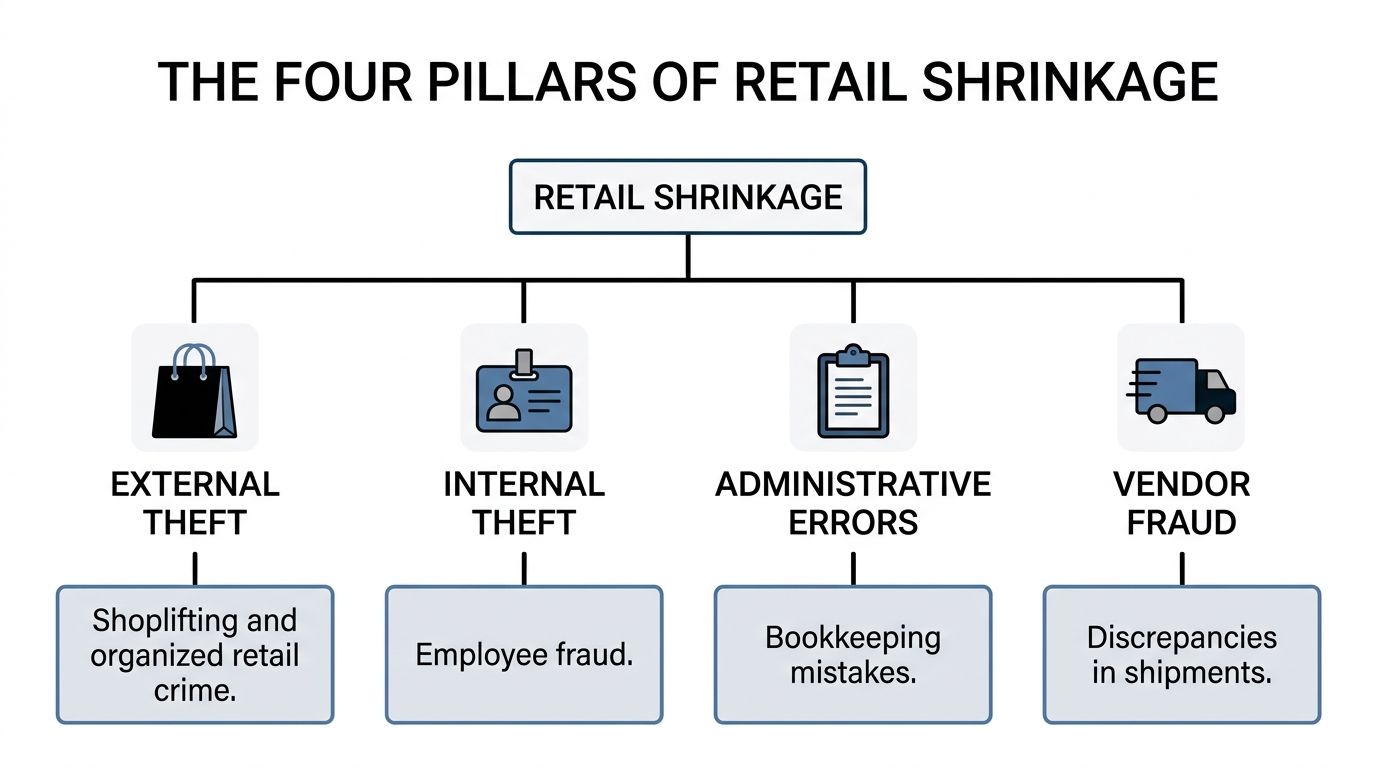
How the four main causes show up
| Cause | Physical retail example | Shopify or e-commerce example |
|---|---|---|
| External theft | Shoplifting, organized retail crime | Fraudulent orders, reship scams, false non-delivery claims |
| Internal theft | Employee pocketing cash or product | Staff misuse of refunds, discounts, or manual adjustments |
| Administrative errors | Wrong counts, pricing mistakes, bad receiving | Duplicate refunds, incorrect SKU mapping, order edit mistakes |
| Vendor fraud | Short shipments, invoice discrepancies | Supplier sending less than billed, poor reconciliation on inbound stock |
External theft
This gets the most attention because it's visible. In stores, it's shoplifting or organized groups targeting high-value items. Online, it's less visible but just as real. Fraudsters exploit delivery claims, refund loopholes, and weak order verification.
The online version is often harder to catch because it arrives disguised as customer support work.
Internal theft
Merchants don't like talking about this, but they should. Internal loss happens when employees misuse discounts, issue improper refunds, or manipulate returns. In a smaller Shopify operation, this can happen without obvious malice. One staff member takes shortcuts, another skips approvals, and suddenly you've trained your team into creating shrink.
Administrative errors
This is the most boring category, which is exactly why it gets missed. A receiving mistake, mis-scanned return, or wrong product status can throw off inventory and reporting for weeks.
Most shrink investigations start with "something is missing." The better question is "which workflow let this happen?"
Vendor fraud and receiving issues
If inbound shipments aren't verified carefully, you'll pay for stock you never received. This gets worse when merchants rely on rushed receiving or trust supplier paperwork without checking cartons and quantities.
And for Shopify brands, one more category deserves attention even though traditional shrink articles often downplay it: friendly fraud. That's when a customer disputes a legitimate charge and keeps the goods or service anyway. If you want the online version explained clearly, this breakdown of what is friendly fraud is worth reading.
Digital Shrinkage The Hidden Cost of Chargebacks
Traditional shrink conversations still overfocus on shelves and store exits. That misses one of the ugliest loss channels in e-commerce: digital shrinkage.
Digital shrinkage is what happens when your business loses money through payment disputes, returns abuse, refund abuse, and friendly fraud. The product is gone, the revenue is gone, and the admin work piles on after the fact.

Why chargebacks belong in the shrink conversation
If a customer files a dispute for an order they received, that isn't just a payments problem. It's functionally the same as theft. You lose the inventory, the sale, and time your team should've spent on growth.
Shopify's own retail shrinkage guidance has started separating returns fraud and digital fraud as shrink sources, and one industry report cited $103 billion in fraudulent and abusive returns in 2024 (Shopify on retail shrinkage). That's the clearest sign that online loss isn't a side issue anymore.
Why merchants undercount it
A lot of brands file chargebacks under "finance" and shrink under "operations." That's a reporting mistake.
When those teams work in separate lanes, you get bad conclusions:
- Operations thinks inventory is the main issue
- Finance thinks disputes are just a processor problem
- Support treats repeat abusers like normal refund tickets
- Leadership never sees the full loss picture
That's why stores need one view of post-purchase loss. Returns, refunds, disputes, and non-delivery claims should sit in the same conversation.
For merchants trying to tighten these workflows, technical integration matters too. If you're looking at the plumbing behind order, payment, and dispute systems, this guide on integrating with chargebacks apps gives useful context.
If a customer keeps the product and wins a dispute, your business didn't just lose a payment case. It absorbed shrink.
Friendly fraud is the silent driver
Friendly fraud is especially damaging because it doesn't always look fraudulent at first. Some cases come from confusion. Others are deliberate. Either way, the financial result is the same unless you challenge it properly.
That means chargeback prevention belongs inside your shrink strategy, not outside it. This is why merchants should treat chargeback prevention as part of loss prevention, customer operations, and margin protection at the same time.
Practical Steps to Reduce Shrinkage on Shopify
You need two playbooks. One for physical and operational loss. One for digital loss.
If you only tighten warehouse controls, you'll still bleed through disputes and abusive returns. If you only fight chargebacks, you'll still lose margin through bad counting and process mistakes.
Tighten the operational side first
Start with the boring stuff. That's usually where easy wins hide.
- Count your risky SKUs more often: Don't wait for a full annual count. Check fast-moving, expensive, and frequently returned items on a tighter schedule.
- Verify inbound shipments properly: Match supplier deliveries against purchase orders and actual received quantities. Don't trust paperwork alone.
- Clean up returns handling: A returned item should move through one clear workflow. Received, inspected, restocked or quarantined. No gray area.
- Limit manual adjustments: Every inventory override, refund edit, and order change should have a reason attached.
There is also a strong operational argument for better inventory flow. One analysis suggests that a one-unit increase in inventory turnover is associated with a 3.5% reduction in shrinkage, which points to a simple idea: stock that moves cleanly leaves fewer opportunities for loss (Spot AI on shrink reduction).
Build controls around people, not just systems
Software helps, but staff behavior still matters. Set approval rules for refunds, post-delivery claims, replacement orders, and discounting. Make one person accountable for reviewing exceptions each week.
A small merchant doesn't need a giant compliance framework. It needs discipline.
Here's a useful way to understand this:
| Area | Bad habit | Better control |
|---|---|---|
| Returns | Refund first, inspect later | Inspect before final resolution |
| Disputes | Ignore small chargebacks | Review every dispute reason code |
| Inventory | Trust system counts blindly | Reconcile system and physical counts |
| Support | Give repeat abusers the benefit every time | Flag repeat patterns in CRM or help desk |
Protect the digital side like it's inventory
Most Shopify stores still underinvest here. They spend on ads to win the order, then leave the post-purchase layer exposed.
You need clear rules for:
- Order verification on high-risk purchases
- Delivery documentation that can support dispute evidence
- Returns policy enforcement without vague exceptions
- Customer communication logs that prove what happened
- Fraud review before reshipment or refund on suspicious cases
If you're reviewing your stack, this guide to Shopify fraud prevention is a practical place to start.
A quick walkthrough can help make this more concrete:
Don't let disputes sit in a spreadsheet
Many brands lose the plot in this area. They know chargebacks hurt, but they handle them with scattered screenshots, rushed responses, and no repeatable system.
That approach fails for three reasons:
- Deadlines are tight
- Evidence is usually spread across apps
- Friendly fraud cases need a structured rebuttal, not a guess
The stores that recover more revenue usually aren't doing anything magical. They document better, respond faster, and treat dispute evidence like an operational process.
If shrinkage in retail is about protecting what you bought and sold, then dispute management is part of that job for every Shopify merchant. Ignore it, and you're not just losing cases. You're accepting digital shrink as normal.
Stop Letting Shrinkage and Chargebacks Steal Your Profit
Shrinkage in retail has changed. The old definition still matters, but it no longer covers the whole problem for a Shopify merchant.
You still need clean counts, disciplined receiving, and tighter returns handling. But if you stop there, you're missing the losses that hit after the order is marked fulfilled. That's where digital shrink lives, and it's where a lot of online brands give up margin every month.
What smart merchants do differently
They stop treating losses as isolated issues. They connect inventory discrepancies, refund behavior, post-delivery claims, and chargebacks into one operating picture.
That mindset helps you spot the actual leaks:
- Inventory loss from poor controls
- Refund loss from policy abuse
- Dispute loss from weak documentation
- Friendly fraud loss from not challenging false claims
If you're serious about fixing financial leaks in your business, this article on fixing financial leaks in your business is a useful reminder that margin problems usually come from a cluster of small failures, not one dramatic event.
The practical next step
Don't wait until shrink shows up as a nasty surprise in your monthly numbers. Build a single operating rhythm around counts, returns, fraud review, and dispute handling.
And if chargebacks are part of your loss stack, stop handling them as an afterthought. A structured system for evidence collection, representment, and recovery belongs in the same category as any other loss-control process. That's why merchants evaluating chargeback management solutions should think in terms of recovered profit, not just admin convenience.
The bottom line is simple. If your store loses a product, a payout, and the original sale through a bad dispute, that's shrink. Call it what it is, manage it like it matters, and stop writing it off as the cost of doing business.
If chargebacks and friendly fraud are eating into your margins, ChargePay gives Shopify merchants a direct way to fight back. It has a 92.4% win rate, has handled 100K+ disputes, and recovered $2.8M+ for merchants. You also get the trust signals that matter on Shopify, including a 4.9-star rating and a Built for Shopify badge. Install ChargePay from the Shopify App Store and turn dispute recovery into a real profit protection system.


.svg)



.svg)


.svg)
.svg)
.svg)