

You launch your Shopify store, connect a payment processor, and start watching orders come in. Then the first chargeback hits. The payment is gone, the product is gone, and now you're stuck asking a question most fee-comparison articles ignore.
Did I choose the processor that gives me the best shot at getting my money back?
That’s the core stripe vs paypal question for a Shopify merchant. Not just who charges a little less. Not just who looks more familiar at checkout. The decision affects your fees, your payout timing, your checkout flow, and most of all, how hard it is to fight disputes when customers claim fraud, item not received, or product not as described.
Choosing Your Payment Gateway The First Big Decision
A lot of store owners choose fast. They see Stripe. They see PayPal. They compare setup screens, glance at fees, and move on.
That works until disputes start.
A simple example. A new Shopify brand sells a few hundred orders, mostly paid ads traffic, mostly first-time buyers. Checkout works. Revenue looks healthy. Then a cluster of chargebacks lands in the dashboard. Some customers claim unauthorized use. Others say the item never arrived. Suddenly the owner isn’t comparing payment buttons anymore. They’re scrambling for tracking numbers, order details, customer messages, and any evidence that might help win a dispute.
That’s why choosing the right payment gateway matters more than people think. The processor you pick doesn’t just move money. It shapes how much data you can access, how disputes are handled, and how painful chargeback recovery becomes once your order volume rises.
If you're still sorting through Shopify payment options, this breakdown of Shopify payment processors is a useful starting point. But the short version is this: your gateway choice becomes a revenue protection choice the moment the first dispute arrives.
Why this decision gets expensive fast
Most merchants underestimate chargebacks because they look isolated at first. One here, one there. Then they stack up.
You lose the sale. You often lose the product. You spend staff time responding. If the case goes badly, the processor learns your account carries more risk. That can affect reserves, holds, and day-to-day operations.
Practical rule: Pick a payment processor as if you’ll need to defend transactions later, because you will.
What matters more than setup speed
For a Shopify merchant, the gateway decision should come down to three things:
- Dispute position: How much evidence can you collect and submit when a chargeback hits?
- Fee drag: How much margin disappears before you even start fighting refund and dispute losses?
- Cash flow stability: How quickly can you access funds, and how vulnerable are you to holds?
That’s the lens I’d use for stripe vs paypal. Not convenience first. Revenue protection first.
A Tale of Two Giants Understanding The Players
Stripe and PayPal are both huge. But they’re huge in different ways.
PayPal wins on consumer familiarity. Stripe wins on business infrastructure.
According to CoinLaw’s PayPal vs Stripe statistics, PayPal processed $1.92 trillion in total payment volume in 2025 and had 435 million active users, while Stripe served over 5.3 million businesses, including 92% of the Fortune 100. The same source says Stripe’s average transaction value was $98.10 compared to PayPal’s $84.60.
That tells you a lot. PayPal is built around broad consumer reach. Stripe is built around businesses that want more control, more customization, and often larger-ticket or more structured payment flows.
PayPal’s core advantage
PayPal has one thing you can’t fake. Recognition.
Buyers know the name. Some trust it immediately. For newer Shopify stores, especially those still building credibility, that matters. A PayPal button can reduce hesitation for customers who don’t want to type card details into a brand they’ve never seen before.
That trust can help conversion. But trust at checkout isn’t the whole game if your post-purchase risk is high.
Stripe’s core advantage
Stripe is stronger when your business is getting more operationally complex. Think subscriptions, multiple payment methods, custom checkout flows, back-office reporting, and more detailed transaction data.
If you need a cleaner explanation of where a gateway ends and a merchant account begins, this guide on merchant account vs payment gateway is worth reading.
PayPal is the familiar storefront sign. Stripe is the wiring behind a more configurable system.
What this means for a Shopify store owner
If you sell to a broad consumer audience and want instant recognition, PayPal is easy to understand.
If you run a scaling DTC brand and care about systems, automation, and dispute-readiness, Stripe usually fits better.
That doesn’t automatically make Stripe the right answer for everyone. It does mean that stripe vs paypal isn’t really a popularity contest. It’s a question of what kind of store you’re building, and whether your processor helps or hurts once fraud and chargebacks show up.
The Ultimate Fee and Feature Breakdown
Let’s get to the part everyone looks at first. Fees.
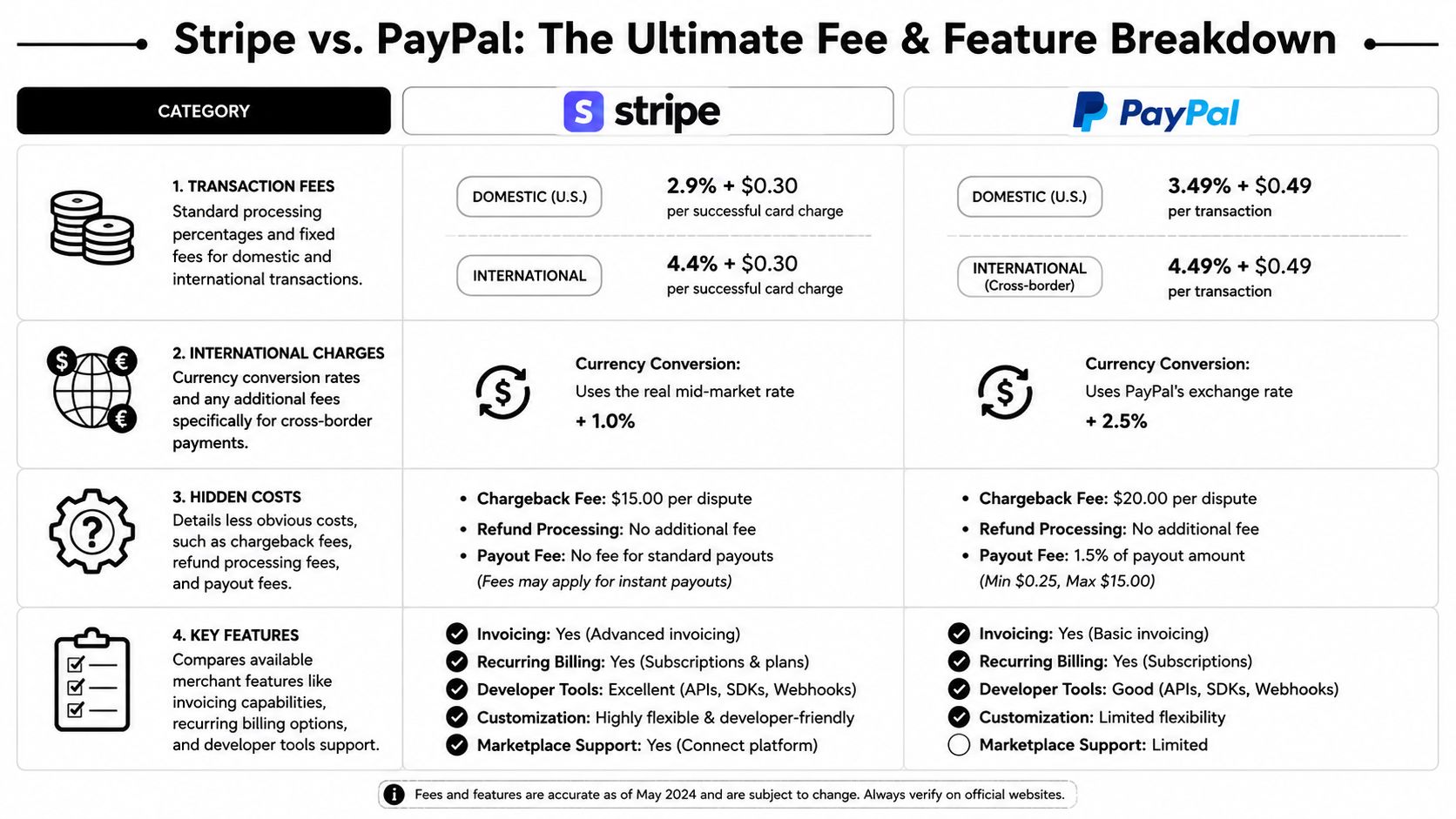
Stripe usually pulls ahead for online Shopify stores, and not by a tiny amount once volume increases.
| Category | Stripe | PayPal |
|---|---|---|
| Online transaction pricing | 2.9% + $0.30 | 3.49% + $0.49 for digital wallet payments |
| In-person pricing | 2.7% + $0.05 | 2.29% + $0.09 |
| ACH pricing | 0.8% capped at $5 | 1% capped at $10 |
| Currency support | 135+ currencies | 25 currencies |
| Payment methods | 120+ payment methods | 41 methods |
| Refund fee retention | Keeps fees on refunds | Keeps fees on refunds |
Based on Merchant Maverick’s Stripe vs PayPal comparison, Stripe charges 2.9% + $0.30 per online transaction while PayPal charges 3.49% + $0.49 for digital wallet payments, and a merchant doing $50,000 in monthly volume could save over $5,820 annually with Stripe.
Why fee differences matter more for chargeback-heavy stores
A lot of merchants shrug at small pricing gaps. That’s a mistake.
If your store sees refunds, fraud, and chargebacks, lower base processing fees matter more because you’re already giving up revenue on the back end. Every extra fee point takes margin away from the orders that do go through cleanly.
And both platforms keep their fees on refunds. So if you issue a refund before a dispute escalates, you still don’t get that processing fee back. That makes the cheaper starting rate more valuable.
Stripe is usually cheaper online. PayPal has a few exceptions
PayPal does better for some in-person scenarios. If you sell at pop-ups or retail, that lower in-person rate can matter.
But for a standard Shopify store selling online, Stripe usually gives you the cleaner economics.
A few places where Stripe stands out from the verified pricing data:
- Online checkout: Stripe’s base online rate is lower.
- ACH payments: Stripe’s cap is lower.
- International sales: Stripe’s currency conversion and total international cost are lower in the verified data.
- Subscriptions: Stripe includes integrated billing options, while PayPal adds a monthly charge for subscription functionality.
The hidden cost merchants miss
The hidden cost isn’t just a line-item fee. It’s operational friction.
If your processor costs more, gives you less data, and still keeps fees on refunded orders, you’re paying extra while also making dispute defense harder. That’s a bad combination for stores in categories like fashion, supplements, beauty, electronics, and impulse-driven products.
If you're comparing payment stack options more broadly, this breakdown of Shopify Payments vs Stripe and their differences helps put the processor choice in context.
Save money where you can on clean transactions. You’ll need that margin when disputed transactions start eating into revenue.
Getting Paid Payouts Checkout Experience and Holds
A sale isn’t finished when the customer clicks buy. It’s finished when the money lands in your bank account and stays there.
That’s where stripe vs paypal gets more operational.
According to Pronto Marketing’s Stripe vs PayPal analysis, Stripe offers standard 2-day transfers, but 20% of merchants reported payout delays of 7+ days for high-risk sales in 2025. The same source says PayPal often guarantees daily deposits, but also notes that PayPal is known for account holds during disputes.
Stripe on payouts
Stripe’s normal payout flow is predictable for many merchants. That’s a plus when your store is stable and your risk profile is clean.
The problem shows up when your business looks risky to the processor. That can happen if sales spike fast, refund rates climb, or disputes increase. Then payout timing can stretch, and the delay hurts exactly when your business needs cash.
PayPal on payouts
PayPal often feels faster and simpler on the surface. If you’re a smaller store and your operation is straightforward, that can be appealing.
But PayPal’s dispute-related holds are a real concern. If a payment is tied up in a case, your cash flow can get messy quickly. You may have strong top-line sales and still feel squeezed because too much money is stuck in review.
Checkout flow matters too
The payout discussion isn’t separate from checkout. It connects directly to who buys and how they behave later.
- PayPal checkout: Familiar, trusted, and often easier for hesitant buyers.
- Stripe checkout: More embedded, more branded, and usually better if you want the customer to stay inside your site experience.
If PayPal recognition boosts conversion for your audience, that’s useful. If Stripe’s integrated experience keeps checkout cleaner and gives you stronger transaction records, that’s useful too.
For merchants thinking about adding PayPal as an option inside a broader Shopify stack, this look at PayPal Checkout for Shopify helps clarify where it fits.
Faster payouts don’t help much if disputes lock up your funds. A slick checkout doesn’t help much if it gives you weaker evidence later.
The practical takeaway is simple. If your business has volatile order patterns or a category that attracts chargebacks, cash flow risk deserves the same attention as processing fees.
The Critical Difference Fraud and Chargeback Handling
This is the section that matters most.
Fees matter. Payouts matter. Checkout UX matters. But if your store loses money to fraud and friendly fraud, the ultimate stripe vs paypal decision comes down to one question.
Which processor gives you a better chance of winning disputes?
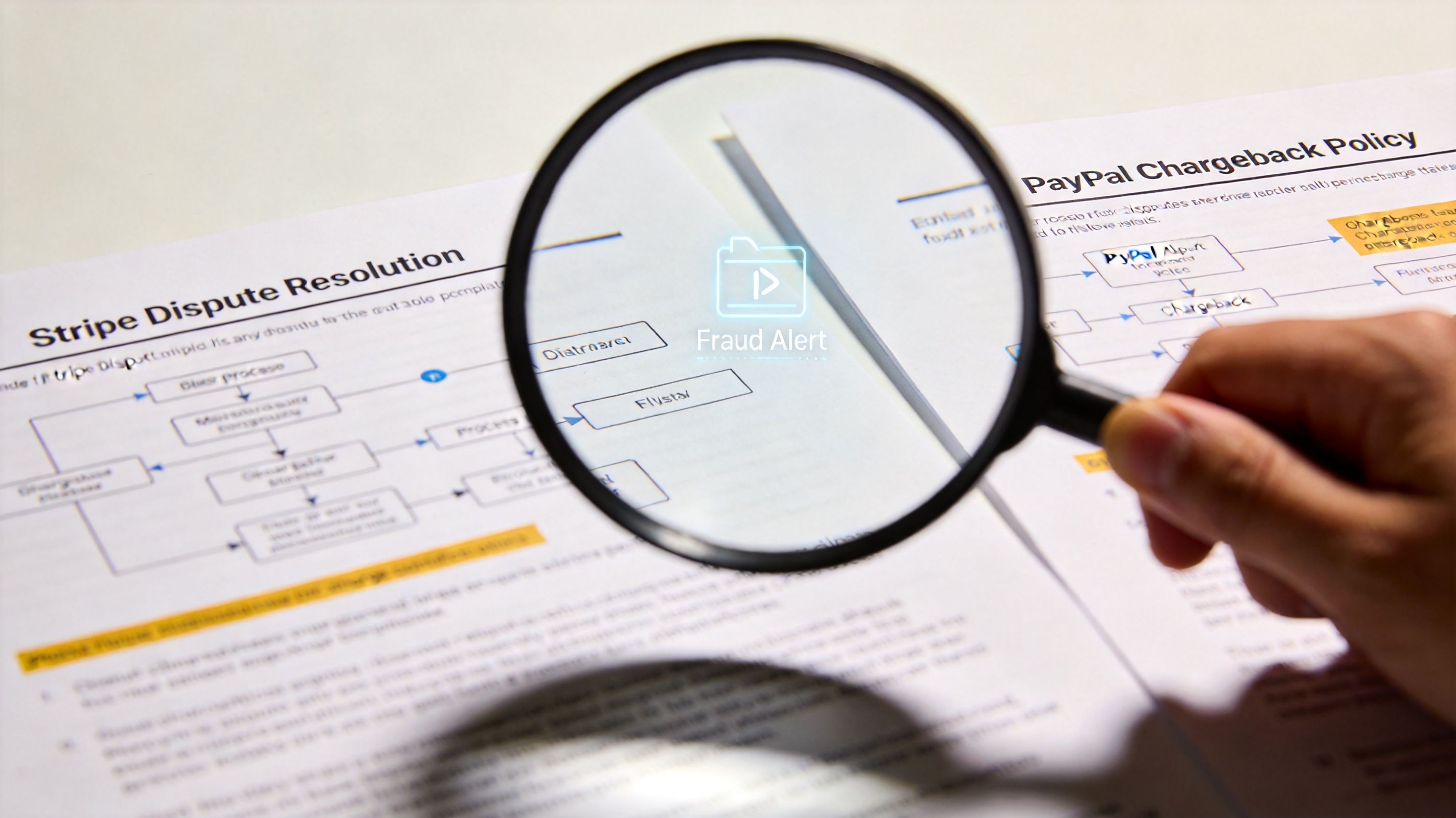
According to Tipalti’s Stripe vs PayPal resource, Stripe representments win about 40% to 50% of the time, while PayPal disputes are won by merchants around 35% of the time due to buyer-friendly policies. The same source says that integrating ChargePay with Stripe’s rich data can automate dispute fighting and achieve a 92.4% win rate.
Why PayPal is harder in disputes
PayPal tends to lean buyer-friendly. That’s good for customer trust. It’s not always good for merchants defending a borderline case.
If a buyer claims item not received or not as described, PayPal often requires a very clean paper trail. When your documentation is incomplete or scattered across tools, you’re on the back foot. For many Shopify merchants, that means more manual work and weaker responses under tight deadlines.
Why Stripe is stronger for dispute defense
Stripe’s advantage is the data environment around the transaction.
It gives merchants and connected tools more room to pull together the details that matter in representment. Order records, customer behavior, shipping events, payment metadata, and supporting transaction context are easier to work with when the system is built for integration.
That’s why stores focused on chargeback recovery usually prefer Stripe.
- More useful transaction detail: Better input for evidence building.
- Cleaner integrations: Easier to connect fraud and dispute tools.
- More adaptable workflows: Better fit for stores that want automated responses instead of manual dispute handling.
The recommendation I’d give a Shopify merchant
If your store rarely gets chargebacks and your audience strongly prefers PayPal, adding PayPal can still make sense.
If you’re in a category where fraud and friendly fraud are a weekly issue, Stripe is the better foundation for chargeback operations. Not because it eliminates disputes. It doesn’t. Because it gives you a stronger position when the fight starts.
If chargebacks are already hurting your margins, this guide to Stripe chargeback protection is worth reading.
The processor that gives you more usable evidence is usually the processor that gives you more recoverable revenue.
Customization Developer Tools and Shopify Integration
Some merchants want plug-and-play. Others want control.
If you’re serious about scaling, control wins.
According to Justt’s comparison of Stripe and PayPal for ecommerce merchants, Stripe offers AI-powered anomaly alerts with over 90% precision and SQL query interfaces for deep transaction analysis, while PayPal’s reporting is described as basic. That gap matters if you want to understand fraud patterns before they become expensive.
Stripe gives operators more visibility
Stripe is built for merchants who want to inspect what’s happening, not just accept payments and hope for the best.
That means better dashboards, richer reporting, and more flexible data access. If your ops team wants to trace a spike in disputes back to a campaign, a product line, a geography, or a checkout issue, Stripe is far easier to work with.
PayPal is simpler but more limited
PayPal is easier for stores that just want a known brand and a straightforward setup.
The tradeoff is visibility. You get less depth, less customization, and less room to build a payment operation that adapts as your store grows. For some merchants, that’s fine. For others, it becomes a ceiling.
What this looks like inside Shopify
For Shopify, the difference shows up in day-to-day workflows:
- With Stripe: You can run a more data-heavy operation, connect specialized tools, and diagnose problems faster.
- With PayPal: You get convenience and familiarity, but less flexibility once you need deeper analysis.
This matters even outside payments. If you’ve ever looked into how to grow a Shopify app, you’ve seen the same pattern. Better platforms usually win because they give builders more room to customize, test, and improve.
If you want your payment layer to support fraud analysis, dispute ops, and reporting, Stripe is the stronger tool. If you want simple acceptance and broad recognition, PayPal is easier.
For a growing Shopify brand, I’d rather have more data than more convenience.
The Decision Matrix Choosing The Right Processor For You
By this point, the answer should be clearer.
There isn’t one universal winner in stripe vs paypal. But there is a better choice for your type of store.
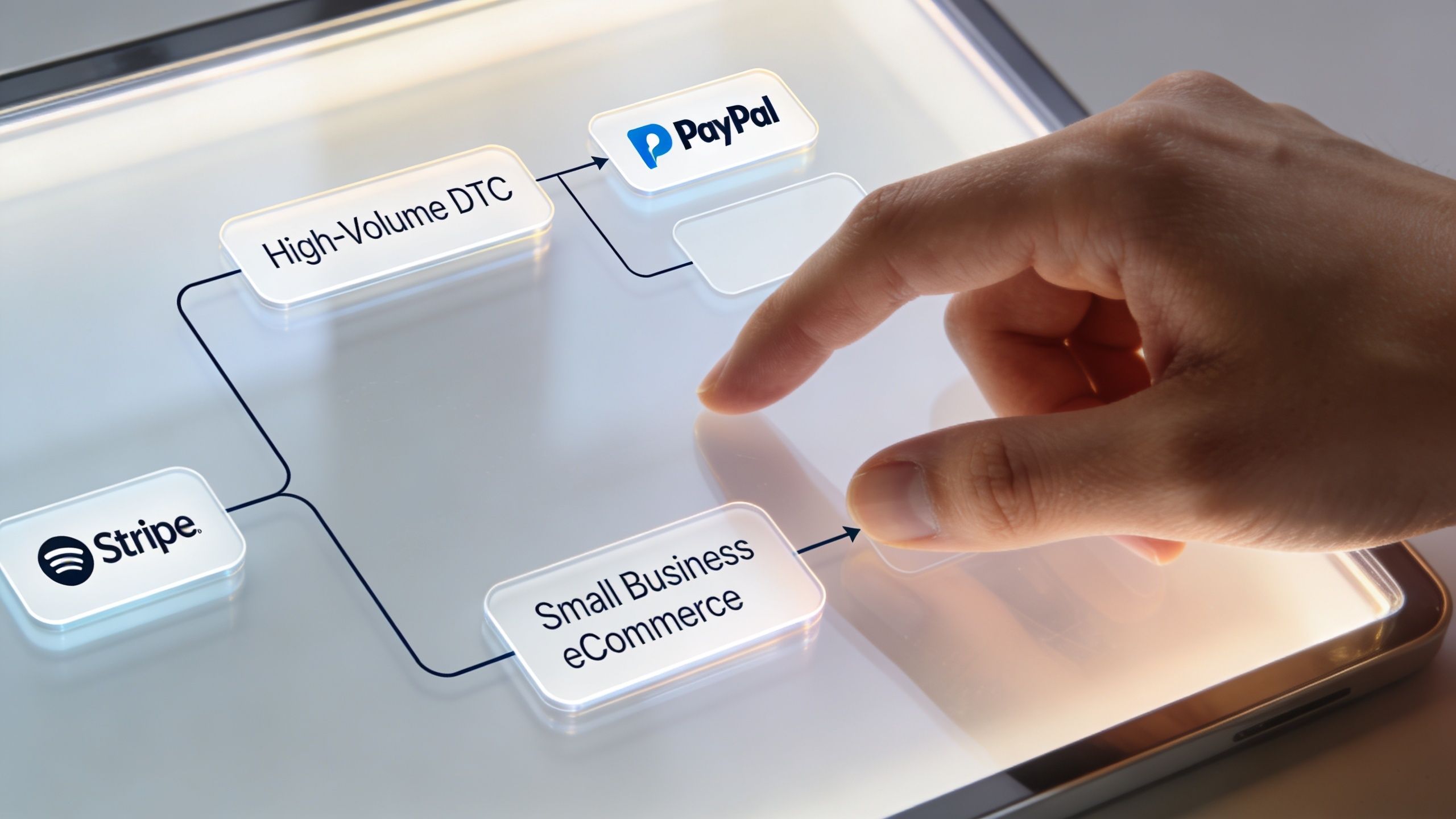
Choose Stripe if this sounds like you
You run a scaling Shopify brand. You care about lower online fees, stronger data access, better reporting, and a better dispute position.
This is especially true if you sell products that attract friendly fraud, rapid repeat orders, or cross-border transactions. Stripe gives you more control and better raw material for fighting chargebacks.
Choose PayPal if this sounds like you
You’re newer, your audience values brand familiarity, and you want a checkout option customers already trust.
That can be a reasonable starting move. It may help conversion with buyers who feel safer using PayPal. Just don’t confuse buyer trust with merchant protection. If disputes become frequent, PayPal’s buyer-friendly setup can become expensive.
Use both if you want flexibility, but know the tradeoff
Some Shopify stores should offer both. That can increase customer choice.
But it also means more complexity. Two payment environments. Two dispute flows. Two sets of operational habits. If you do this, make sure your team knows exactly where evidence lives and how each platform handles disputes.
For merchants still thinking through broader platform decisions, this deep dive into platform choice is a useful reminder that infrastructure choices compound over time. Payments work the same way.
My direct recommendation
If chargebacks are a meaningful problem in your business, pick Stripe first.
If conversion trust is your top concern and disputes are still light, use PayPal as a support option, not your entire strategy.
Most Shopify merchants should stop treating this like a pure fee comparison. The processor that helps you recover revenue is usually the one that helps your business stay healthy.
Chargebacks don’t wait for you to build a manual process. ChargePay is built for Shopify merchants who want disputes handled automatically, with a 92.4% win rate, 200K+ cases handled, and $10.8M+ recovered for merchants. It has a Built for Shopify badge, a 4.9-star rating, and a pay-per-win model, so you only pay when money is recovered. If your store is losing revenue to disputes on Stripe or PayPal, install ChargePay from the Shopify App Store and stop letting chargebacks drain your margin.


.svg)



.svg)


.svg)
.svg)
.svg)