


A Shopify order comes in with a clean-looking shipping address, a valid card authorization, and no obvious warning signs. You pack it, ship it, and move on. A few days later, the cardholder files a dispute. The package is gone, the payment is reversed, and your team is burning time trying to prove what happened.
That's why merchants should care about a question that usually gets framed as consumer advice: what can scammers do with your address? Quite a lot. And when they do it through your store, you're the one paying for the inventory loss, shipping cost, ops time, and chargeback headache.
Most address fraud doesn't look dramatic at the start. It looks normal. A house address in a residential neighborhood. A customer name that doesn't raise suspicion. A standard order flow. But a physical address can be the first useful piece of identity data in a much bigger fraud chain, and e-commerce merchants often absorb the downstream damage.
Your Customer's Address Could Be a Scammer's Goldmine
A customer checks out with a normal-looking residential address, your fraud filters stay quiet, and the order goes out on time. From the merchant side, that address can be the detail that makes a bad order look safe enough to approve.
For fraudsters, a physical address is useful because it adds credibility to the rest of the identity they are building. It can support a stolen card, a synthetic profile, a mule location, or a reshipping setup. For a Shopify merchant, that shifts address theft from a consumer privacy issue to a revenue protection issue.

Why merchants get caught off guard
Address-linked fraud rarely announces itself with obvious warning signs.
Fraud rings already know what merchants watch for. They know large first-time orders, random strings in email addresses, and mismatched billing details get reviewed. So they adapt by using believable addresses, smaller test purchases, and shipping patterns that look routine until losses start stacking up.
That is why these cases are expensive. The order often clears initial review, gets packed, gets shipped, and only later turns into a chargeback or a customer service problem. By then, your team is not deciding whether to approve the order. Your team is trying to recover margin that is already gone.
A useful operating rule is simple: if the address looks strong but the buyer profile around it looks thin, review the order more closely.
Stores that see repeat abuse usually end up tracking patterns across names, emails, ZIP codes, apartment formats, and forwarding behavior. If that sounds familiar, build a process for blocking fraudulent customers on Shopify before the same buyer profile comes back under a slightly different identity.
What this costs in the real world
Address fraud creates losses in places merchants feel immediately:
- Approval risk. A plausible address can help a fraudulent order pass manual review or basic fraud checks.
- Fulfillment risk. Inventory leaves the warehouse before the actual cardholder notices the transaction.
- Dispute risk. A delivered package does not automatically win a fraud dispute if the underlying identity was stolen.
I see merchants underestimate the ops cost here. Each suspicious order pulls in review time, support time, and evidence gathering. If the same pattern repeats, the issue stops being one bad order and becomes a workflow problem that drains your team and weakens unit economics.
ChargePay handles a high volume of disputes tied to merchant fraud losses, including cases where address credibility helped the original order get approved. That is why this topic matters for Shopify stores. A customer address can be one small data point at checkout, but in the wrong hands it becomes a practical tool for fraud, reshipping abuse, and chargebacks.
How Scammers Exploit a Physical Address
A fraudster does not need a full identity file to cause damage. A real street address is often enough to reroute mail, answer weak verification questions, and make a fake customer profile look credible long enough to get an order out the door.
Mail diversion and document theft
One common play is mail redirection. The U.S. Postal Inspection Service warns about change-of-address fraud and identity theft tied to stolen mail and fraudulent forwarding requests in its guidance on mail theft and identity crime. Once mail is redirected, the attacker can collect account statements, tax documents, replacement cards, and other records that help them build a more convincing identity.
For a Shopify merchant, that matters because the fraudster is no longer checking out with only a stolen card. They may now have enough supporting detail to pass manual review, answer support questions, or make a disputed order look legitimate on the surface.
Social engineering gets easier with an address
Addresses are also useful on phone calls, chat, and email. Support teams across banking, telecom, insurance, and retail still use street address as a basic verification point. A scammer who already knows the customer's name and address can sound believable fast.
In e-commerce, that usually shows up after the order is placed. The fraudster contacts support and tries to create a second failure point inside your workflow. Common asks include:
- Changing the shipping destination before the package is picked and packed
- Requesting a refund or store credit exception while posing as the legitimate buyer
- Pulling order details from your team to use later in a chargeback claim
- Testing your reshipment and replacement policies for easy abuse paths
I see merchants focus heavily on checkout risk and miss this post-purchase angle. That is expensive. A clean-looking order can still turn into fraud if the attacker persuades your team to change the destination or disclose too much account detail after authorization.
Why AVS helps, and where it falls short
AVS is useful, but it solves a narrower problem than many merchants assume. It checks whether the billing address entered at checkout matches the address the issuer has on file for the cardholder. That helps catch obvious mismatches. It does not confirm who placed the order, who will receive the package, or whether support will later be manipulated into changing delivery details.
A fraudster with stolen card data and the correct billing address can still pass AVS. They can ship to a drop address, a reshipper, or an alternate location entered later through support. Merchants that want a practical breakdown should review this guide to AVS address verification checks for Shopify fraud screening.
An address match lowers one kind of risk. It does not settle the fraud question.
The trade-off is operational. Auto-approving every AVS match increases fraud exposure. Rejecting every mismatch costs real revenue from legitimate customers who mistype apartment numbers, use business cards, or ship while traveling. The better approach is to treat address data as one signal in a larger review process that also considers shipping behavior, velocity, device patterns, and post-purchase change requests.
From Simple Address to Full Identity Theft
The jump from “they know my address” to “they took over my accounts” happens faster than most merchants realize.
A scammer starts with public records, data broker lists, exposed mail, or social media clues. Then they combine that address with other basic identity details and move upstream into account access. For a store owner, the frightening part isn't only customer fraud. It's the possibility that the same playbook gets used against your business accounts.

The SIM swap path merchants should take seriously
LifeLock explains the chain clearly in its guide to what scammers can do with your address. Scammers use a victim's name, address, and birth date to impersonate them with a mobile carrier. By providing the verified address for identity confirmation, they can persuade the carrier to activate a new SIM card for the victim's number. The reported success rate is 60% to 70%, and once the attacker controls the phone number, they can intercept SMS-based two-factor authentication codes for email accounts, bank portals, and Shopify merchant dashboards.
For a merchant, this turns an address leak into an account takeover problem.
What that looks like inside a store
Once a phone number is hijacked, the scammer doesn't need to break into your office or guess your password forever. They can move through password reset flows that depend on text messages.
That can affect:
| Account area | What the attacker may try |
|---|---|
| Email inbox | Password resets, invoice access, customer communications |
| Shopify admin | Login recovery, settings changes, team access misuse |
| Payment accounts | Reset flows, payout changes, admin lockouts |
| Customer support tools | Impersonation, refund abuse, order edits |
A merchant dealing with a SIM swap may lose more than money. They may lose response time during a live incident. Orders keep moving. Customer emails keep coming in. Meanwhile, the attacker may be changing shipping details, monitoring notifications, or creating noise that hides the theft itself.
If your store still relies on SMS for critical admin authentication, your phone number is part of your attack surface.
LifeLock's guidance also points to the practical fix. Security keys such as FIDO2/U2F are the remediation that prevents SIM swap attacks entirely, because the physical key can't be remotely intercepted through a carrier support workflow.
Here's a short explainer on how identity theft chains develop and why that matters for store operators:
The merchant takeaway
A physical address isn't just a shipping field. It can become a trust token in weak verification systems. Once that happens, scammers can move from customer impersonation to merchant impersonation.
That's why basic fraud prevention and account security have to work together. If your team treats address fraud as only a customer issue, you leave the admin side of the business exposed.
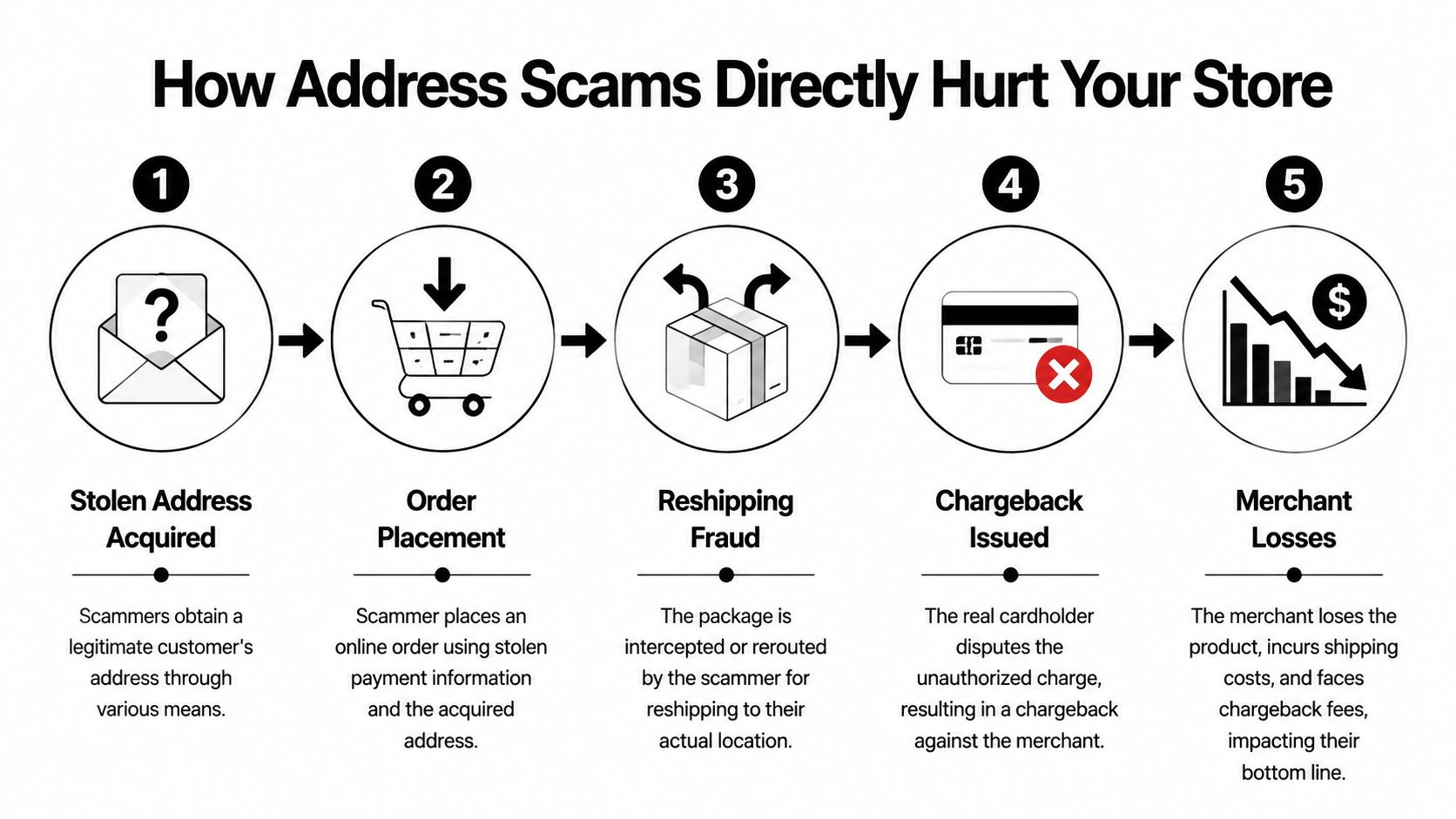
How Address Scams Directly Hurt Your Store
A fraudulent order lands in your Shopify admin. The billing details pass a basic check. The shipping address looks residential. Your team fulfills it. A week later, the issuer reverses the charge, the product is gone, and support is now sorting through a dispute tied to an address that looked safe on day one.
That is how address fraud hits merchants in practice. The address is rarely the whole scam. It is the piece that helps the order clear review, reroutes inventory, weakens your evidence, or gives a fraudster enough credibility to manipulate support.
Public reporting from the FTC continues to show millions of fraud and identity theft complaints each year. For a store operator, the important part is not the headline count. It is how often stolen identity details show up inside ordinary order data, then turn into chargebacks, refund abuse, and fulfillment losses.
Reshipping scams
A common pattern is reshipping fraud. The scammer uses stolen payment credentials and pairs them with a delivery address that looks normal enough to avoid early rejection. That address may belong to an uninvolved resident, a package mule, or a forwarding point that moves goods again after delivery.
By the time the cardholder disputes the purchase, the shipment has already changed hands.
The financial hit is direct:
- Inventory is gone
- Shipping and fulfillment costs are unrecoverable
- Your team spends time on dispute evidence
- Future order review gets harder because the fraud looked ordinary
If your store is seeing disputes tied to delivery issues, this guide to shipping chargebacks helps separate carrier failures from fraud patterns.
The address problem in item-not-received claims
An address can also weaken your defense in item-not-received disputes.
If a scammer ships to a real address that is not connected to the legitimate cardholder, tracking may still show a successful delivery. That helps with carrier confirmation. It does not prove the authorized buyer received the goods. Issuers look at that gap closely, especially when the billing and shipping relationship is unclear.
Proof of delivery matters. Proof that the package went to the legitimate customer matters more.
Fraudulent returns and support abuse
Address theft also creates operational loss outside the initial transaction. A fraudster can contact support, cite an address, and sound credible enough to request a refund, replacement, order edit, or account change. Teams that use address details as a verification shortcut are easier to manipulate.
I see this mistake often in growing Shopify stores. The address becomes a trust signal because it feels specific. In fraud work, specific does not mean trusted.
Here is how the losses usually show up:
| Scam pattern | What the store loses |
|---|---|
| Reshipping fraud | Product, shipping spend, dispute fees |
| Item-not-received disputes | Revenue, evidence quality, staff time |
| Fraudulent returns | Refunds, replacement inventory, margin |
| Support impersonation | Account trust, policy control, customer confidence |
Address data also circulates well beyond one order. Brokers, breach forums, and monitoring services track exposed personal details because they are useful in larger fraud chains. Tools such as GoSafe dark web monitoring solutions exist for that reason.
ChargePay's internal case data shows a 92.4% chargeback win rate across more than 200,000 cases when merchants preserve the right evidence and contest the right disputes, according to ChargePay case results. The trade-off is simple. Catching suspicious address use before fulfillment is cheaper, but strong post-order evidence still protects margin when bad orders slip through.
A store can absorb a few bad orders. Repeated address-based fraud eats margin, raises support load, and trains fraudsters that your review process is easy to test.
Protecting Your Business from Address Fraud
You won't stop every fraudulent order. You can make your store much harder to exploit.
The practical goal is to catch bad orders before fulfillment, tighten account recovery paths, and preserve enough evidence to fight the disputes that still get through.

Start with checkout controls that actually help
The basics still matter when they're configured properly.
- Use AVS and CVV together. AVS checks whether billing address details line up with issuer records. CVV checks whether the buyer has the card security code. Neither is enough alone, but together they screen out a lot of low-effort fraud.
- Review billing and shipping mismatches in context. Some mismatches are normal, like gifts or workplace deliveries. Others deserve a closer look, especially when paired with a new customer, rush shipping, or an unusual support request.
- Watch for forwarding behavior. Freight forwarders, package relays, and address changes right after purchase often deserve manual review.
- Don't ignore small test orders. Fraudsters often probe your controls with lower-risk purchases before placing larger ones.
Build a review habit around combinations, not single signals
One red flag rarely proves fraud. Several together usually mean you should slow down.
A simple internal checklist works well:
Order identity check
Does the customer name, email, phone number, and address feel consistent?Address behavior check
Is this a residential address, a known forwarding setup, or a location that appears in previous problem orders?Order intent check
Is the basket consistent with a normal first purchase, or does it look optimized for resale value?Post-purchase contact check
Did the buyer quickly ask to reroute, split, expedite, or modify delivery details?
Store policy tip: Your team should require stronger verification for address changes after checkout than for the original order placement.
Tighten admin security, not just customer screening
A lot of merchants focus on front-end fraud and overlook back-end account security. That's a mistake when address theft can feed identity takeover.
Use stronger authentication for staff accounts. Avoid relying on SMS where possible. Restrict who can edit payout settings, shipping rules, and customer contact details. Review how your support team verifies identity before changing an order.
Shopify's built-in fraud analysis can help surface risk signals, and some merchants add layered rules through fraud filter tools when order volume justifies it. For broader prevention tactics, this guide to ecommerce fraud prevention is a useful reference.
If you're also thinking about exposure outside your storefront, GoSafe dark web monitoring solutions are worth reviewing. The reason is simple: address fraud often starts long before the checkout attempt, and monitoring exposed identity data can help teams understand where account compromise risk is coming from.
Prepare for the dispute before it arrives
Good prevention lowers fraud. It doesn't eliminate chargebacks.
Keep shipment records organized. Save address edits, customer messages, delivery scans, and any identity verification steps your team took. If you manually approved a risky order, document why. That evidence matters later when the issuer asks whether the transaction was legitimate.
Stores that handle this well treat fraud review and dispute readiness as the same workflow, not two separate jobs.
Let AI Handle the Chargebacks For You
Even with solid controls, some address-based fraud will still land as disputes. That's where merchants usually hit a wall.
Representment takes time. Evidence has to be assembled fast. The argument has to match the reason code. And the order history often needs to be translated into something an issuer reviewer can follow without context. Most store teams don't have spare hours for that, especially when disputes arrive in batches.
Why merchants struggle to fight these cases manually
Address-linked fraud cases are messy because the surface story sounds simple while the evidence trail is fragmented. You may have AVS data, tracking scans, customer emails, a last-minute shipping edit, and internal fraud notes. If nobody pulls those pieces together correctly, the dispute still gets lost.
That's why merchants often need a system, not just a checklist.
When you're evaluating upstream tools, this guide to choosing address verification solutions is helpful because it frames the trade-offs between validation accuracy, workflow fit, and operational use. But even the right verification stack won't remove the need to respond well once a chargeback is filed.
One practical option for the dispute side
One option is ChargePay's AI chargeback management system, which automates the dispute workflow for Shopify merchants. According to ChargePay's publisher data, it handles 200K+ disputes, has recovered $10.8M+, and operates on a pay-per-win model. The app also carries a 4.9-star rating in the Shopify App Store and a Built for Shopify badge.
Those details matter because chargebacks from address abuse are rarely one-off admin tasks. They repeat. They pile up. And they eat margin in ways that are hard to see if you only look at the original order value.
Good fraud prevention reduces approvals of bad orders. Good dispute handling recovers revenue when prevention misses.
The operational takeaway
Most Shopify merchants should think about address fraud in two layers:
- Prevention, where you screen risky orders, protect admin access, and make rerouting harder
- Recovery, where you answer disputes quickly with evidence that fits the claim
If you only do the first, fraud still leaks through. If you only do the second, you keep paying for preventable mistakes. The stores that hold margin best do both.
If address-based fraud is turning into chargebacks, returns abuse, or hard-to-review orders, ChargePay can take the dispute work off your team's plate. It's built for Shopify merchants, automates representment, and uses a pay-per-win model so you only pay when money is recovered. Install it from the Shopify App Store if you want a practical backstop for the chargebacks your fraud filters don't stop.


.svg)



.svg)


.svg)
.svg)
.svg)