


You wake up, open Shopify, and see a chargeback tagged fraudulent transaction. The order didn't look crazy. The payment went through. You shipped it. Now the product is gone, the revenue is gone, and you're stuck proving you didn't do anything wrong.
That's the moment transaction analysis stops sounding like accounting jargon and starts sounding like survival.
If you searched what is transaction analysis, you probably ran into pages about psychology and communication. That's part of the confusion. Search results often lean toward the therapy meaning and skip the finance and operations meaning entirely, which is exactly why so many merchants still don't have a clear process for reviewing orders and disputes (International Transactional Analysis Association overview).
For a Shopify merchant, transaction analysis means one thing that matters. Looking at the data behind an order so you can spot fraud early, keep clean orders moving, and fight chargebacks with evidence instead of guesswork.
A Familiar Story for Shopify Owners
A customer places an order late at night. Nothing about it screams fraud at first glance. The card authorizes. The shipping address looks normal. The order value is high, but not absurd. Your team packs it, prints the label, and moves on.
A week later, the bank sends a chargeback.
Now you're in the worst position a merchant can be in. You already paid for ads to get the sale. You already paid to fulfill it. You already shipped the inventory. Then the cardholder says they didn't authorize it, and the burden lands on you.
Why merchants get stuck
Most store owners review orders too casually when they're busy. They check the order total, maybe the destination, maybe Shopify's risk label, then move on. Fraudsters count on that. They don't always place cartoonishly fake orders. They place orders that look just plausible enough to slip through.
That's why transaction analysis matters. It forces you to slow down and ask, “What does this order say when I look at the full picture?”
Good fraud review isn't about one red flag. It's about whether several small details line up or contradict each other.
This isn't the psychology version
A lot of content on transactional analysis talks about Parent, Adult, Child communication models. That's not what matters here. You're not trying to decode a tense Zoom call. You're trying to stop fake orders and recover money from bad disputes.
For e-commerce, transaction analysis is your first serious filter between revenue and loss. It helps you answer practical questions fast:
- Is this buyer consistent with the order they placed
- Does the payment behavior match normal customer behavior
- Do I have enough evidence now, before I ship, to defend this order later
If you don't build that habit, chargebacks stay reactive. You only start investigating after the money is already gone.
What Transaction Analysis Means for E-commerce
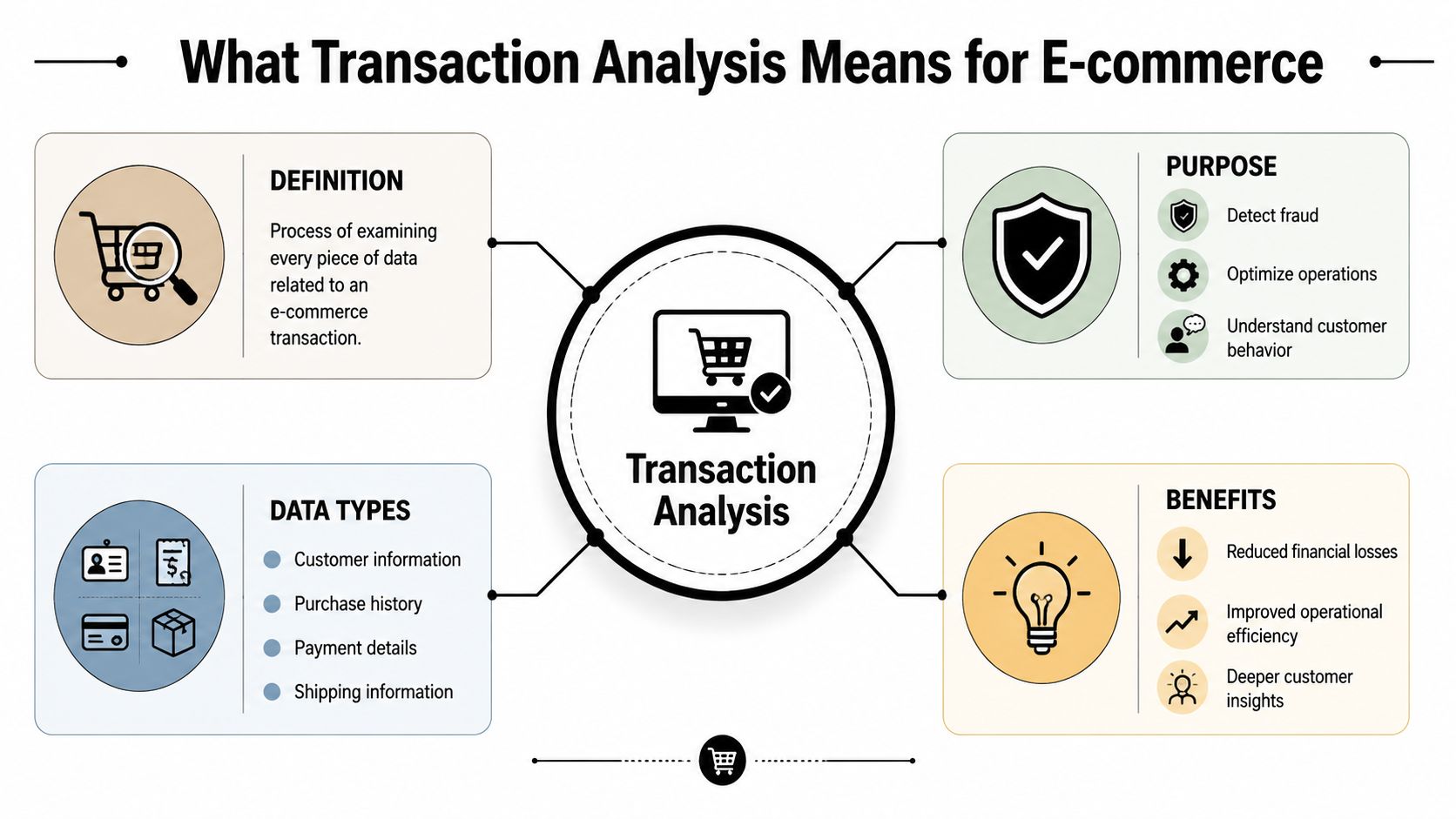
Transaction analysis is simple. You take a single order and break it into the parts that matter. In classic accounting, analysts ask three questions for every transaction: which accounts are affected, by what amount, and whether each account increases or decreases. In e-commerce, that same mindset becomes a much more useful question set for merchants: who bought what, from where, and is it legitimate (foundational transaction analysis framework).
Think like a detective, not a cashier
A cashier checks whether a payment clears.
A fraud analyst asks whether the whole story makes sense.
The order itself is only one clue. You also want the surrounding context:
- Customer details like name, email, order history, and whether they've bought from you before
- Payment details like card verification results, billing match signals, and payment attempt patterns
- Device and location clues like IP region, browser behavior, and whether the location matches the rest of the order
- Fulfillment details like shipping speed, delivery destination, and whether the address looks residential, commercial, or suspicious
One data point rarely proves anything. A customer can send a gift to another state. A first-time buyer can place a large order. A traveler can buy from a hotel. Fraud review gets sharper when you stop treating each signal in isolation.
What you're really trying to answer
Here's the cleanest way to look at it:
| Question | What you check | Why it matters |
|---|---|---|
| Who is this buyer | Customer profile, email, past orders | Tells you whether the identity feels established or disposable |
| What happened | Products ordered, quantity, value, checkout path | Shows whether the purchase fits normal buying behavior |
| Where did it come from | Billing, shipping, IP region, device clues | Helps you spot mismatches and risky routing |
| What happens next | Approval, review, hold, cancel, fulfill | Determines whether you ship, investigate, or collect more proof |
That's why transaction analysis isn't just bookkeeping anymore. It's active store protection.
If you're also tightening your back office, operations and accounting meet. Merchants that work with specialized providers like Bookkeeping and Accounting of Florida Inc. services usually get cleaner transaction records, which makes fraud review and dispute evidence much easier later.
A related concept is transaction monitoring for e-commerce stores, which focuses on ongoing order and payment activity instead of a single order snapshot.
A quick walkthrough helps make this less abstract:
How Transaction Analysis Works Techniques and Tools
A useful transaction analysis setup does two jobs at once. It catches obvious bad orders fast, and it spots the suspicious ones that do not trip a simple rule.
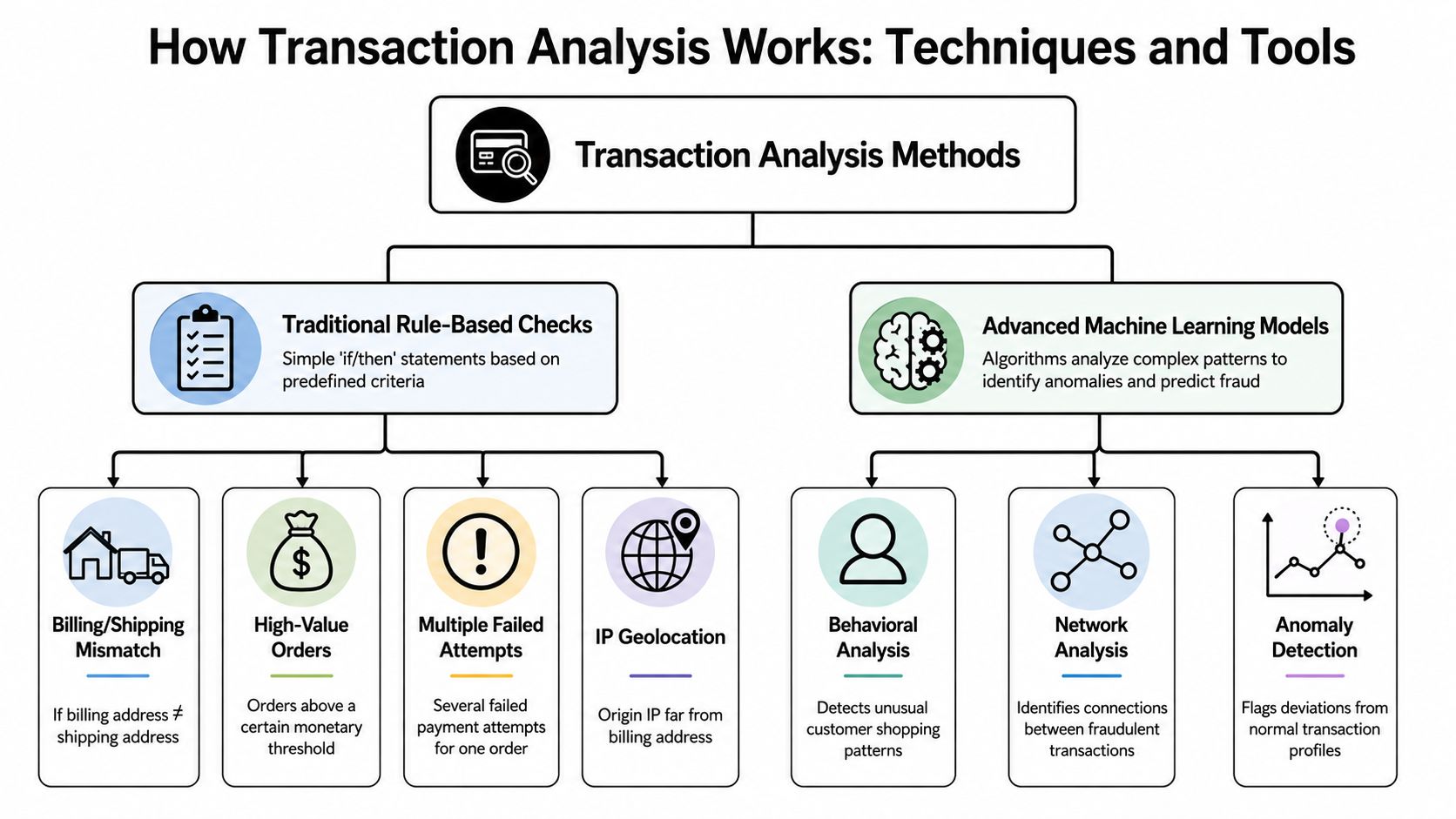
For a Shopify merchant, that usually means using a layered system. Start with clear rules. Then add scoring or pattern analysis once order volume rises and manual review starts wasting time.
Rule-based checks
Rules are the first line of defense. They are simple, fast, and easy to audit later when a chargeback hits.
Examples:
- Address mismatch rule. If the billing country and shipping country do not match, send the order to review.
- Order value rule. If a first-time customer places a high-value order, hold it for manual review.
- Velocity rule. If several payment attempts hit the same customer, card, or device in a short period, flag it.
- Shipping risk rule. If the order uses overnight shipping on a high-risk item, pause fulfillment.
Use rules for clear red flags.
Do not expect rules to carry the whole fraud program. Card testers and repeat fraudsters adjust fast. If your setup only checks fixed conditions, they will learn how to slip around them while your team wastes time reviewing harmless edge cases.
Pattern-based systems
Pattern analysis handles the messy middle. Instead of asking whether one rule fired, it scores the whole transaction against the buying behavior your store usually sees.
That matters because normal looks different for every Shopify store. A subscription brand may see repeat orders from the same household. A gift-heavy store may see frequent billing and shipping mismatches. A luxury shop may have fewer orders, but much higher ticket sizes and more reseller abuse.
Good systems look at combinations, not isolated facts. A new email alone is weak. A new email plus a high-ticket item plus rush shipping plus a device tied to prior declines is a very different story.
Use the split that works in real life. Fixed rules for obvious risk. Pattern analysis for gray-area orders that can turn into chargebacks if you guess wrong.
What good tools actually do
The best tools do more than slap a risk label on an order. They help you decide what action to take next.
A solid setup will:
- Score risk at checkout so bad orders do not move straight to fulfillment
- Group related activity across cards, devices, emails, and IPs
- Track review outcomes so you can tighten rules that miss fraud and remove rules that block good customers
- Store the evidence trail you will need later if the buyer files a dispute
- Feed alerts into your ops workflow so fraud review does not live in somebody's inbox
That last point matters. Transaction analysis is not just fraud screening. It is chargeback prevention and chargeback evidence collection in the same workflow.
A simple comparison helps:
| Method | Strength | Weak spot | Best use |
|---|---|---|---|
| Manual rules | Clear and fast to set up | Misses layered fraud patterns | Small stores, obvious red flags |
| Fraud apps with scoring | Better context for review decisions | Still needs clean review workflows | Growing stores |
| Machine learning models | Catches harder-to-spot behavior patterns | Harder to explain without strong reporting | Larger or more complex operations |
If manual review is eating hours every week, study transaction monitoring solutions for online stores and tighten the handoff between risk checks, order holds, and dispute evidence collection. That is how transaction analysis starts saving money instead of producing more admin work.
Key Use Cases for Your Shopify Store
Transaction analysis becomes valuable when it solves actual problems. For most Shopify stores, those problems come in three flavors: stopping fraud before shipment, fighting friendly fraud after delivery, and building better dispute responses.

Stopping fraud before it ships
This is the cleanest win. If an order looks wrong, you cancel it before inventory leaves the warehouse.
A fake order often leaves fingerprints. The customer uses a brand-new email, selects rush shipping, buys an unusual quantity, and sends the package to an address that doesn't fit the billing details. None of those clues alone closes the case. Together, they tell you to pause.
That's what transaction analysis does best. It helps you stop thinking in isolated signals and start thinking in patterns.
Fighting friendly fraud
Friendly fraud is uglier because the order often was real. The customer placed it, received it, then claimed otherwise.
Stored transaction evidence matters significantly. If you captured the right details early, you can show a coherent timeline:
- Order placement evidence tied to the customer's checkout behavior
- Payment verification signals that support cardholder participation
- Shipping and delivery records showing the goods reached the destination
- Customer communication history that confirms post-purchase engagement
If you don't collect evidence until the dispute arrives, you're already behind.
A lot of merchants lose here because they treat fraud review and dispute management as separate jobs. They aren't. The order review phase is where your future evidence comes from.
Automating the dispute response
When a chargeback lands, transaction analysis becomes your evidence engine. The same order details you used to judge risk now help build a response package.
That can include proof of purchase consistency, customer history, delivery confirmation, and any signals showing the transaction was legitimate. If that process is manual, it gets slow fast. Your team ends up digging through Shopify, shipping software, inboxes, and payment records just to answer one case.
That's why stores focused on chargeback prevention for Shopify merchants usually tighten transaction analysis before they obsess over dispute templates. Better inputs create better representment.
Essential Metrics and Indicators to Monitor
Bad orders usually announce themselves before they turn into chargebacks. The problem is that merchants often watch the wrong signals, or they treat one weak flag like proof. That costs sales on good orders and lets riskier ones slip through.
Watch patterns, not isolated quirks.
The indicators that deserve attention
Start with the signals that show up repeatedly in chargeback-heavy orders:
- AVS or CVV mismatch. This weakens confidence in the card details, especially when other issues show up on the same order.
- High-value order from a brand-new customer. Check whether the basket, shipping speed, and customer profile make sense together.
- Multiple cards tied to one shipping address. That often points to stolen card use or account abuse aimed at a single drop point.
- Freight forwarder or reshipper address. These orders need closer review because recovery gets harder once the package moves again.
- Sudden order velocity spike. A burst of similar purchases can signal card testing, promo abuse, or coordinated fraud.
- Billing, shipping, and location inconsistency. One mismatch may be harmless. Several at once usually mean you should stop and verify.
Score the whole order, not one flag
A single mismatch should not decide the outcome. The key question is whether the order makes sense as a whole.
For example, a new customer with a gift order and a different shipping address is normal. A new customer with overnight shipping, a CVV mismatch, three payment attempts, and a freight forwarder address is a very different story. Review those signals together and you will make better calls.
| Signal mix | Recommended action |
|---|---|
| One weak indicator | Approve or do a light manual check |
| Two to three related indicators | Hold the order and verify customer or payment details |
| Several strong mismatches plus urgency | Cancel, refund, or escalate before fulfillment |
This is the balance that matters. Catch more bad orders without blocking profitable customers who happened to place an unusual order.
A review process that treats every odd detail like fraud will burn revenue just as fast as fraud does.
If disputes are rising, track your broader e-commerce chargeback rate alongside order-level risk signals. Order review shows where you are making weak approval decisions. Chargeback rate shows whether those decisions are costing you money after the sale.
How to Implement Transaction Analysis on Shopify
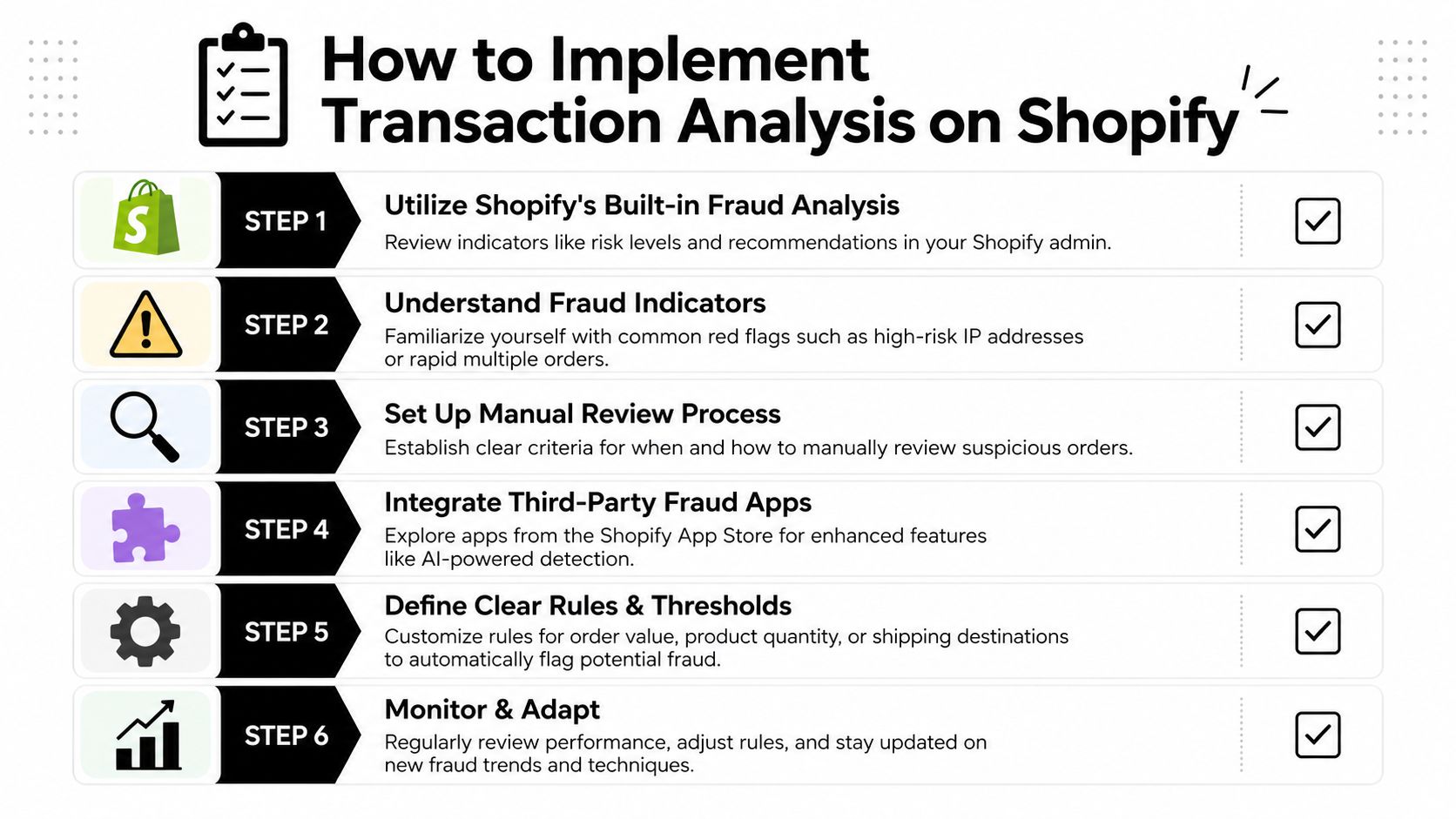
Most Shopify merchants should follow a simple path. Start with what Shopify already gives you. Add manual review where it matters. Then automate the parts that are repetitive and easy to miss.
Good option
Shopify already provides fraud signals on orders. Use them. Don't just glance at the label and move on. Open the order, read the indicators, compare billing and shipping details, and look for anything odd in the customer profile.
For low order volume, that gets you started.
Better option
Create a real manual review workflow. Not a vague “someone checks suspicious orders” process. A real checklist.
For example:
- Review the customer record and see whether this buyer has successful prior orders.
- Check the destination and ask whether the address type and shipping choice fit the order.
- Look for pattern mismatch such as rush shipping, odd quantities, or repeated attempts.
- Document your decision so you can reference it if the order later turns into a dispute.
Merchants typically hit the wall at this stage. Manual review works until volume climbs. Then people rush, skip steps, or apply different standards depending on who's working that day.
Best option
Use specialized apps from the Shopify App Store for fraud review and dispute handling. Some tools focus on order filtering. Others cover the full chargeback workflow.
One example is ChargePay, which handles automated dispute and chargeback management for Shopify stores, including evidence preparation and submission across the dispute lifecycle. If you're comparing options, it helps to understand the broader shift toward automated chargeback and dispute management using AI.
The smartest setup is usually a layered one:
- Shopify's native fraud indicators for quick order-level context
- A manual review checklist for medium-risk edge cases
- An app-based workflow for scale, consistency, and faster dispute handling
That gives you something every merchant needs. A process that still works when your team gets busy.
Automate and Win The ChargePay Advantage
Manual transaction analysis is a decent starting point. It isn't a serious long-term plan if your store is dealing with regular chargebacks.
You already know why. The data lives in too many places. Orders come in too fast. Evidence gets missed. Deadlines get close. Then your team sends thin responses and hopes for the best.
ChargePay is built for the part merchants usually struggle with most. It takes the transaction data behind the order, turns it into dispute-ready evidence, and submits representment without making your team do the assembly work by hand.
The case for automation is straightforward:
- It saves time because your team stops rebuilding the same evidence package again and again.
- It improves consistency because every dispute gets the same structured review instead of whatever someone can pull together that day.
- It protects revenue because stronger evidence gives you a real shot at recovering lost sales.
- It reduces operational drag because disputes stop hijacking your support and ops teams.
According to ChargePay's published company information, the platform has a 92.4% win rate across 200K+ cases and has recovered $10.8M+ for merchants. It also has a 4.9-star rating in the Shopify App Store and carries the Built for Shopify badge.
That's what transaction analysis should lead to. Not more dashboards. Not more manual digging. A tighter system that helps you stop bad orders, defend legitimate ones, and keep chargebacks from eating your margin.
If chargebacks are draining revenue from your Shopify store, install ChargePay. It automates dispute handling, builds evidence from your transaction data, and only charges on recovered cases.


.svg)



.svg)


.svg)
.svg)
.svg)