

Picking the best payment gateway for ecommerce really boils down to what fits your business best. For most online stores, especially those running on platforms like Shopify, the conversation usually circles back to two main players: Stripe, for its incredible developer tools, and PayPal, for its massive, built-in user trust. The right choice for you will hinge on the nitty-gritty of transaction fees, security, and how it plugs into your existing setup.
What Is an Ecommerce Payment Gateway
Think of a payment gateway as the digital bouncer for your online store. It’s the secure tech that connects your website to the payment processor, letting you safely accept credit cards and other digital payments. When a customer types in their card details at checkout, the gateway wraps that sensitive info in layers of encryption and zips it over to the bank for a thumbs-up or thumbs-down.
Simply put, without a payment gateway, your online store can't take anyone's money. It's the critical piece of the puzzle that handles a few key jobs:
- Securely grabbing and transmitting customer payment data.
- Chatting with the banks to authorize or decline the transaction.
- Protecting both you and your customer from fraudulent activity.
It’s the engine that makes your checkout work, making it an absolute must-have for doing business online. If you're curious about the finer points, we've broken down the differences between a gateway and a merchant account in our detailed guide right here: https://www.chargepay.ai/blog/merchant-account-vs-payment-gateway.
Why Your Gateway Choice Matters
Choosing the right payment gateway has a direct line to your store's bottom line. A clunky or confusing checkout is one of the top reasons shoppers ditch their carts. A huge part of your decision should be how your choice impacts the customer experience and, ultimately, how to increase ecommerce conversion rate.
This isn't a small decision, and the market is exploding. The global payment gateway market was valued at around USD 28.7 billion in 2024 and is expected to rocket to USD 56.92 billion by 2030. That growth alone shows you just how essential these tools have become to the way we buy and sell.
A payment gateway isn’t just a tool for taking money; it's a core part of the customer experience. A smooth, trustworthy checkout can be the difference between a one-time visitor and a loyal customer.
Key Factors to Consider
Before we get into a head-to-head comparison, let's lay the groundwork. You need a solid framework for evaluating any payment gateway. Keep these factors in your back pocket as you weigh your options.
Comparing Stripe vs PayPal vs Braintree
When you start digging into payment gateways, three names always surface: Stripe, PayPal, and Braintree. They’re the heavyweights in the e-commerce world, but they are absolutely not interchangeable. Each was built with a different kind of business in mind, and picking the right one boils down to your specific needs, your team's technical comfort level, and where you plan to take your business.
Let’s get past the shiny marketing slogans and dive into a real-world comparison of what actually matters: fees, the customer checkout experience, and how they plug into your store.
This quick overview hits the core factors you need to weigh when choosing between these payment giants.
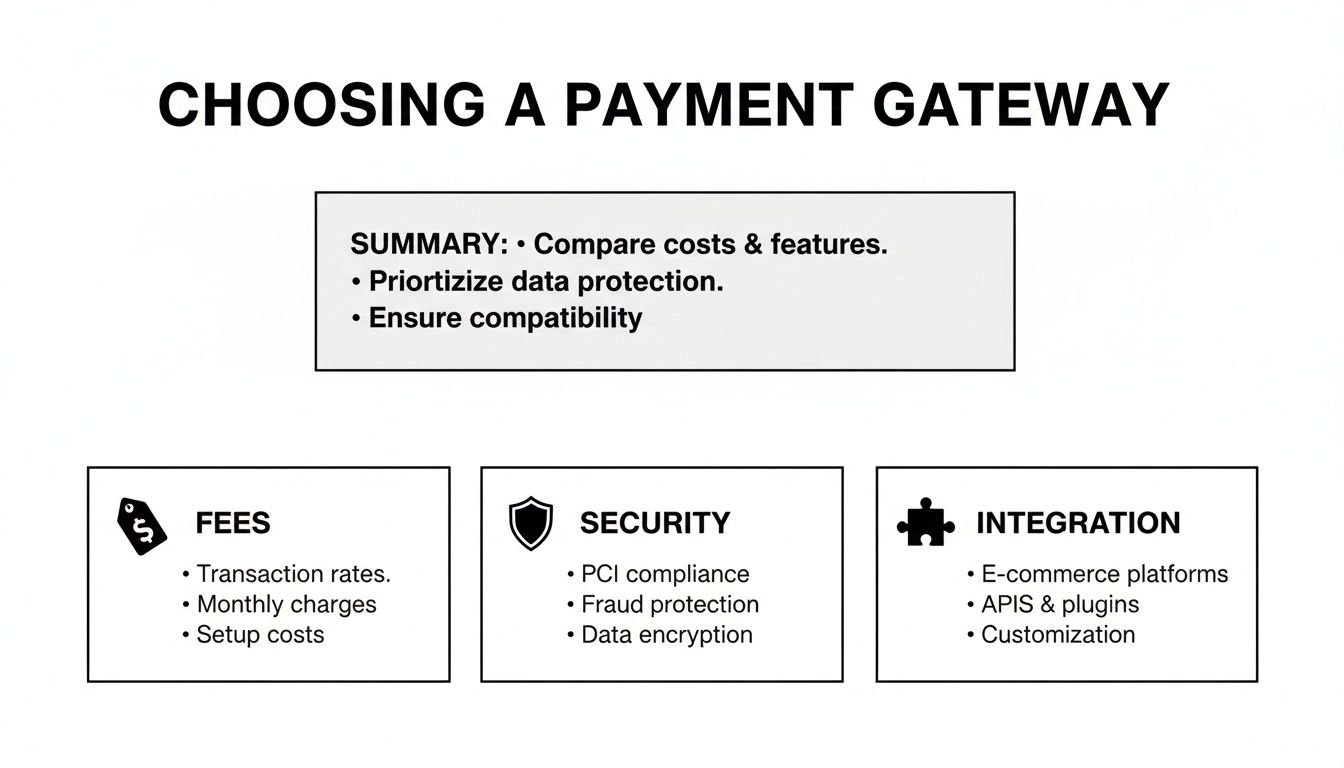
The decision really comes down to those three pillars: transaction fees, security, and integration. All three directly impact your bottom line and, frankly, your operational sanity.
Unpacking the Fee Structures
At first glance, the pricing for all three looks pretty similar. They all run on a flat-rate, pay-as-you-go model, and you won’t find any monthly fees on their standard plans. But the devil is always in the details, especially once you start processing different transaction types or selling internationally.
- Stripe's Standard Fee: 2.9% + $0.30 for every successful online card payment. That rate is clean and simple for domestic sales, but it gets more complex for international cards, which tack on an extra 1.5% fee. If currency conversion is involved, that’s another 1% on top.
- PayPal's Standard Fee: 3.49% + $0.49 per transaction for standard credit and debit card payments in the US. This rate is noticeably higher than Stripe's, and that higher fixed fee can really eat into your margins if you sell a lot of small-ticket items. PayPal is also known for a sometimes-confusing fee schedule with different rates for different payment types.
- Braintree's Standard Fee: As a PayPal company, Braintree has a similar but distinct structure, charging 2.59% + $0.49 per card transaction. While the percentage is lower than Stripe's, the fixed fee is higher. The real advantage here is that Braintree includes Venmo and PayPal payments at the same unified rate, giving you more checkout options without a complicated fee maze.
Key Takeaway: For domestic e-commerce, Stripe often proves to be the most transparent and cost-effective option. However, Braintree's unified rate is a huge plus for merchants who want to offer PayPal and Venmo without juggling separate fee schedules.
The All-Important Checkout Experience
How your customers pay is just as critical as how much you pay in fees. A clunky, untrustworthy, or confusing checkout is a guaranteed way to lose sales. Each of these gateways handles this differently.
Stripe’s Checkout is built from the ground up for customization and a seamless, on-site experience. Using Stripe Elements, you can build a checkout form that is fully branded and lives directly on your website. The customer never leaves your domain, which is a huge trust signal and keeps your brand front-and-center. This is the go-to for businesses that want total control over the user journey.
PayPal’s Checkout has one massive advantage: brand recognition. When customers see that familiar PayPal button, they often feel a sense of security. The downside is that the standard PayPal checkout redirects customers off your site to PayPal's domain to finish paying. While it's a trusted process, that redirect can feel jarring and is a known point of cart abandonment. For merchants looking for more control, digging into the advanced features of PayPal Checkout can help bridge this gap.
Braintree's Checkout gives you the best of both worlds. It delivers a customizable, on-site checkout just like Stripe, but it also lets you easily integrate PayPal and Venmo buttons. This hybrid approach gives customers choice and familiarity without kicking them off your site.
Payment Methods and Platform Integrations
The payment methods you accept have a direct impact on your conversion rates. Shoppers today expect to pay with a lot more than just a credit card.
Here’s a direct comparison of how Stripe, PayPal, and Braintree stack up on the features that matter most to e-commerce merchants.
Head-to-Head Payment Gateway Feature Comparison
This table makes it clear that each gateway is optimized for different priorities.
Stripe is the undisputed champion for businesses targeting a global audience. It offers a huge array of local payment methods like iDEAL in the Netherlands or GrabPay in Southeast Asia. Its integrations with platforms like Shopify are deep, reliable, and powerful.
PayPal is simply everywhere. Just about every e-commerce platform supports it right out of the box, which makes setup incredibly easy. Its main value proposition is tapping into its massive user base, who can pay in just a few clicks with their stored balances.
Braintree shines by bundling today’s most popular payment methods. By offering credit cards, PayPal, and Venmo through a single, clean integration, it simplifies the technical lift for businesses that want to give shoppers maximum flexibility at checkout—especially on mobile.
Making the Final Decision
So, which one is the right fit for your e-commerce store?
- Choose Stripe if: You're a tech-forward business that needs deep customization, a smooth on-site checkout, and access to a massive library of developer tools. It’s the perfect choice for subscription models and stores planning aggressive international expansion.
- Choose PayPal if: You're just starting out and need the quickest, simplest path to accepting payments. The power of its brand name can genuinely lift conversion rates for new stores that haven't yet built up trust.
- Choose Braintree if: You want the custom on-site experience of Stripe but know you can't ignore the massive user bases of PayPal and Venmo. It’s a powerful middle ground for businesses that want a sophisticated, integrated payment solution without making any compromises.
Selling Internationally and Accepting Global Payments
Taking your e-commerce store global is one of the biggest growth levers you can pull, but it opens up a whole new can of worms when it comes to payments. This is where your choice for the best payment gateway for ecommerce gets seriously tested. Customers across borders have different currencies, payment habits, and expectations. You need a gateway built from the ground up for global sales to give everyone, everywhere, a smooth checkout.
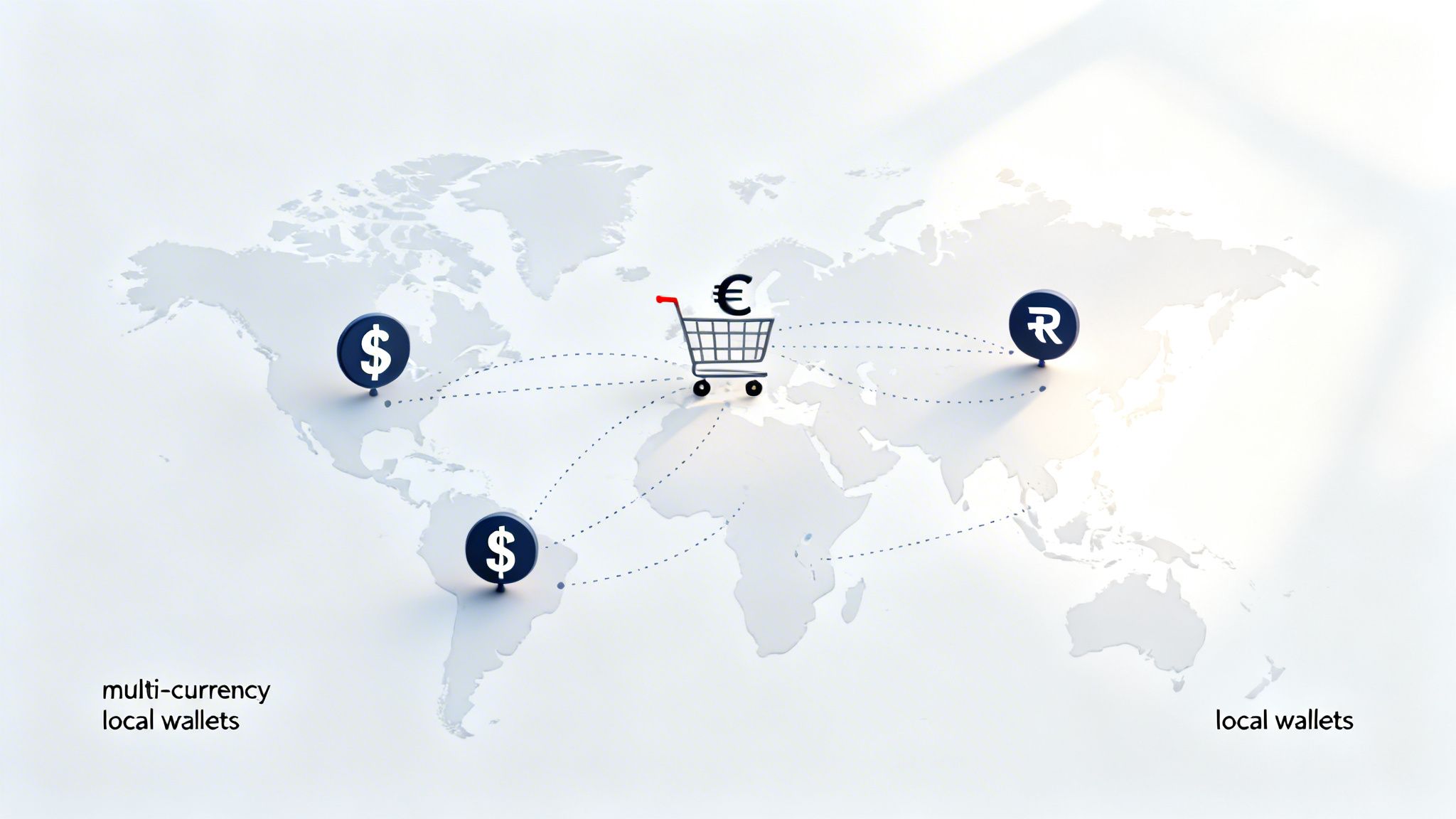
The absolute number one feature you need is multi-currency support. Forcing someone to pay in a currency that isn't their own adds a layer of friction and confusion that kills conversions. A solid international gateway lets shoppers see prices and pay in their local currency, which is a massive trust signal.
But it’s not just about the currency. How people pay varies wildly from one country to another. While credit cards rule in North America, other parts of the world operate on completely different systems.
Why Local Payment Methods Matter
What works in the U.S. will likely fall flat in Germany or Brazil. To really succeed on a global scale, you have to offer the payment methods your target customers already know and trust. This is where a gateway's support for local payment options becomes a total game-changer.
Here’s a quick snapshot of regional preferences:
- Europe: Bank transfers are huge. Think iDEAL in the Netherlands or Sofort in Germany.
- Southeast Asia: Digital wallets are king. Options like GrabPay and GoPay are essential.
- Latin America: Local card schemes and even cash-based voucher systems are still very common.
If you ignore these local habits, you're just leaving money on the table. A gateway that supports a wide range of these regional methods lets you create a checkout experience that feels native and secure to international shoppers. We dive deeper into these complexities in our guide to https://www.chargepay.ai/blog/cross-border-e-commerce.
The secret to selling internationally isn't just translation; it's localization. Offering local payment methods tells your customers you understand their market and you’ve made it easy for them to give you their money.
Global Reach: Stripe vs. PayPal vs. Braintree
So, how do the big three handle global payments? Each has its own playbook, with distinct pros and cons for merchants looking to expand.
Stripe is pretty much the gold standard for global payments, mostly because of its massive list of supported local payment methods. It handles over 135 currencies and dozens of regional options, from Alipay in China to OXXO in Mexico. Its API is also incredibly powerful, making it simple to show the right payment methods to the right customers based on their location.
PayPal’s biggest advantage is its name. With over 400 million active users across the globe, customers everywhere already have an account and trust the brand. It supports over 25 currencies in more than 200 countries, making it a safe and straightforward choice for testing new markets.
Braintree, as a PayPal service, has a strong international foundation right out of the box. It gives you access to PayPal’s entire global network and supports transactions in over 130 currencies. While it doesn't have the sheer volume of local payment methods that Stripe offers, the smooth PayPal integration is a powerful tool for converting international customers.
The rise of digital currencies also adds a new layer to global commerce. As you expand, figuring out how to deal with cryptocurrency tax effectively can have a major impact on your financial strategy.
This is especially critical in fast-growing markets. For instance, in 2025, the Asia-Pacific region is projected to capture a staggering 54.6% of the global eCommerce payments market. Within that, China's market is valued at USD 57.52 billion with a CAGR of 16.02%, while India has the highest mobile wallet adoption rate in the world at 90.8%.
Managing Hidden Costs Like Chargebacks and Fraud
The transaction fees on a pricing page are just the tip of the iceberg. The real costs—the ones that quietly drain your profits—come from two places you can't afford to ignore: chargebacks and fraud. Picking the right payment gateway means looking past the sticker price to see how well it defends your revenue from these threats.
A chargeback kicks in when a customer disputes a charge with their bank, which then yanks the money back from you. This isn't just a simple refund. You get hit with a non-refundable penalty fee, usually $15 to $25 per dispute, whether you win or lose. While some disputes are legit (like a product never arriving), many are "friendly fraud"—where a customer gets to keep the product and their money.

Those penalties pile up fast. Worse, a high dispute rate can seriously damage your relationship with your payment processor. If you want to get a better handle on these penalties, it's worth learning about what a chargeback fee is and why it matters. All of this makes a gateway's built-in fraud prevention tools a make-or-break feature.
Built-In Fraud Tools: Stripe vs. PayPal
Both Stripe and PayPal come armed with slick, machine-learning systems designed to catch fraudulent transactions before they happen. They just tackle the problem from slightly different angles.
Stripe Radar is a beast. It's a powerful, data-driven tool that vets every transaction by checking it against billions of data points from the entire Stripe network. It’s constantly hunting for patterns that scream "fraud." It gives each payment a risk score, letting you automatically block the sketchy ones or flag them for a second look.
PayPal’s Fraud Protection is just as solid, built on the company's colossal dataset from its global network of buyers and sellers. It’s particularly good at spotting risky behavior based on user history, device info, and past transactions, especially for fraud coming from other accounts inside the PayPal ecosystem.
The real value of these native fraud tools is that they're your first line of defense. They leverage massive transaction networks to shut down obvious fraudsters, and that protection is baked right into their standard fees.
The Limits of Native Gateway Protection
Here's the catch: while built-in fraud tools are essential, they're built to stop fraudulent transactions, not to help you fight fraudulent chargebacks after the sale is complete. A payment can look perfectly clean to the gateway—correct CVC, valid address—and still morph into a friendly fraud chargeback weeks down the road. This is where the gateway's protection hits a wall.
Once a customer files a dispute, the fight becomes yours. And it’s a manual, time-sucking grind. You have to:
- Get the dispute notification.
- Dig up compelling evidence like shipping confirmations, customer emails, and order details.
- Write a formal rebuttal letter that ticks all the bank's boxes.
- Submit everything before a crazy-strict deadline.
This process is a huge operational drag. Most merchants just don't have the bandwidth or the know-how to fight every single dispute effectively. The result? Businesses end up writing off these losses, which can easily add up to thousands of dollars every month.
Why You Need a Dedicated Chargeback Solution
If you're growing an e-commerce business, relying only on your gateway's fraud tools is like bringing a knife to a gunfight. It’s not enough. This is where specialized chargeback management solutions step in. These platforms plug directly into your payment gateway—whether it's Stripe, PayPal, or Braintree—to put the entire dispute process on autopilot.
Instead of you manually fighting every case, an AI-powered tool does the heavy lifting automatically:
- Analyzes the Dispute: It instantly reads the chargeback reason code and figures out what evidence is needed to build a winning case.
- Generates a Response: Using machine learning, it pulls together all the necessary proof and crafts a data-backed rebuttal designed for the specific bank and dispute type.
- Submits and Tracks: The tool submits the response for you and keeps tabs on the outcome, clawing back revenue that would have been lost.
Pairing your gateway with an automated chargeback tool turns a reactive, manual headache into a hands-off, revenue-recovery machine. It lets you get back to growing your business while a smart system protects your bottom line from the relentless threat of friendly fraud.
Which Payment Gateway Is Right for Your Business?
There’s no magic bullet here—the “best” payment gateway isn’t a one-size-fits-all solution. The right choice is completely tied to your business model, how comfortable you are with tech, and where you plan to take your store in the future. So, let’s cut through the noise and look at a few real-world scenarios to match you with the right partner.
Think of this as a practical decision-making guide. We're moving past generic feature lists to focus on what actually works for specific types of businesses, helping you find the perfect fit.
For Startups and Small Stores on Shopify
If you’re just getting a new store off the ground, especially on a platform like Shopify, your priorities are simple: get set up fast, and build trust from day one. You don't have time for a technical nightmare, and you need to earn your first customers' confidence immediately.
This is where PayPal is a no-brainer. Its brand recognition is its biggest asset. When a new shopper sees that familiar blue button, it creates an instant feeling of security, which can directly boost conversions for a store that hasn't built its own reputation yet. The setup is incredibly simple, plugging into Shopify and other major platforms in just a few clicks.
Sure, its fees can be a little higher, but the trust it buys you in those critical early days is almost always worth it. It’s the path of least resistance to taking your first payments.
For a brand-new store, the immediate trust a customer feels when they see the PayPal option can be more valuable than a slightly lower transaction fee. It’s about removing any hesitation at the final step of the sale.
For Custom Websites and Subscription Models
Now, if your business runs on a custom-built website or depends on recurring revenue from subscriptions, your needs are totally different. You're looking for flexibility, powerful developer tools, and a checkout experience you can control completely.
This is Stripe’s territory. It was built from the ground up for developers and businesses that need total control over the payment flow. Its API is famous for being well-documented and easy to work with, allowing for deep customization. This means you can create a fully branded payment experience where the customer never leaves your site—a huge factor in keeping your brand consistent and cutting down on abandoned carts.
Stripe’s subscription billing tools are also the gold standard, making it the default choice for SaaS companies and any e-commerce store running a recurring payment model.
For High-Volume Stores Needing Flexibility
What if you're running a high-volume store and want the best of both worlds? You need a customizable, on-site checkout like Stripe offers, but you also know you'd be crazy to ignore the conversion power of PayPal and Venmo.
This is the sweet spot for Braintree. As a PayPal service, it delivers a killer combination. You get a highly customizable checkout that keeps customers on your site, but you can also easily switch on one-click PayPal and Venmo payment options. This hybrid approach gives your customers total flexibility without making you sacrifice a professional, integrated checkout experience.
This setup is perfect for mobile-first businesses where quick payment options like Venmo can make a real difference. It also opens the door to a wider range of payment strategies, which you can read more about in our guide on payment orchestration platforms. By offering all the major payment types through a single, clean integration, Braintree helps you capture every possible sale without a technical mess.
Got Questions? We've Got Answers.
Diving into payment gateways can feel a little overwhelming. There's a lot of jargon, and it's easy to get lost. To clear things up, here are some straightforward answers to the questions we hear most often from merchants.
What's the Difference Between a Payment Gateway and a Payment Processor?
Think of it this way: the payment gateway is the digital equivalent of a credit card terminal in a physical store. It's the secure technology that sits on your website, collecting and encrypting your customer's card details before sending them off.
The payment processor is the engine working in the background. It takes that information from the gateway and communicates with the customer's bank and your bank to approve the transaction and actually move the money. Modern all-in-one providers like Stripe and PayPal bundle both services together, so you don't have to think about the distinction.
Can I Use More Than One Payment Gateway?
Absolutely. In fact, it's often a smart move. Using multiple gateways gives your customers more ways to pay, which can make a real difference in your conversion rates. For instance, you could use Stripe for its top-notch credit card processing while also offering PayPal for the millions of users who love its familiar, one-click checkout.
There's another big benefit: redundancy. If one of your gateways has a technical hiccup or goes down for maintenance, your other provider is still up and running. That means you can keep accepting payments without losing sales.
Are There Hidden Fees I Should Watch Out For?
Yes, and this is where you need to read the fine print. The advertised transaction rate is just one piece of the puzzle, and what looks like a tiny percentage difference can easily be wiped out by other costs.
The most common surprise costs are chargeback fees, monthly minimums, and cross-border transaction fees. You have to look at the total cost of using a gateway, not just the number they put front and center.
For example, a gateway might hit you with a $15 to $25 fee for every single chargeback you get—even if you fight it and win. Others tack on extra fees for processing international cards or for currency conversion, and these costs aren't always obvious upfront.
Do I Need a Merchant Account to Use a Payment Gateway?
It really depends on the provider you pick. Modern solutions like Stripe and PayPal are what's known as payment service providers (PSPs), or aggregators. They combine the gateway and a merchant account into one package, so you don't need to go out and get one from a bank yourself. This makes getting started incredibly fast and simple.
On the other hand, traditional payment gateways often require you to have your own dedicated merchant account. This route can sometimes lead to lower rates for businesses doing massive volume, but the application process is much more complex. For the vast majority of e-commerce stores, an all-in-one PSP is the most practical way to go.
Ready to stop losing money to chargebacks? ChargePay uses AI to automate the entire dispute process, integrating directly with your payment gateway to recover lost revenue for you. Learn how ChargePay can boost your win rate and protect your bottom line.


.svg)



.svg)


.svg)
.svg)
.svg)