


Friendly fraud isn't just another line item on your P&L. It’s a quiet but relentless drain on your profits, and tackling it means more than just winning a dispute here and there. It's about a combination of sharp communication, solid evidence, and smart post-purchase controls to stop customers from disputing charges they know are valid.
This problem costs you far more than just the sale. You're also hit with chargeback fees, and if it gets out of hand, it can even put your payment processing abilities at risk. At ChargePay, we've helped over 100,000 Shopify merchants fight back, recovering over $2.8 million in lost revenue. Let's look at how you can protect your store.
The Real Cost of Friendly Fraud on Your Shopify Store

Let's get straight to it: friendly fraud is silently bleeding your Shopify store dry. It’s when a customer buys something, receives it, and then turns around and tells their bank the charge wasn't authorized or the package never arrived. This isn't just a cost of doing business; it's a growing threat that can seriously wound your store’s financial health.
The damage goes way beyond just losing the sale. For every successful friendly fraud claim, you get hit with a triple-whammy: you lose the product you shipped, the revenue from the sale, and you get slapped with a painful chargeback fee from your processor.
At ChargePay, we've seen this cycle cripple otherwise healthy Shopify stores. A single $100 fraudulent dispute can easily cost a merchant over $150 after accounting for the lost item, revenue, and non-refundable fees.
And this isn't slowing down. A recent report from the Merchant Risk Council found that a whopping 64% of merchants worldwide are seeing a sharp rise in this kind of first-party misuse. What’s even more alarming is that a quarter of those merchants have seen these incidents jump by 25% or more. You can read the full report from the Merchant Risk Council to see the data for yourself.
Breaking Down the Financial Damage
Think of friendly fraud as a hidden tax on your store. The lost revenue is the obvious part, but the ripple effects are where the real pain sets in.
- Non-Refundable Chargeback Fees: Processors like Shopify Payments charge a fee—usually $15 to $25—for every single dispute filed against you. You pay this whether you win or lose the fight.
- Operational Strain: Your team has to drop everything to dig up evidence and respond to these claims. That’s time they could be spending on marketing, customer service, or anything else that actually grows your business.
- Increased Processing Rates: If your chargeback ratio climbs too high, payment processors will start seeing your store as "high-risk." This could mean they hold your money for longer or jack up your transaction fees.
- Risk of Account Termination: This is the worst-case scenario. If your chargeback rate goes over the processor's threshold (typically around 1%), you risk losing your payment processing account entirely. No account, no sales.
Understanding these layered costs is the first step. You aren't just fighting to get your money back on one sale; you're defending your store’s financial stability and operational future.
Common Excuses and Tactics
Friendly fraud almost never looks like a customer admitting they just changed their mind. They use specific "reason codes" when filing the dispute, which makes the claim look legitimate on the surface.
Here are a few of the most common scenarios we see every day at ChargePay:
- "Transaction Not Recognized": The customer insists they don't recognize the charge on their credit card statement. This often happens if your billing descriptor is unclear, or frankly, they just forgot they bought it.
- "Product Not Received": The buyer swears the package never showed up, even when tracking clearly shows it was delivered right to their doorstep.
- "Product Not as Described": This is a classic case of buyer's remorse. The customer gets a perfectly fine product but claims it doesn't match the description, just so they can get a refund without the hassle of a return.
These aren't simple customer service issues; they are deliberate tactics. We've seen it all, from customers disputing a charge weeks after leaving a glowing 5-star review, to those claiming a product never arrived when their own Ring camera footage shows them bringing it inside. This is exactly the kind of misuse that requires a tough, specific strategy, something we’ve perfected while handling over 100,000 disputes.
How to Spot Friendly Fraud Red Flags Before Shipping

The best way to handle friendly fraud is to stop it before it even starts. Your most effective strategy begins long before you even think about printing a shipping label. A good offense is your best defense, and that means learning to spot the subtle signs that an order might turn into a headache later.
You have to move beyond just relying on generic fraud filters. It's time to train your eyes to see the specific behaviors that often come right before a friendly fraud dispute.
At ChargePay, we've dug into the data from over 100,000 disputes for Shopify merchants, which gives us a pretty clear picture of what a high-risk order looks like. This isn't about aggressively blocking good customers. It’s about knowing when to pause a suspicious order for a quick manual review that could save you hundreds, or even thousands, of dollars.
Understanding Pre-Shipment Verification
Your first line of defense is pre-shipment verification. This is all about using the tools you already have to take a closer look at orders that just don't feel right. The two most important checks are the Address Verification System (AVS) and the Card Verification Value (CVV).
- Address Verification System (AVS): This tool checks if the billing address the customer entered matches the address their credit card company has on file. A mismatch is a major red flag.
- Card Verification Value (CVV): This is that little three or four-digit code on the card. A correct CVV shows the customer probably has the physical card, which makes criminal fraud less likely. But it doesn't stop a legitimate cardholder from committing friendly fraud down the road.
Shopify's own fraud analysis will flag these mismatches for you, but it’s your job to actually pay attention to them. A partial or failed AVS check deserves a closer look. Every single time.
The High-Risk Order Checklist
Certain order patterns should immediately make you pause. Think of it as a checklist—the more boxes an order ticks, the more likely it is to become a problem.
Here are the top red flags we consistently see tied to friendly fraud chargebacks:
- Mismatched Billing and Shipping Addresses: Yes, people send gifts. But a mismatch, especially when paired with other red flags on this list, is suspicious.
- Unusually Large First-Time Orders: A brand-new customer dropping an order that's way bigger than your average order value (AOV) is a classic warning sign.
- Multiple Declined Payments: An order that fails a few times with different cards or payment details before one finally works? That could be someone cycling through stolen or maxed-out cards.
- Expedited Shipping on High-Value Items: Fraudsters want their stuff fast, before the real cardholder sees the charge. They don't mind paying $50 for overnight shipping on a $1,000 order because they never plan on actually paying for it.
- Orders with AVS or CVV Mismatches: As we said before, these should be automatic triggers for a review. If the bank's own systems are telling you something is off, you should probably listen.
We see this scenario all the time: a new customer places a $1,200 order for your priciest products at 3 AM. The card fails twice before going through, and they want next-day air shipping to a completely different state than the billing address. This isn't just an excited new fan; it's an order that needs an immediate manual review before anything leaves your warehouse.
Taking Action on Suspicious Orders
So, your internal alarms are going off. What now? The goal is to figure out if the order is legitimate without creating a ton of friction for a potentially great customer. If you panic and cancel every flagged order, you’ll lose good sales. Instead, you need a calm, methodical process.
First, dig into the order details in Shopify. Look at the customer's IP address location. Does it roughly line up with the billing or shipping address? A customer in California using an IP from Nigeria to ship a package to New York is a huge red flag. Our guide on managing Shopify high-risk orders gets into more detail on using Shopify's native tools for this.
Next, a simple verification email can work wonders. You don't need to sound accusatory. A friendly note can both confirm a real purchase and scare off a potential fraudster.
Example Verification Email:
"Hi [Customer Name],
Thanks so much for your order! We're just doing a quick, standard verification before we ship it out. Can you please confirm that the shipping address below is correct for your order #[Order Number]?
[Shipping Address Here]
Just a quick reply to this email is all we need. We're excited to get your items on their way!
Thanks,
The [Your Store Name] Team"
This simple step forces them to respond. A real customer will have no problem confirming their address. A fraudster will usually just go silent. And just like that, you've saved yourself a product, a sale, and a chargeback fee. This kind of proactive communication is a cornerstone of smart friendly fraud prevention.
Building an Unbeatable Evidence Package to Win Disputes
Even with the best game plan, some friendly fraud disputes are going to slip through. When a chargeback hits your desk, your ability to get your money back hinges on one thing: the strength of the evidence you fire back with. This is your playbook for building a case so solid that the banks have to take notice.
Think of the person at the bank reviewing your case. They're like a judge seeing hundreds of cases every single day, spending just a few minutes on each one. Your evidence package has to be crystal clear, straight to the point, and absolutely compelling. You're not just fighting one dispute; you're sending a clear message that you won’t be an easy target for fraud.
The Anatomy of a Winning Response
A powerful evidence package tells a complete story. It needs to walk the bank reviewer from the moment the order was placed all the way to the "delivered" notification on their doorstep, leaving zero doubt that the transaction was legit and the customer got exactly what they paid for. Your job is to dismantle the customer's claim, piece by piece.
This isn't about just dumping a folder of data on their lap. It's a strategic game of presenting the right information in the right order. For a deep dive into structuring your rebuttal from start to finish, our guide on chargeback representment offers a detailed framework.
Evidence Checklist for Friendly Fraud Disputes
When you get that chargeback notification, it's go-time. Every piece of data you can find strengthens your case and tells a more complete story. Here's a quick checklist of the non-negotiables you need to gather to give yourself the best shot at winning.
| Evidence Type | What to Include | Why It Matters |
|---|---|---|
| Order Confirmation | A screenshot of the order confirmation email and details from your Shopify dashboard. | This proves a transaction was initiated and an agreement was made with the customer. |
| Payment Verification | AVS and CVV match results (e.g., "AVS Address & Zip Code: Match," "CVV: Match"). | This confirms the person placing the order likely had the physical card and knew the billing details. |
| IP Address Logs | The IP address used to place the order and its geolocation. | This links the order to a physical location. An IP address that matches the shipping or billing city is incredibly powerful evidence. |
| Shipping & Delivery Proof | The tracking number, carrier name, and a direct link to the tracking page showing "Delivered." A photo of the package at the door is the gold standard here. | This is your single most important piece of evidence to counter those "Product Not Received" claims. |
| Customer Communication | Any emails, chat logs, or support tickets from the customer, especially if they praise the product before the dispute. | This shows the customer got the product and was happy with it, which can completely undermine a "Not as Described" claim. |
Having this data organized and ready to go is half the battle. It's this exact structured approach that has allowed ChargePay to successfully handle over 100,000 disputes and recover more than $2.8 million for Shopify merchants just like you.
Common Mistakes That Cost You Money
Knowing what not to do is just as important as knowing what to do. So many merchants I've worked with have lost winnable disputes because of simple, unforced errors.
Here are the big ones to avoid:
- Missing the Deadline: The issuing bank gives you a strict window to respond, usually 20-45 days. If you miss it, you lose by default. No exceptions.
- Providing a Wall of Text: Bank reviewers are swamped. A long, rambling paragraph without clear headings or highlighted data will get skimmed or ignored. Make it easy for them.
- Submitting Messy Evidence: Unlabeled screenshots, confusing data, or a disorganized file dump just makes your case hard to follow. Present your evidence like a pro.
- Using an Angry or Accusatory Tone: Stick to the facts. Getting emotional in your response makes you look unprofessional and can actually work against you.
The post-checkout environment has become the new battleground for friendly fraud. It's a fact: 64% of merchants have seen a spike in this type of fraud. Experts predict that identity-based attacks will make up 27-29% of all eCommerce fraud cases by 2026. This new reality means that having a rock-solid evidence collection process isn't a "nice-to-have"—it's essential for survival.
The principles of building a solid case are universal. While you're focused on Shopify, it's smart to see how others approach similar disputes. For instance, the strategies for winning an Amazon A-to-Z Claim can offer some valuable insights for crafting a rock-solid defense on any platform.
Ultimately, winning friendly fraud disputes comes down to being more prepared and more organized than the person trying to get a freebie. By following this evidence-gathering playbook, you put yourself in the strongest possible position to win. This is exactly what ChargePay's AI does automatically, which is how we achieve a 92.4% win rate by building these unbeatable evidence packages for our merchants.
Automating Your Defense with AI-Powered Tools
Let’s be honest: fighting friendly fraud by hand is a quick way to burn out. It eats up your time, drains your energy, and hits your wallet hard. This is where automation, especially tools powered by AI, becomes your most important ally in any friendly fraud strategy. It turns the reactive, time-sucking headache of dispute management into an automated system that recovers your revenue.
Manually gathering evidence for every single dispute just isn't scalable for a growing Shopify store. You’re forced to hunt down order confirmations, dig through shipping details, find IP data, and then try to write a persuasive response that meets the bank's super-strict requirements. It's tedious work. Every minute you spend on that is a minute you're not growing your business.
At ChargePay, we built our AI to take this entire burden off your shoulders. The moment a dispute hits, our system gets to work.
How AI Transforms Dispute Management
An AI-powered platform doesn't just make things faster; it completely changes the game. Instead of you scrambling to react to a chargeback notice, the AI is already building your defense.
Here’s a look at how it works:
- Instant Analysis: The moment a dispute comes in, the AI analyzes the details, identifies the reason code, and flags it as potential friendly fraud.
- Automated Evidence Gathering: It automatically pulls all the crucial evidence. Think delivery confirmation with photo proof, AVS and CVV match data, customer history, and IP logs connecting the order to the shipping address.
- Professional Response Generation: Our AI writes a professional, bank-ready response letter that presents your evidence clearly and effectively. This ensures the person reviewing it at the bank sees a compelling case every single time.
This automated process creates a crystal-clear trail from the order all the way to delivery, making it incredibly difficult for a bogus claim to succeed.
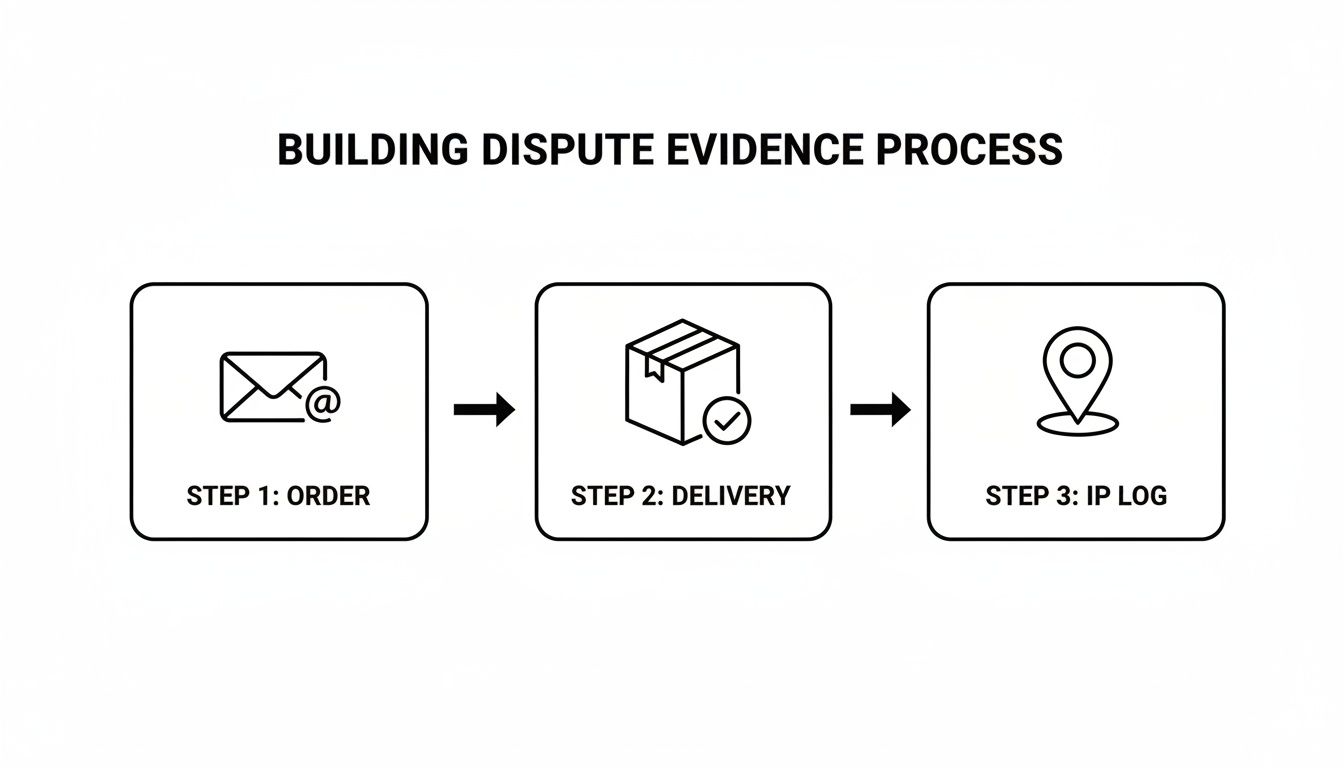
The key takeaway here is that a strong defense links every stage of the transaction with hard data. This builds an undeniable record of a legitimate purchase and fulfillment.
Real Results Backed by Data
This isn't just theory. We've used this exact automated approach to handle over 100,000 disputes, recovering more than $2.8 million for Shopify merchants.
Our 92.4% win rate really speaks for itself. It’s a direct result of AI's ability to build a perfect evidence package, every single time, without the risk of human error or delay.
The numbers don't lie. Friendly fraud now makes up 36% of all eCommerce fraud cases worldwide. This trend is fueling a projected explosion of fraudulent transactions, expected to surge from $56 billion in 2025 to over $131 billion by 2030. For Shopify merchants, this translates to devastating losses—with cascading fees amplifying the damage to $207 for every $100 of fraud. You can find more on these projections from Juniper Research and see why automation is no longer optional.
AI-driven tools like ChargePay, which proudly holds a 4.9-star rating and a Built for Shopify badge, fight this threat by automatically generating winning representment letters. It turns a major headache into a managed problem.
For merchants looking to defend themselves against friendly fraud, exploring how you can start leveraging AI apps for your Shopify store can seriously protect your bottom line.
By automating your defense, you're not just winning disputes; you're getting countless hours of your time back. This lets you refocus on what actually matters: marketing, product development, and connecting with your customers. To learn more about this approach, check out our complete guide to automated chargeback and dispute management using AI.
Ultimately, the goal is to make it unprofitable for fraudsters to target your store. With an AI partner, you send a clear message: you fight every dispute, and you win. The best part? You can do it all without lifting a finger. Install ChargePay from the Shopify App Store and let our AI start protecting your revenue today.
Time to Stop Losing Money and Start Winning It Back
You've made it this far, so you get it. You know what friendly fraud looks like, you've seen the red flags, and you understand what it takes to fight back. Now it's time to put that knowledge into action. It's time to stop writing off these losses as just another cost of doing business.
Let’s be honest, surrendering your hard-earned revenue stings. Fighting chargebacks isn't just about winning back one sale; it's about drawing a line in the sand. Every minute you spend digging through order histories is a minute you're not spending on growing your brand.
Take Control with a True AI Partner
This is the part where you decide what your time is worth. You can stick with the frustrating, time-consuming cycle of managing disputes by hand, or you can bring in a partner that does the heavy lifting for you. Installing ChargePay from the Shopify App Store is more than just adding an app—it's like hiring an AI-powered dispute specialist dedicated to getting your money back.
We’ve been in the trenches, handling over 100,000 disputes and recovering more than $2.8 million for Shopify merchants just like you. The entire process is built on the exact strategies we've talked about: instant analysis of the claim, automated evidence collection, and professionally written responses designed to win.
You're not just installing a piece of software; you're deploying a defense system. A system that has been battle-tested and refined over thousands of disputes to achieve a 92.4% win rate. This isn't just about fancy tech; it's about real, measurable results.
Think of our system as your silent partner. It works around the clock, 24/7, making sure no deadline is ever missed and no critical piece of evidence gets overlooked. This frees you up to focus on what you actually love to do: running and growing your store.
Your Risk-Free Path to Revenue Recovery
We're so confident we can win back your money that we've made it completely risk-free to try. Our pay-per-win model is as straightforward as it gets: you only pay a small fee after we successfully win a dispute and recover your funds. If we don’t win, you don’t pay a dime. Simple as that.
- Zero Upfront Cost: Install the app and get started without any initial investment.
- No Monthly Fees: You aren't getting locked into another subscription.
- Pay Only for Success: We only make money when you get your money back.
This is your chance to finally turn the tide on friendly fraud. You can stop the financial drain and start turning those frustrating chargebacks into recovered revenue. Our 4.9-star rating and official Built for Shopify badge are a testament to the trust thousands of merchants have placed in us.
Your business deserves a defender that's just as relentless as the people trying to chip away at your profits. Your 92.4% win rate is waiting.
Ready to stop losing money? Install ChargePay from the Shopify App Store and let our AI start protecting your business today.
Got Questions About Friendly Fraud? We Have Answers.
Let's cut through the noise. Here are direct answers to the most common questions we hear from Shopify merchants about friendly fraud, chargebacks, and how to protect their stores.
What Is the Difference Between Friendly Fraud and a Regular Chargeback?
A regular chargeback is usually legitimate. Think of it as a result of criminal fraud—like when a stolen credit card gets used for a purchase—or a genuine customer service issue that you just couldn't resolve in time. In these cases, the customer is typically an innocent victim.
Friendly fraud is a completely different beast. Sometimes called "first-party misuse," this is when a real customer disputes a charge they actually made. They received the exact product they ordered but are trying to game the system to get it for free.
They might claim the package never arrived or that they don't recognize the charge on their statement. It’s fraud masquerading as a customer complaint, and it demands a strong, evidence-based response. For a deeper dive, you can learn more about what friendly fraud is in our dedicated guide.
Can I Really Win Friendly Fraud Disputes on Shopify?
Yes, you absolutely can. Winning these disputes is entirely possible, but it all comes down to the quality of your evidence. Banks and card networks are impartial judges; they make their decisions based on the proof you bring to the table.
If you can lay out a clear trail of evidence—like a successful AVS and CVV match, IP address logs that line up with the shipping address, and undeniable delivery confirmation from the carrier—your chances of winning go up dramatically.
This is exactly what ChargePay's AI was built for. Our tech automatically gathers all this compelling evidence and packages it into a professional response. It’s how we’ve hit a 92.4% success rate across more than 100,000 disputes for Shopify merchants just like you.
How Much Time Does It Take to Fight a Chargeback Manually?
Honestly, fighting just one chargeback manually can eat up anywhere from 15 minutes to over an hour, and that’s if you have your records in order. You have to drop everything to dig through different systems for order details, shipping info, customer emails, and payment data.
After you find everything, you still have to write a convincing response letter and get it submitted before the bank’s non-negotiable deadline. For a busy store owner, that time adds up fast, pulling you away from the things that actually grow your business. An automated tool like ChargePay can handle that entire headache for you in seconds.
Will Fighting Chargebacks Hurt My Customer Relationships?
This is a huge concern for many merchants, but it’s important to separate genuine customer service from fraud protection. You should always bend over backward to resolve legitimate customer problems with top-notch service—offering returns, replacements, or refunds when they're deserved.
Fighting a chargeback is what you do when you have clear evidence of friendly fraud. In these situations, the customer has already chosen to bypass you and go straight to their bank. You aren't damaging a valuable relationship; you are defending your business from a fraudulent claim. Once filed, the dispute process is between you and the banks, not you and the customer.
Tired of watching your hard-earned revenue vanish because of friendly fraud? It’s time to automate your defense and start turning those losses back into wins. ChargePay uses AI to fight and win disputes for you, and our pay-per-win model means there’s zero risk for your store. Let our AI, with its 92.4% win rate, start recovering your money today.


.svg)



.svg)


.svg)
.svg)
.svg)