


When a customer wants their money back, it feels like a simple reversal. But for you, the Shopify merchant, a credit card refund is a whole financial process where you send money back through a complex card network to land in a customer's account.
This process is packed with hidden costs that go way beyond the product's price tag. Worse, if handled poorly, a simple refund request can quickly escalate into a damaging chargeback.
At ChargePay, we've recovered over $2.8M for Shopify merchants, handling 100K+ disputes with a 92.4% win rate. We know exactly how a simple refund can spiral out of control and hurt your bottom line.
The True Cost of a Refund to Your Shopify Store
Every merchant knows refunds are a part of doing business. But do you know what each one really costs you? It’s not just the sale amount. Every return quietly eats away at your profit through non-refundable fees, labor, and operational costs.
When a customer asks for a refund, you're losing more than just that sale.
First, you lose the non-refundable credit card processing fees you paid on the original transaction. That money is gone. Then you pay an employee to handle the return, inspect the product, and update your inventory. And don't forget shipping—you often lose money on both the initial delivery and the return shipment.
This financial drain adds up, but it's only half the story. The bigger risk is that a slow refund process is one of the fastest ways to trigger a customer to file a chargeback, which brings steep fees and penalties. You can get the full breakdown of that financial hit in our article explaining what a chargeback fee is.
A single refund on a $100 product can easily cost you over $15 in sunk costs from processing fees, labor, and shipping—a 15% loss before you even factor in the lost sale.
To make matters worse, the returns process is a playground for fraudsters. In fact, retailers are bracing for nearly $850 billion in returns in 2025, with online stores like yours seeing a staggering return rate of 19.3%. Even more alarming? An estimated 9% of all returns are fraudulent, turning what should be a customer service gesture into a direct financial attack on your business. You can dive deeper into these trends in the latest report from the National Retail Federation.
A Refund's Hidden Costs at a Glance
It’s easy to overlook the small costs that add up with every return. This table breaks down where the money really goes when you process a refund for a customer.
As you can see, a simple $100 refund can quickly cost you over $17 out of pocket, not including the lost revenue from the sale itself.
Understanding these hidden costs is the first step toward protecting your revenue. At ChargePay, we’ve recovered over $2.8M for merchants by automating chargeback defense with a 92.4% win rate.
The Credit Card Refund Journey Step by Step
Let's pull back the curtain on what actually happens when you hit "refund" on a Shopify order. It's not as simple as money zipping from your account back to your customer's. It's more like a delivery running in reverse, with several checkpoints along the way.
The whole thing relies on communication between four main parties:
- Your Shopify Store (The Merchant): You kick off the refund request.
- Your Payment Processor (The Courier): A service like Shopify Payments or PayPal. They package up the refund information and send it into the financial network.
- The Customer's Bank (The Issuing Bank): The final destination. This bank gets the refund details and credits the customer's account.
- Your Bank (The Acquiring Bank): Your bank works with the payment processor to ensure funds are routed correctly out of your merchant account.
Understanding this flow is critical. A delay at any point can frustrate a customer, turning a simple return into a costly chargeback.
From Your Dashboard to Their Statement
The refund process follows a specific, multi-step sequence, which is why it's never instant. A request has to pass through multiple systems before the money finally lands.
First, you initiate the refund in your Shopify admin. Your payment processor then batches this request with others and sends it to the major card networks (like Visa or Mastercard). From there, the network routes it to the customer's issuing bank, which finally processes the transaction and posts a credit to the customer's statement. This whole chain is why a refund can take 5-10 business days to show up. To get a deeper look at the players involved, you can learn more about how the Top Payment Gateways for E-commerce manage these transactions.
This visual below highlights the direct costs you eat with every single refund, and that's before you even think about the operational side of things.
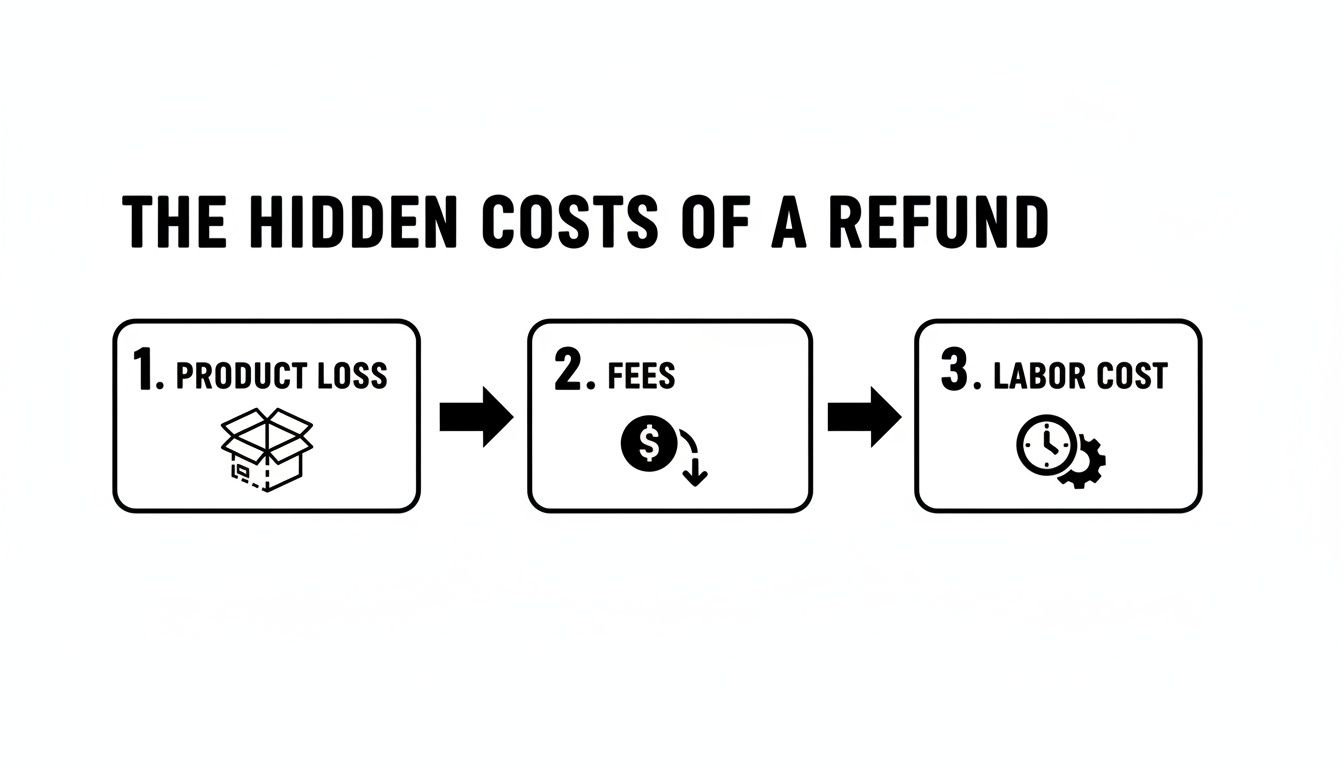
As you can see, every refund chips away at your profits through the lost product, non-refundable fees, and the labor it takes to process it. For a complete picture of how the money moves, check out our guide on how the initial credit card transaction process works.
The key takeaway is that you, the merchant, kickstart the entire process, but the timing is largely out of your hands once the request leaves your system. This is a common friction point where impatient customers, not seeing an instant credit, may decide to file a chargeback instead.
Refunds vs Chargebacks: Understanding the Critical Difference
For any Shopify merchant, confusing refunds with chargebacks is a costly mistake. Think of it like this: a refund is a controlled demolition, while a chargeback is a surprise earthquake that rattles your business. One is a manageable part of doing business; the other is a direct hit to your bottom line.
A refund is your choice. When a customer returns an item, you voluntarily return their money. You're in the driver's seat, communicating directly with your customer. Get it right, and you can even turn a negative experience into a positive one.
A chargeback, on the other hand, is a forced reversal. The customer bypasses you and goes straight to their bank to dispute the charge. The bank then yanks the money right out of your merchant account. Suddenly, you're on the defensive, scrambling to prove the charge was legitimate.

Why Chargebacks Are So Much Worse
The damage from a chargeback goes way beyond just losing the money from that one sale. When a bank forces that reversal, they hit you with a painful list of penalties that makes a simple refund look like a gift.
Here’s the breakdown of what a single chargeback actually costs you:
- Hefty Fees: Your payment processor will hit you with a non-refundable chargeback fee, usually between $15 and $100, for every single dispute. You pay this even if you win.
- Lost Revenue: The original transaction amount is gone, immediately pulled from your account while the dispute plays out.
- Lost Product: In many cases, especially with friendly fraud, the customer has already received the product and has no intention of returning it.
- Major Business Risk: A high chargeback rate gets you flagged as a high-risk business. This can lead to much higher processing fees or, worst-case scenario, losing your merchant account entirely.
Refund vs Chargeback Head-to-Head
To put it plainly, a proactive refund is always better than a reactive chargeback. The difference in cost, control, and long-term impact on your business is night and day.
Here's a direct comparison:
The takeaway is clear: managing returns effectively is your first line of defense against the financial and operational nightmare of chargebacks. For a deeper dive, check out our complete guide comparing a chargeback vs. a refund.
A slow or confusing refund process is a primary driver of chargebacks. When customers feel ignored or don't see their money back quickly, their first call is often to their bank, instantly escalating a simple return into a damaging dispute.
This is where automation becomes your secret weapon. At ChargePay, we've seen it all, handling over 100,000 disputes and recovering more than $2.8 million for Shopify merchants. Our 92.4% win rate is powered by an AI that is Built for Shopify, taking on the entire dispute process from start to finish.
If you’re tired of losing money and time to chargebacks, it's time to fight back.
How Slow Refunds Fuel Chargebacks
In online shopping, speed is everything. Customers expect fast orders, and when something goes wrong, they expect their money back even faster. A slow, confusing, or poorly communicated refund process is one of the biggest triggers for friendly fraud, where a legitimate customer gets fed up and files a chargeback instead of waiting.
This isn't just a hunch—the data backs it up. Customer expectations for refund speed are through the roof. A recent study found that a staggering 43.6% of consumers now expect their money back within just 60 seconds of a refund being approved. On top of that, 82% of shoppers say free and instant returns are a major factor in their buying decisions. You can dig into this trend in the 2025 instant refunds report.
When your refund process misses the mark, it creates mistrust. A customer gets a refund confirmation email but doesn't see the money in their account for a week. They start to wonder, "Did I get scammed?" Instead of contacting your support team again, it’s just easier to call their bank.
The Psychology of Impatience
From the customer's point of view, they did their part. They returned the product. Now every day that passes without their money back feels like a failure on your end. This is where the seeds of a chargeback are planted.
- Loss of Control: When a customer has no idea what’s happening with their refund, they feel powerless. A chargeback is their way of taking control.
- Perceived Unfairness: A slow refund feels like you're holding their money hostage, even if the delay is just standard bank processing time.
- The Path of Least Resistance: Calling their bank often feels simpler and more effective than going back and forth with a merchant’s customer service.
This is a massive friction point for Shopify merchants. We've seen it play out time and time again across the 100,000+ disputes we’ve handled here at ChargePay. A customer's patience runs out, and a simple refund request blows up into a costly chargeback that hits you with fees and hurts your merchant account. You can learn more about the timelines in our guide explaining how long chargebacks take to resolve.
A customer's perception becomes your reality. If your refund process feels slow—even if it's within industry-standard timeframes—the risk of a chargeback skyrockets. Clear communication is your only defense.
A streamlined refund workflow is a powerful chargeback prevention tool. By setting crystal-clear expectations on your policy page and using automated notifications to keep customers in the loop, you can turn a potential conflict into a chance to build trust. This proactive approach dramatically reduces the frustration that fuels so many disputes.
Crafting a Refund Policy That Prevents Disputes
Your refund policy isn't just a legal page on your Shopify store—it's your first line of defense against chargebacks. Think of it as a contract with your customer. A clear, fair, and easy-to-find policy sets expectations from the start, preventing the misunderstandings that blow up into costly disputes.
A vague or buried policy is an open invitation for a customer to skip your support team and go straight to their bank. When they don’t know the rules, they make up their own, and that usually ends with a chargeback.
A well-written policy, on the other hand, builds trust. It gives customers a clear roadmap for returns. More importantly, it becomes powerful evidence for ChargePay's AI to use when fighting to get your money back. We’ve seen it firsthand across more than 100,000 disputes—a solid policy can make or break a case. It's a huge reason we've hit a 92.4% win rate.
The Non-Negotiables for Your Policy
To make your refund policy dispute-proof, you have to eliminate ambiguity. Vague language is your worst enemy. Every Shopify merchant needs to include these core elements, leaving no room for a customer to "interpret" the rules in their favor.
Your policy has to state, without a doubt:
- Return Timeframe: How many days does a customer have to start a return after their order arrives? Be specific (e.g., "30 days from the delivery date").
- Product Condition: What shape does the item need to be in for a refund? Use clear terms like "unworn," "in original packaging," or "with tags still attached."
- Refund Type: Are they getting their money back, store credit, or an exchange? Lay out all the options clearly.
- Return Shipping: Who’s paying to ship it back? Say flat-out whether you provide a prepaid label or if the customer is responsible for the cost.
- Items Not Eligible for Return: Are some things non-refundable, like final sale products or custom orders? List them out so there are no surprises.
Make Your Policy Impossible to Miss
A brilliant policy is useless if no one can find it. Hiding it on your website is a classic mistake that fuels chargebacks. Don't do it. Make it ridiculously easy to access.
Your refund policy should be prominently linked in your website's footer, on every single product page, and during the checkout process. Requiring customers to check a box acknowledging they've read the policy is a simple, effective way to strengthen your defense in a dispute.
By being transparent, you get rid of the surprise that makes customers angry. This doesn't just stop disputes; it shows you're a professional and builds long-term loyalty.
And when a chargeback does slip through, this clear documentation is exactly what our AI uses to build a winning case for you. If you're tired of losing revenue, install ChargePay from the Shopify App Store and let us turn your policies into your shield.
Automating Your Chargeback Defense When Refunds Fail

Let's be direct: even with a flawless refund process, you're still going to face chargebacks. Friendly fraud is a reality for every ecommerce merchant, and fighting it by hand is a losing game. It's slow, messy, and pulls you away from growing your business.
Once a dispute hits, the clock starts ticking. You're left scrambling to dig up evidence before a strict deadline.
This is why automation is non-negotiable. Managing disputes manually is like bailing out a sinking ship with a teaspoon. You pour time into paperwork that could have gone into marketing, all while revenue slips away. For Shopify merchants, it's just not sustainable.
How AI Turns the Tables on Chargebacks
When a chargeback lands in your account, ChargePay’s AI gets to work instantly. We're exclusively for Shopify and hold a Built for Shopify badge, which means our entire system is designed to do one thing: win disputes for Shopify merchants.
The AI immediately analyzes the chargeback reason code and starts pulling the most compelling evidence straight from your Shopify store. This isn't a simple data dump; it's the specific information banks want to see.
- Order and Shipping Confirmations: This is your best evidence. Proof of delivery is one of the strongest defenses against "product not received" claims.
- Customer History: Our system pulls the customer's past order data, which can help establish a pattern of legitimate transactions.
- Policy Acknowledgment: We can even reference data showing the customer ticked a box agreeing to your refund policy at checkout—a small detail that can make a big difference.
We’ve handled over 100,000 disputes and clawed back more than $2.8 million for Shopify merchants. Our AI doesn't just fill out a generic form; it builds a professional, evidence-backed case designed to win.
Of course, solid automation in customer service can help prevent many disputes from ever happening. But when they do, you need an automated defense ready to go. We handle the entire representment process for you, submitting a winning response before the deadline and plugging that revenue leak.
Want a deeper dive into this strategy? Check out our complete guide to automated chargeback and dispute management.
It’s time to stop losing money to disputes you can and should be winning. With a 92.4% win rate and a 4.9-star rating from merchants like you, ChargePay is your best defense. Install ChargePay from the Shopify App Store and let our AI start protecting your bottom line today.
Got Questions About Refunds? We've Got Answers.
We've walked through the whole refund journey, but you might still have a few lingering questions. Let's tackle some of the most common ones Shopify merchants run into.
How Long Does a Refund Actually Take?
You can hit "refund" in your Shopify admin in seconds, but the money doesn't instantly reappear in your customer's account.
The whole trip—from you, to your payment processor, to the card networks, and finally to the customer’s bank account—usually takes 5 to 10 business days. Holidays and weekends can stretch this out, which is often why an impatient customer might file a chargeback.
Can a Refund Be Sent to a Different Credit Card?
No. For security and anti-fraud reasons, a refund has to go back to the exact same card used for the purchase.
If the customer's card has expired or they've canceled it, their bank has a system for this. They'll automatically route the money to the customer's new card or directly into their bank account. You don’t need to do anything.
Do I Get My Processing Fees Back When I Issue a Refund?
Unfortunately, the answer is almost always no. The credit card processing fees you paid on the original sale (like 2.9% + 30¢) are typically gone for good.
It's a hidden cost of doing business that many merchants overlook. Every time you process a return, that fee eats directly into your profit margin.
Even with the slickest refund process, you're still going to face chargebacks from friendly fraud. Fighting them one by one is a recipe for lost time and money. ChargePay puts AI on your side, automating your defense to recover lost revenue with a 92.4% win rate. Stop letting disputes drain your profits—install ChargePay from the Shopify App Store and let our AI start protecting your bottom line today.


.svg)




.svg)


.svg)
.svg)
.svg)