

Loss of revenue sounds like an accounting label. For a Shopify merchant, it's simpler than that. It's money you already earned, should have earned, or could have kept, but didn't.
The expensive mistake is treating every loss the same. A slow refund process, a pricing error, a chargeback, a broken shipping workflow, and a fraud order don't hurt you in the same way. Some reduce margin. Some block cash flow. Some put your payment processing at risk. And one problem usually sits at the top of the list for stores that sell at any real volume: chargebacks.
If you want to stop the bleed, don't start with abstract finance talk. Start with the leaks you can find, measure, and fix.
How Loss of Revenue Silently Drains Your Shopify Store
Most store owners think about revenue loss as missed sales. That's too narrow.
Revenue leakage is the gap between what your store should earn and what it recognizes. MGI Research says leakage can reduce earnings by 1% to 5%, and if it crosses the 5% threshold, it can create serious ASC 606 compliance issues (MGI Research on the impact of revenue leakage). That's not a bookkeeping annoyance. That's an operating problem that can become a reporting problem.
It's not one big failure
Loss of revenue usually shows up as small recurring misses:
- A valid order turns into a chargeback
- A promo code stacks when it shouldn't
- A replacement shipment goes out twice
- A support agent approves a refund that policy didn't require
- A high-risk order slips through because nobody reviewed it in time
Each one looks manageable on its own. Together, they drain cash every week.
Practical rule: If you can't point to the exact workflow where money is disappearing, you don't have a revenue problem under control. You have a visibility problem.
Why Shopify stores miss it
Shopify makes selling fast. It doesn't automatically make operations disciplined.
A lot of merchants know they need to optimize Shopify for profitability, but they focus on conversion first and clean up operational issues later. That order is backwards when your store is already leaking money. More traffic into a broken system just makes the leak bigger.
Chargebacks are the clearest example. You already paid for the acquisition. You shipped the product. Then the customer disputes the charge, and now you're down product, revenue, fees, and staff time. If you're not actively managing disputes, read this guide on ecommerce chargeback protection. It gets to the heart of why accepted chargebacks become a recurring tax on growth.
What silent drain looks like in practice
Watch for these patterns inside your store operations:
| Warning sign | What it usually means |
|---|---|
| Revenue looks healthy but cash feels tight | Money is getting stuck in refunds, disputes, or delayed recoveries |
| Support volume rises after promotions | Discount logic, shipping promises, or product expectations are off |
| Finance closes the month with adjustments | Revenue recognition and order reality don't match cleanly |
| Team members keep “fixing” orders manually | The system isn't enforcing policy consistently |
You don't need a dramatic collapse to have a serious loss of revenue problem. You just need repeated leakage that nobody owns.
That's why I want you to stop using the phrase like it belongs only in accounting. In e-commerce, loss of revenue is operational. It lives in checkout, fulfillment, returns, fraud review, billing, and dispute handling.
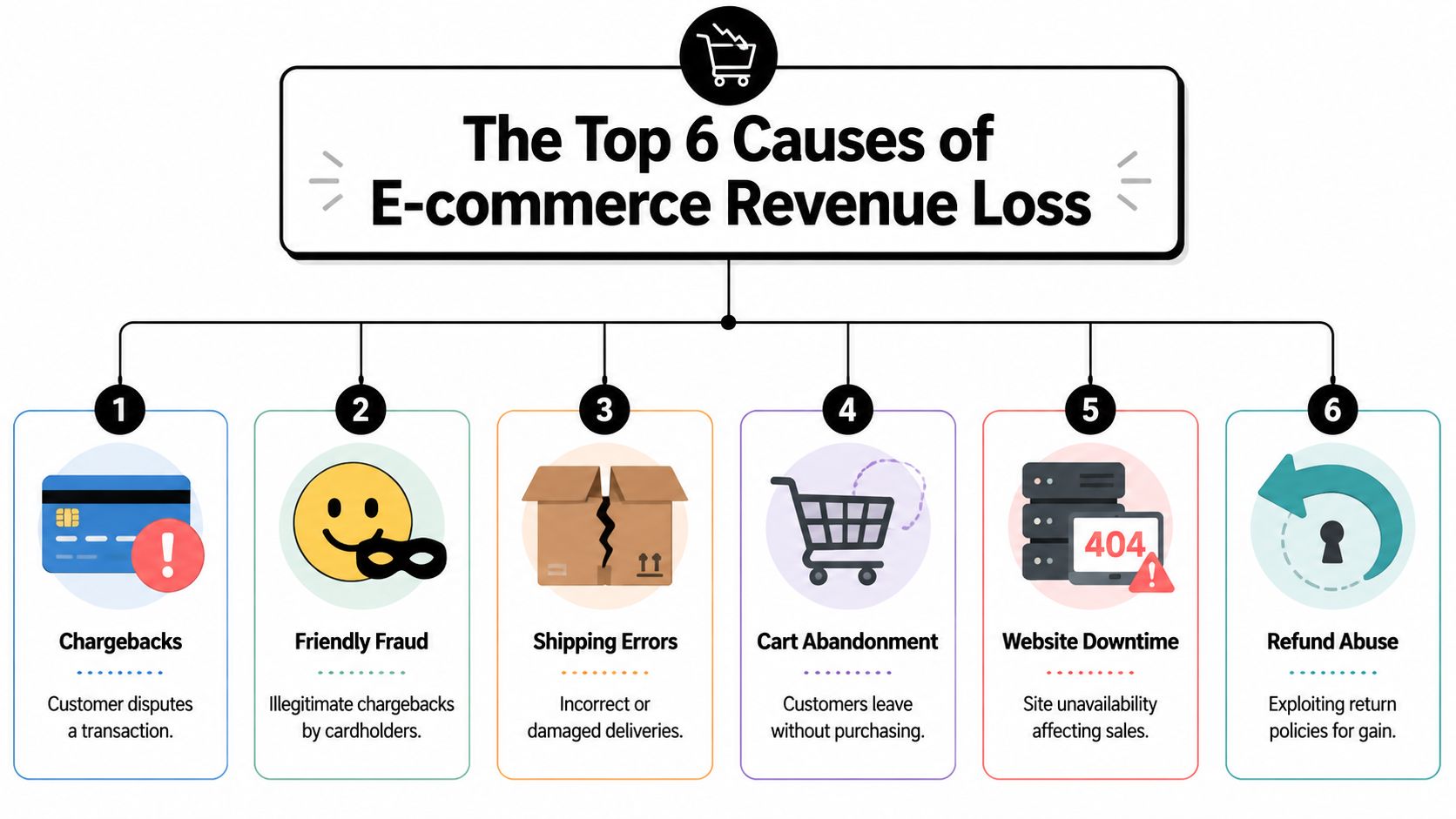
The Top 6 Causes of E-commerce Revenue Loss
The biggest leaks aren't mysterious. They're familiar. The problem is that merchants normalize them.
Chargebacks
This is the most expensive leak because it hits multiple times. You lose the sale, you may lose the inventory, you absorb fees, and you spend time gathering evidence.
A common Shopify scenario looks like this: the order clears, fulfillment ships fast, tracking shows delivery, then the cardholder disputes the transaction anyway. If you don't respond correctly and on time, the money is gone.
Friendly fraud
Friendly fraud is when the cardholder files a dispute on a purchase they made or received. It often hides behind confusion, buyer's remorse, subscription complaints, or “I don't recognize this” claims.
This is why generic customer service scripts don't solve the problem. Friendly fraud needs evidence, pattern recognition, and a fast representment workflow.
True criminal fraud
This is the classic stolen card problem. Fraudsters place orders, often target fast-shipping products, and leave you with a guaranteed loss once the cardholder notices.
The hard part is balance. If you tighten fraud rules too aggressively, you block good buyers. If you loosen them, fraud gets through. That's why fraud review has to be connected to payment, shipping, and post-purchase behavior, not handled in isolation.
Refunds and returns
Returns are normal. Return abuse is not.
Some stores create their own loss of revenue by writing loose policies, approving exceptions too freely, or failing to track why items come back. If one SKU gets hit with repeated “not as described” complaints, that's not a returns issue. That's a merchandising or product page issue.
For practical ways to recover more sessions before they disappear, these ecommerce CRO strategies are worth reviewing alongside your returns and checkout data. Better conversion only matters when the revenue you win is retained.
Operational and pricing errors
Bad data breaks revenue. According to industry estimates cited by IBM, bad data costs U.S. companies $3.1 trillion annually, and Great Expectations cites a case where Unity lost $110 million in revenue after corrupt training data poisoned its ad-targeting algorithms (Launch Consulting on the hidden costs of bad data). That's an extreme example, but the lesson is straightforward. Small data integrity failures create very real financial damage.
For a Shopify merchant, that can mean:
- Broken variant pricing that undercharges on certain combinations
- Incorrect inventory syncs that oversell unavailable products
- Discount stacking that support didn't intend
- Tax or shipping logic errors that force manual fixes after the order
Fulfillment and shipping issues
A late package, damaged item, or wrong delivery doesn't always show up first as a shipping problem. It often returns as a refund request or chargeback.
If your warehouse mistake turns into a dispute, that's not a fulfillment metric. That's recovered revenue you never got the chance to keep.
You should also treat abandonment as a leak, especially when the cause is operational friction rather than shopper intent. If you haven't reviewed that recently, this breakdown of how to reduce cart abandonment gives you a useful lens for spotting friction that blocks revenue before payment even happens.
Using Metrics to Find and Measure Revenue Leaks
You can't fix what you're still describing with vague words like “too many” or “kind of high.”
Start with a simple scorecard. Not a giant dashboard. Just a handful of numbers you review every week.

Four store metrics worth tracking
Use these formulas:
- Chargeback rate = chargebacks / total orders
- Refund rate = refunded orders / total orders
- Return rate by SKU = returned units for SKU / sold units for SKU
- Average realized revenue per order = net revenue / total fulfilled orders
None of these need complicated tooling to start. Shopify reports, your payment provider, and your help desk can usually give you enough to build the first version.
A useful companion to this work is stronger transaction monitoring solutions, especially when fraud signals, order review, and disputes are spread across different systems.
What the warning signs actually look like
Structural revenue loss is often visible before it becomes a crisis. Industry analysis notes that if two or more indicators are present, such as effective fees drifting below list pricing, widespread undocumented discounting, or heavy manual intervention in billing, the loss is almost certainly systemic rather than incidental (The Wealth Mosaic on structural revenue loss warning signs).
That matters for Shopify stores because the same pattern shows up in slightly different language:
| Metric signal | Likely leak |
|---|---|
| Net revenue per order keeps dropping | Discount sprawl, refunds, or product mix deterioration |
| Support team issues lots of one-off credits | Product expectation or fulfillment inconsistency |
| Orders need manual review after payment | Fraud controls are weak or poorly tuned |
| Month-end reconciliation is messy | Data, billing, or exception handling is broken |
Here's a practical walkthrough that complements this process:
Track leaks by workflow, not just by department. A chargeback may start in marketing, show up in support, and finish as a finance write-off.
Build a weekly revenue health review
Keep it short. Ask these questions every week:
- Which SKUs generated the most refunds or disputes?
- Which acquisition channels produced the worst post-purchase outcomes?
- Where did the team intervene manually most often?
- Which payment, shipping, or return exceptions repeated?
Once you can answer those consistently, loss of revenue stops being a fuzzy complaint and becomes a list of fixable causes.
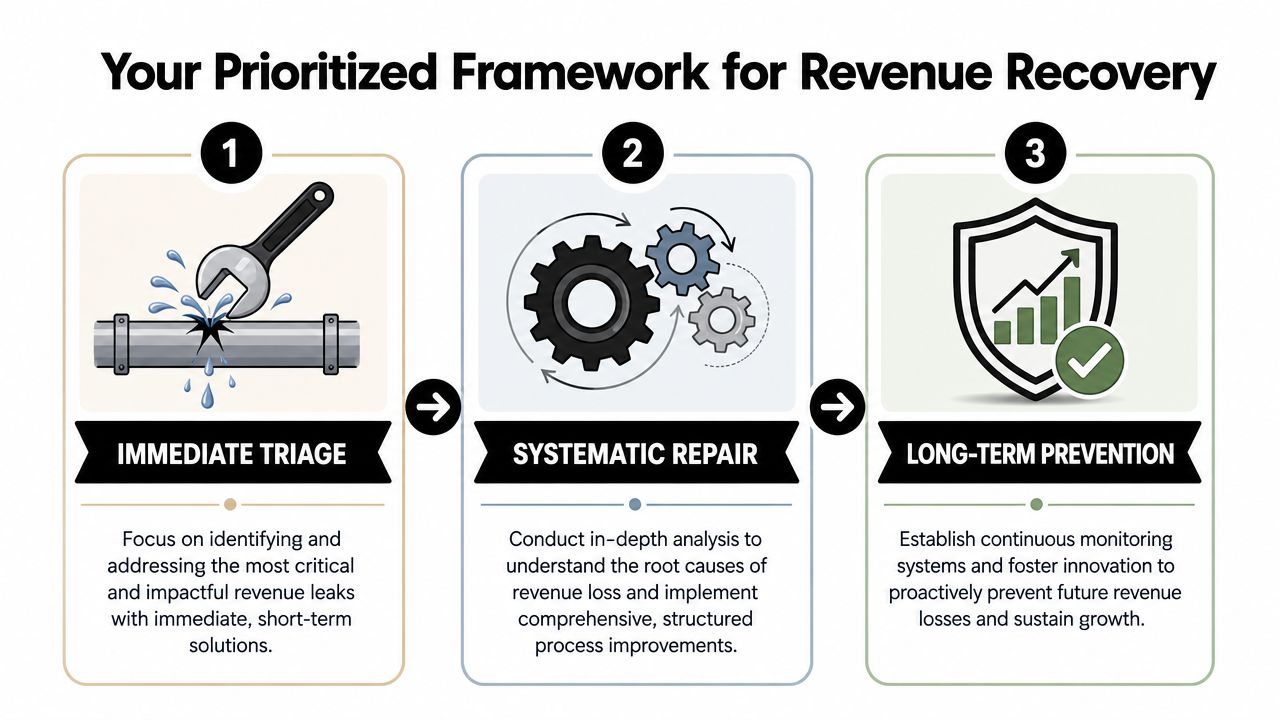
Your Prioritized Framework for Revenue Recovery
Not every leak deserves equal attention. If you treat everything as urgent, nothing gets fixed fast enough.
Global tax abuse causes an estimated $480 billion in annual revenue losses, and the Tax Justice Network says that if current rules don't change, countries are on course to lose about $4.8 trillion over the next 10 years (Tax Justice Network State of Tax Justice 2023). The lesson for a Shopify store is obvious. Small leaks left alone become massive cumulative losses.
Stage 1 Immediate triage
Start where money can come back fastest.
For most Shopify stores, that means chargebacks first. A product page rewrite may reduce future returns. A warehouse process fix may help next month. Winning a dispute can put recoverable revenue back into your business on a much shorter timeline.
Do this immediately:
- Pull every open dispute and sort by deadline
- Group claims by reason code so you see patterns
- Match each dispute to proof like delivery, customer communication, usage, and policy acceptance
- Escalate repeat offenders and note customer history
If your team is still handling disputes ad hoc in inboxes, fix that before anything else.
Stage 2 Systematic repair
Once the biggest leak is under control, go upstream.
You clean up the causes behind refunds, reshipments, cancellations, and fraud losses. You're not chasing isolated incidents now. You're correcting recurring process failures.
Focus on a few high-impact fixes:
| Repair area | Action |
|---|---|
| Product pages | Tighten descriptions, sizing guidance, and delivery expectations |
| Promotions | Remove conflicting discounts and test checkout logic |
| Fraud review | Create clear approval, hold, and cancel rules |
| Returns | Tag reason codes and review repeat abuse patterns |
| Fulfillment | Audit wrong-item, late-shipment, and damaged-order trends |
Working rule: If the same customer complaint shows up every week, your policy is not the problem. Your process is.
Stage 3 Long-term prevention
In this scenario, mature operators separate themselves from reactive ones.
You need systems that make leaks harder to create in the first place. That means cleaner data, fewer manual overrides, tighter exception handling, and regular review of payment, shipping, and support workflows.
A durable prevention setup usually includes:
- Standardized reason codes across refunds, returns, and disputes
- Monthly pricing audits to catch logic errors early
- Fraud threshold reviews based on actual order outcomes
- Carrier performance reviews tied to customer complaints
- A single owner for revenue leakage reporting
Don't try to perfect everything at once. Recover cash first. Repair root causes second. Build prevention around the patterns you've already proved are hurting you.
Essential Tools and Practices for Shopify Merchants
A lot of revenue recovery advice falls apart at the implementation stage. The checklist sounds good. Then your team runs into capacity, messy data, and disconnected apps.
That's why I prefer a simple comparison. Manual processes give you control, but they also create inconsistency. Automated systems remove repetitive work and force a cleaner workflow.

What merchants should do manually
Some work still belongs with your team:
- Review return reasons weekly so bad SKUs and misleading product pages surface quickly
- Audit discount behavior after every campaign
- Check order notes and customer timelines on suspicious purchases
- Use Shopify Flow to trigger alerts for high-risk order combinations or repeat refund behavior
Revenue loss isn't always about demand. In healthcare, some specialties saw revenue declines near 40% after rule changes affected out-of-network payments, with initial payments often only 10% to 15% of billed charges (HFMA on access, coverage, and revenue constraints). For merchants, the parallel is clear. Payment rules, gateway constraints, and dispute workflows can limit realized revenue even when customer demand is healthy.
Where automation pays off
Disputes are the clearest example. Manual chargeback handling usually means someone exports order data, searches emails, grabs tracking, writes a response, and hopes they met the deadline. That process is slow and uneven.
Tools should reduce that burden. For fraud prevention specifically, this guide to ecommerce fraud prevention is a good reference for tightening controls before bad orders become disputes.
One option inside the Shopify ecosystem is ChargePay. It's an AI-powered chargeback management app for Shopify that reports a 92.4% win rate, has handled 200K+ cases, and recovered $10.8M+ for merchants. It generates representment evidence, detects friendly fraud, submits responses before deadlines, and uses a pay-per-win model. It also has a 4.9-star rating and a Built for Shopify badge.
That doesn't replace good operations. It handles one of the most recoverable leaks at scale, which is exactly what a tool should do.
Winning Chargebacks Is Your First and Best Move
If your store has multiple leaks, you still need a priority order.
Fixing product pages is smart. Tightening fulfillment is smart. Cleaning up pricing logic is smart. But those projects usually take time before you feel the cash impact. Chargebacks are different. They're direct, visible, and recoverable if you act fast and present the right evidence.
That's why I push merchants to start there. Chargebacks combine revenue loss, inventory loss, fee pressure, and operational drag in one problem. Solving them improves cash recovery and reduces noise across support, finance, and ops.
You should also get more serious about transaction data quality. If your stack can't clearly tie an order, payment event, customer identity, and dispute together, your team will stay stuck in manual research. Tools like a transaction identification API show why structured transaction data matters so much when you're investigating fraud, reconciling orders, or building dispute evidence.
The fastest way to reduce loss of revenue is to recover money that should never have left your business in the first place.
If you're still letting chargebacks age in a queue, you're choosing the slowest path back to profitability. Start with representment. Build a repeatable workflow. Then keep tightening the upstream causes.
For a deeper look at what strong responses require, review this guide on chargeback representment. It's the operational side of revenue recovery that too many stores ignore until the losses stack up.
If chargebacks are draining your Shopify store, install ChargePay from the Shopify App Store. It's built specifically for Shopify merchants, carries a Built for Shopify badge, holds a 4.9-star rating, and handles the dispute workflow from evidence collection to submission. If you want the fastest path to recovering lost revenue, start there.


.svg)



.svg)


.svg)
.svg)
.svg)