

Think of a Merchant of Record (MOR) as the official, behind-the-scenes seller for every single transaction your customer makes. It's the legal entity responsible for the entire financial journey of a sale—from the moment a customer clicks "buy" to handling all the messy legal and tax stuff that comes with it.
What Is a Merchant of Record

Imagine you’re building a house. You could hire the plumbers, electricians, and framers yourself, pulling permits and juggling payments for each one. Or, you could hire a general contractor to manage everything. You focus on the design, while the contractor handles the complex, legally required parts of the build.
A Merchant of Record is the general contractor for your online store. While you're busy creating great products and marketing them, the MOR is the one legally selling those products to the end customer. This means their name appears on the customer’s credit card statement, and they’re the ones on the hook for all the financial liabilities.
This is a huge step up from a simple payment processor. A payment processor just moves money from point A to point B. An MOR, on the other hand, takes on the full legal responsibility for the transaction. It's the difference between hiring a courier to deliver a package and bringing in a full-service logistics firm that also handles customs, insurance, and import duties.
If you want to dive deeper into these roles, check out our guide on the differences between a merchant account vs a payment gateway.
The Core Duties of an MOR
So, what does a Merchant of Record actually do? Their responsibilities are pretty extensive, covering every financial and legal angle of a sale. Instead of you having to manage dozens of different vendors and regulatory bodies, the MOR handles it all under one roof.
Here’s a quick rundown of what they take off your plate:
- Payment Processing: Securely managing and processing all credit card and alternative payments.
- Global Tax Compliance: Calculating, collecting, and remitting sales taxes, VAT, and GST in every single jurisdiction where you sell.
- Regulatory Adherence: Making sure every transaction complies with local and international laws, including PCI DSS standards for data security.
- Liability Management: Dealing with customer billing questions, refunds, and the financial risk that comes with chargebacks and fraud.
A Merchant of Record essentially acts as a reseller. It buys the product from you and sells it to the end customer, instantly taking on the legal and financial burden of the transaction so you don't have to.
To really get why offloading these tasks is so critical, it helps to understand the bigger picture of how to start an ecommerce business. That framework makes it crystal clear why handing off these complexities becomes a lifesaver as you grow.
The table below breaks down these key responsibilities into a simple summary.
Core Responsibilities of a Merchant of Record
In short, the MOR steps in to handle the operational headaches, freeing you up to focus on what you do best: growing your business.
The Hidden Workload of a Merchant of Record

On the surface, selling online seems simple enough. A customer clicks "buy," you ship the product, and the money lands in your account. But dig a little deeper, and you’ll find a massive, often invisible, amount of work humming beneath that single transaction.
When you act as your own Merchant of Record (MOR), you’re not just a seller. You’re also a global financial manager, a tax law expert, and a compliance officer—all rolled into one. This "hidden workload" is the real reason MOR services exist. It’s about much more than just plugging in a payment gateway; it’s about managing the entire financial system that makes a sale legal and possible.
Juggling Payments and Banks
The first layer of complexity is handling the payments themselves. As the MOR, you're the one building and maintaining relationships with multiple banks and payment gateways. This isn't a set-it-and-forget-it task. It means constantly negotiating processing fees, managing settlements in different currencies, and ensuring every part of your system is secure.
Think about it: if you want to sell to customers in Europe, you’ll need to accept SEPA direct debits. In the Netherlands, iDEAL is practically mandatory. Every new market demands a new set of payment relationships and technical integrations. This is where a smart payment orchestration platform becomes a lifesaver, helping to manage the chaos as you piece together your own payment stack.
Getting Through the Maze of Global Tax Compliance
This is where the real headaches begin for most businesses. As the legal seller, the MOR is on the hook for calculating, collecting, and remitting taxes for every single sale, everywhere. Tax laws aren't just complicated; they're a moving target, varying wildly from one country, state, or even city to the next.
Imagine trying to manage these real-world scenarios on your own:
- Selling into the EU: You have to handle Value Added Tax (VAT). The rate changes depending on the customer's country and whether you’re selling a physical product, a digital good, or a subscription service.
- Selling across the U.S.: You’re suddenly dealing with a tangled web of state, county, and city-specific sales tax laws. A customer in Chicago might pay a completely different rate than someone living just a few miles away in a different zip code.
- Expanding into Canada: Get ready to juggle GST, HST, PST, and QST, all depending on the province. Each has its own rules, filing requirements, and thresholds to track.
Getting any of this wrong can bring on severe penalties, back-tax bills, and audits. A dedicated MOR has teams of experts whose entire job is to keep up with these regulations so you don't have to.
Being the Merchant of Record means you are the one signing the tax forms and bearing the full legal responsibility if something is incorrect. It's a level of accountability that many businesses aren't prepared for.
The Weight of Compliance and Financial Risk
Beyond taxes, there's a whole world of other regulations. The MOR has to make sure every transaction meets standards like PCI DSS (Payment Card Industry Data Security Standard) to protect customer card data. This involves regular security audits and maintaining a secure network—a significant technical and financial undertaking.
Then there’s the direct financial risk of refunds and chargebacks. When you're the MOR, you are 100% liable for every single dispute. This is a massive challenge, especially with the rise of "friendly fraud," where customers dispute legitimate charges. For a business selling internationally, this burden can quickly spiral into a crisis.
Chargebacks aren't just a minor cost of doing business. They are projected to cost e-commerce merchants $33.79 billion in 2025, and friendly fraud is responsible for around 75% of all cases. Even worse, for every dollar lost to fraud, U.S. merchants actually lose $4.61 in associated costs like fees and operational overhead.
Ultimately, the hidden workload of being a Merchant of Record is a full-time job. It demands deep expertise in finance, law, and technology—expertise that most entrepreneurs would rather put toward building amazing products and growing their brand.
Choosing Your Path: MOR vs. Payment Processor
When it comes to handling your online sales, you’re standing at a fork in the road. One path has you becoming your own Merchant of Record (MOR), and the other involves bringing on a third-party MOR service. While both get you to the same destination—getting paid—the journey couldn't be more different.
Picking the right path is a massive financial decision for your business. It determines who's legally on the hook for each sale, who deals with the taxman, and ultimately, how much control you keep versus how much operational grunt work you hand off.
Acting as Your Own Merchant of Record
If you're using a standard setup like Shopify Payments or Stripe, guess what? You're already acting as your own Merchant of Record. This is the default route for most e-commerce businesses starting out, and it means you are the legal seller in every single transaction.
In this model, you call all the shots. You own your customer relationships, you set your own return and refund policies, and you have direct access to every bit of transaction data. The money runs through a payment processor, but from a legal standpoint, you're the one making the sale.
But with great control comes great responsibility. You're solely liable for everything that comes with selling online: calculating and remitting sales taxes, staying PCI compliant, and eating the full financial cost of every refund and chargeback. It’s the ultimate DIY approach to running a global store.
Being your own MOR is like being the captain of your own ship. You have the freedom to steer it wherever you want, but you're also the one responsible for navigating storms and fixing any leaks that spring up along the way.
Figuring out whether to act as your own MOR or lean on a payment processor is a serious financial strategy, one that often needs an expert eye. For scaling startups moving beyond the 'winging it' phase, bringing in fractional CFO services can offer the high-level financial guidance needed to weigh these complex choices and their long-term impact.
Using a Third-Party Merchant of Record
The other path is to team up with a third-party MOR service. In this setup, the MOR provider basically becomes a reseller of your products. For a split second, they legally buy your product from you and then immediately sell it to your customer.
It sounds simple, but that tiny legal step shifts all the liability from your shoulders onto theirs. The MOR's name shows up on the customer's credit card statement, and they become responsible for all the messy, complicated backend work.
So, what exactly does a third-party MOR handle?
- Global Tax Collection: They figure out, collect, and send off all the right sales taxes, VAT, and GST in every country you sell to.
- Compliance and Regulations: They keep up with PCI DSS and all the other international payment rules so you don't have to.
- Payment Processing: They manage all the relationships with banks and payment gateways around the world.
- Dispute Liability: They take on the financial risk that comes with fraud and chargebacks.
This model is built to make your life easier, especially as you start selling across borders. You trade a bit of direct control (and pay a fee for the service), but you get to shed a massive administrative and legal headache. If you're looking to get a better handle on how all the pieces of the payment puzzle fit together, you can learn more about what a payment processor is in our detailed guide.
Comparing MOR Models: You vs. A Third-Party Service
To make this choice crystal clear, let's lay out the key differences side-by-side. Getting a grip on these trade-offs is crucial for deciding which model fits your business goals, your resources, and your appetite for risk.
At the end of the day, the decision boils down to a simple trade-off: control vs. convenience. Acting as your own MOR gives you total control but requires a ton of resources to manage all the risks. A third-party MOR, on the other hand, offers a hands-off solution that lets you focus on your product—but it comes at the cost of a higher fee and less direct say over the financial transaction itself.
When Should You Use a Third-Party MOR Service?
So, how do you know if it's time to hand off your financial operations to a Merchant of Record (MOR)? This isn't just a technical decision; it's a strategic one. It all boils down to your business goals, how much risk you're comfortable with, and where you want to focus your time and energy. For many online businesses, an MOR is the key that unlocks global growth without the operational headaches.
Figuring out whether to stick with the default DIY model or partner up with a third-party MOR service really comes down to a few critical questions. Answering them honestly will point you down the right path for your business.
Scenarios That Basically Scream "Use a Third-Party MOR"
Certain business situations almost demand a third-party MOR. If you find yourself nodding along to any of these, it’s a strong sign that offloading these responsibilities could be a complete game-changer.
You're Expanding Internationally: This is the big one. The second you start selling across borders, the complexity just explodes. A third-party MOR already has the entire infrastructure to handle different currencies, local payment methods, and the tangled mess of tax laws in dozens of countries. If you're planning a global push, our deep dive into cross-border e-commerce can give you more context on what you're up against.
You Sell Digital Products or Subscriptions: Digital goods are a magnet for complicated tax rules. VAT, GST, and sales tax laws for software, SaaS, and digital downloads change all the time and vary based on your customer's location. A dedicated MOR manages this intricate web of regulations so you can sell worldwide without needing a degree in international tax law.
You Want to Minimize the Admin Grind: Let's be real—managing financial compliance, haggling with payment processors, and filing tax forms is a massive time sink. If you'd rather pour your limited resources into product development and marketing, an MOR service takes that entire mountain of work off your plate.
This decision tree gives you a visual on the key questions that guide you toward either owning your MOR responsibilities or using a third-party service.

As the chart shows, the more complex your sales—especially across borders—the more a third-party MOR with its built-in compliance shield starts to look like a really smart move.
When Being Your Own MOR Makes Sense
On the flip side, acting as your own Merchant of Record is perfectly fine in some cases. If your business operates under simpler conditions, the extra control and lower direct fees of the DIY model can be a better fit.
Consider staying as your own MOR if:
- You only sell in one country with simple tax laws.
- You have an in-house team that can handle finance, tax, and compliance.
- Keeping absolute control over your brand name on credit card statements is a top priority.
The Chargeback Liability Question
A huge factor in this decision is liability. When you act as your own merchant of record, you're the one legally on the hook for everything, dealing directly with banks and card networks. This leaves you completely exposed to chargebacks.
Globally, chargeback volumes blew up to 238 million in 2023, costing merchants a staggering $117.47 billion. And it's not slowing down—projections show this hitting 337 million cases by 2025, a surge driven by online "card-not-present" sales.
The fundamental question is this: Do you want to build and manage a global financial compliance department, or do you want to focus on your core product? Your answer will point you directly to the right MOR model.
Ultimately, choosing a third-party MOR is about trading a percentage of your revenue for peace of mind and operational simplicity. It lets you scale faster and enter new markets confidently, knowing the complex, high-stakes backend is in expert hands.
How Your Choice of MOR Impacts Chargebacks
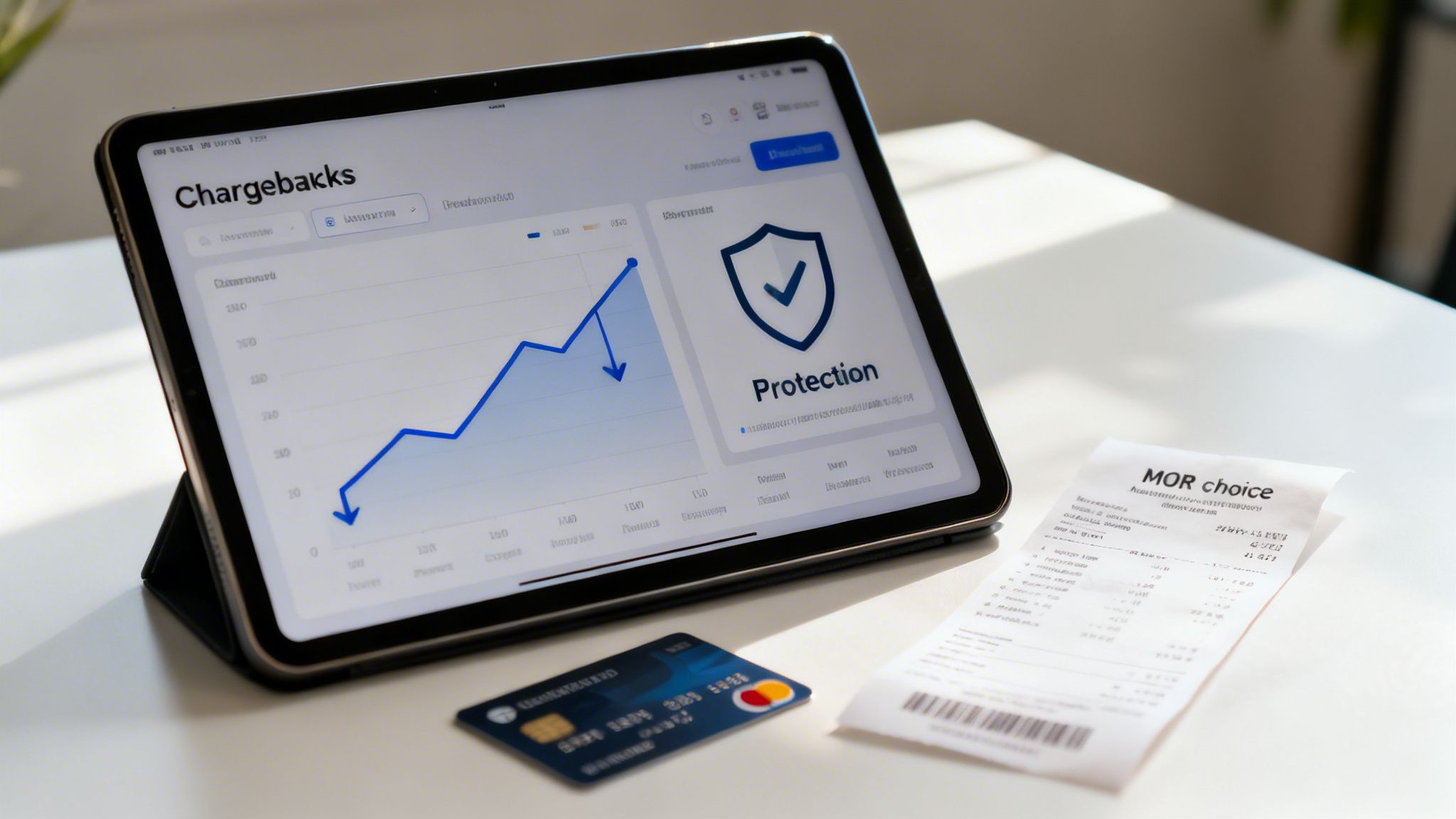
Choosing your merchant of record (MOR) model is far more than just an operational box to tick—it's a critical financial decision. It directly answers one very important question: who is on the hook when a customer files a chargeback? In e-commerce, that liability can feel like a heavy weight.
When you act as your own MOR, which is the default for most businesses on platforms like Shopify or PayPal, you are 100% legally and financially responsible for every single dispute. The customer’s bank doesn't see your platform; it sees your business.
This means every dollar lost, every fee paid, and every bit of effort spent fighting a dispute comes straight from your bottom line. It puts you on the front lines of a problem that is only getting bigger, fueled by a perfect storm of sophisticated fraud and changing customer habits.
The Harsh Reality of Self-MOR Liability
Being your own MOR means you’re weathering the global chargeback storm all by yourself. The financial stakes are climbing fast. Dispute volumes jumped from 265 million in 2022 and are on track to hit a staggering 337 million by 2025.
Add to that the fact that online fraud is expected to spike 15% to $48 billion in 2024, with the average chargeback costing a merchant $169.13. The total damage to your business can be devastating. What makes it worse? 52% of customers don’t even bother contacting the merchant; they go straight to their bank to file a dispute.
For stores on Shopify and PayPal, where merchants are their own MOR, this is a huge deal. A shocking 84% of customers admit they prefer the ease of filing a chargeback, often not realizing it's different from a simple refund. This misunderstanding is a primary driver of friendly fraud, which now makes up as much as 70% of all chargebacks.
When you are your own Merchant of Record, you aren't just selling a product; you are underwriting the risk of every single transaction. In the face of rising friendly fraud, that's a gamble many businesses can't afford to lose.
The odds are stacked against merchants who try to fight these disputes manually. The process is a grind—it's time-consuming, requires very specific evidence, and follows rigid, unforgiving rules set by the card networks. Because of this, merchants who go it alone often see painfully low win rates, forcing them to write off a huge chunk of revenue as just another cost of doing business.
Creating an Automated Defense System
Just because you're your own MOR doesn't mean you have to fight this battle alone and unarmed. You hold the liability, yes, but you can build a powerful defense system to protect your revenue. The key is to stop reacting manually and start automating.
This is where specialized tools become non-negotiable. By integrating an AI-powered automation platform directly into your Shopify, PayPal, or Stripe setup, you can create a hands-free system that fights illegitimate chargebacks for you. It’s like having a team of dispute experts working 24/7, without the overhead.
How Automation Turns the Tide
An automated chargeback solution completely changes the game. Instead of you spending hours digging up evidence and writing responses, an AI-powered system can do it all in seconds.
Here’s how it works to protect your revenue:
- Instant Integration: The tool plugs right into your payment platforms, like Shopify or Stripe. It gets real-time alerts the moment a new chargeback is filed.
- AI-Powered Evidence Generation: The system instantly analyzes transaction data, customer history, and other key details to build a rock-solid evidence packet tailored to the specific dispute reason code.
- Automated Representment: It then submits the professionally crafted response on your behalf, hitting all the strict deadlines set by the card networks.
This isn't just about saving time. It dramatically boosts your win rate because the AI is trained on thousands of successful disputes. It knows exactly what evidence to include and never misses a deadline. It effectively turns a losing battle into a stream of recovered revenue.
For businesses acting as their own MOR, this automated layer is no longer a nice-to-have—it's a necessity. It’s the most effective way to manage the risk that comes with your MOR model while recovering money that would otherwise be gone for good. To see how you can better safeguard your business, check out our complete guide on merchant chargeback protection. Taking proactive steps now means you can manage your liability with confidence and keep your hard-earned cash.
Frequently Asked Questions About Merchant of Record
Jumping into the world of online payments can feel like you’re learning a whole new language. To clear up some of the fog, let’s tackle the most common questions people have about the Merchant of Record (MOR) model. This is your quick-reference guide to make sure everything we've covered really clicks.
Is Stripe the Same as a Merchant of Record?
This is a classic point of confusion, and the short answer is no. While they often work hand-in-hand, a payment processor like Stripe and a Merchant of Record have completely different jobs.
Think of it this way: if you’re hosting a huge party, Stripe is the security guard at the door. Their job is specific and crucial—they check the IDs and make sure the right people (the money) get from your customer’s bank to your bank, safely and securely.
A full-service Merchant of Record, on the other hand, is the event planner. They don't just watch the door. They’re responsible for booking the venue (making sure you’re legally compliant), paying the catering tax (handling sales tax), and dealing with any complaints after the party (managing chargebacks).
- Stripe (Payment Processor): Simply moves the money. You are still the legal seller, which means you’re on the hook for taxes, compliance rules, and any disputes that come up.
- Third-Party MOR: Steps in to become the legal seller for the transaction. The MOR takes on all the liability for taxes, compliance, and disputes for you.
So, when you use Stripe by itself, you are your own Merchant of Record.
Does Using Shopify Payments Make Shopify My MOR?
Another great question that gets right to the heart of how this all works. Just like with Stripe, the answer here is also no. When you use Shopify Payments, you are still your own Merchant of Record.
Shopify gives you an amazing platform—the digital storefront, the shopping cart, and the payment pipeline via Shopify Payments. But at the end of the day, it's your business name on the dotted line for every single sale. You're the one who has to figure out sales tax, send it to the right government agency, and absorb the financial hit from chargebacks.
Think of Shopify as the landlord of a beautiful, fully equipped storefront in a prime location. They provide the physical space and the cash register, but you’re the one running the shop inside. That means you're responsible for your own business taxes and handling any customer complaints.
A third-party MOR, to continue the analogy, would be more like a consignment shop. They sell your products for you, handling the entire transaction from start to finish.
Can I Switch From Being My Own MOR?
Absolutely. In fact, it’s a very common path for growing businesses. Most companies start out as their own Merchant of Record because it’s the default setting on platforms like Shopify or when you sign up with Stripe. It’s simple and gets you selling quickly.
But as a business expands, especially into other countries, the weight of managing global tax laws, different compliance standards, and chargeback liability can become a huge operational headache.
Making the switch to a third-party MOR is a strategic move to offload that complexity and risk. The process usually involves partnering with a provider that plugs into your existing e-commerce setup. They become the official reseller of your products, lifting that entire financial and legal burden right off your shoulders.
This shift allows you to:
- Launch in new global markets almost overnight, without the pain of setting up local business entities.
- Forget about the nightmare of calculating and remitting international taxes like VAT and GST.
- Transfer the financial liability for fraud and chargebacks over to the MOR provider.
Switching is often a sign of a business that’s ready to level up. It frees you to focus your time and money on what you do best—improving your products and marketing—instead of getting bogged down in global financial regulations.
Ready to stop losing money to illegitimate chargebacks? ChargePay uses AI to automate the entire dispute process, recovering up to 80% of lost revenue without any manual work. Protect your profits and focus on growth by visiting https://www.chargepay.ai to get started.


.svg)



.svg)


.svg)
.svg)
.svg)