

Behavioral analytics tracks event-level user actions like clicks, sign-ups, page views, and device changes to explain why customers behave the way they do, not just what your traffic report says happened. It has grown into a $1.5 billion market in 2025, projected to reach $7.63 billion by 2034 according to Fortune Business Insights on the behavioral analytics market, because businesses need better ways to catch fraud, reduce friction, and make smarter decisions from user behavior.
If you run a Shopify store, this matters for a simple reason. A chargeback often looks clean on the surface. The order passed checkout, the address looked plausible, and the customer didn't trigger any obvious rule. Then weeks later, you get hit with an “unauthorized” claim.
Basic analytics won't help much here. Traffic stats tell you visits, sessions, and conversion rate. Behavioral analytics looks at the why behind a session: the clicks, scrolls, pauses, page sequence, checkout timing, and device behavior that tell you whether a real buyer was shopping normally or whether something felt off. For chargebacks and friendly fraud, that's the difference between guessing and having a story you can defend.
Why Customer Clicks Matter More Than You Think
A familiar chargeback pattern looks like this. The order goes through, the address passes a basic check, and fulfillment ships on time. Two weeks later, the cardholder files an "unauthorized" claim, and all you have left is an order record that says almost nothing about how that purchase happened.
That is the gap behavioral analytics closes for Shopify merchants. It looks at the session around the order, not just the order itself. A real shopper usually leaves a trail that makes sense: product views, time spent comparing options, a pause on shipping or return information, maybe a cart edit before checkout. Fraud and friendly fraud often leave a different trail. The session may move too fast, skip the normal decision points, retry payment in odd ways, or change customer details at the last minute.
Those click patterns often matter more than the transaction summary.
Surface metrics miss the story
Conversion rate, cart abandonment, and average order value are useful for running a store. They do not explain intent. If a dispute lands on your desk, those numbers will not help you show whether the buyer behaved like a normal customer or whether the session looked off from the start.
Practical rule: If you can only see the final order, you're reviewing fraud with one frame from the movie.
That is why session behavior matters so much in chargeback work. Banks and card networks do not care that an order "looked fine" in Shopify. They care whether you can document a believable purchase journey. Click history, page sequence, checkout timing, and account changes help build that record.
Behavior already drives decisions across e-commerce
Merchants already use shopper behavior to judge what is working on-site. Creative teams test images and layouts by watching how customers respond, not by asking whether an asset exists. If you're comparing merchandising workflows, this guide on how brands compare flatlay to model AI follows the same logic. The useful question is how behavior changes after the customer sees something.
Fraud analysis works the same way. The question is not whether an order was placed. The question is how it was placed, and whether that behavior fits a legitimate purchase.
This also connects directly to checkout friction. Stores with weak visibility into session behavior struggle to tell the difference between a confused customer and a risky one. If you're reviewing where buyers hesitate or drop off, ChargePay's guide on how to reduce cart abandonment is a helpful reference, because many of the same session signals that explain abandonment also help explain disputed orders.
The Core Concepts of Behavioral Analytics
Most explanations of what is behavioral analytics are written for product managers. For a Shopify merchant, the version that matters is simpler. You need to know what happened in a session, what “normal” looks like, and which patterns deserve a second look.
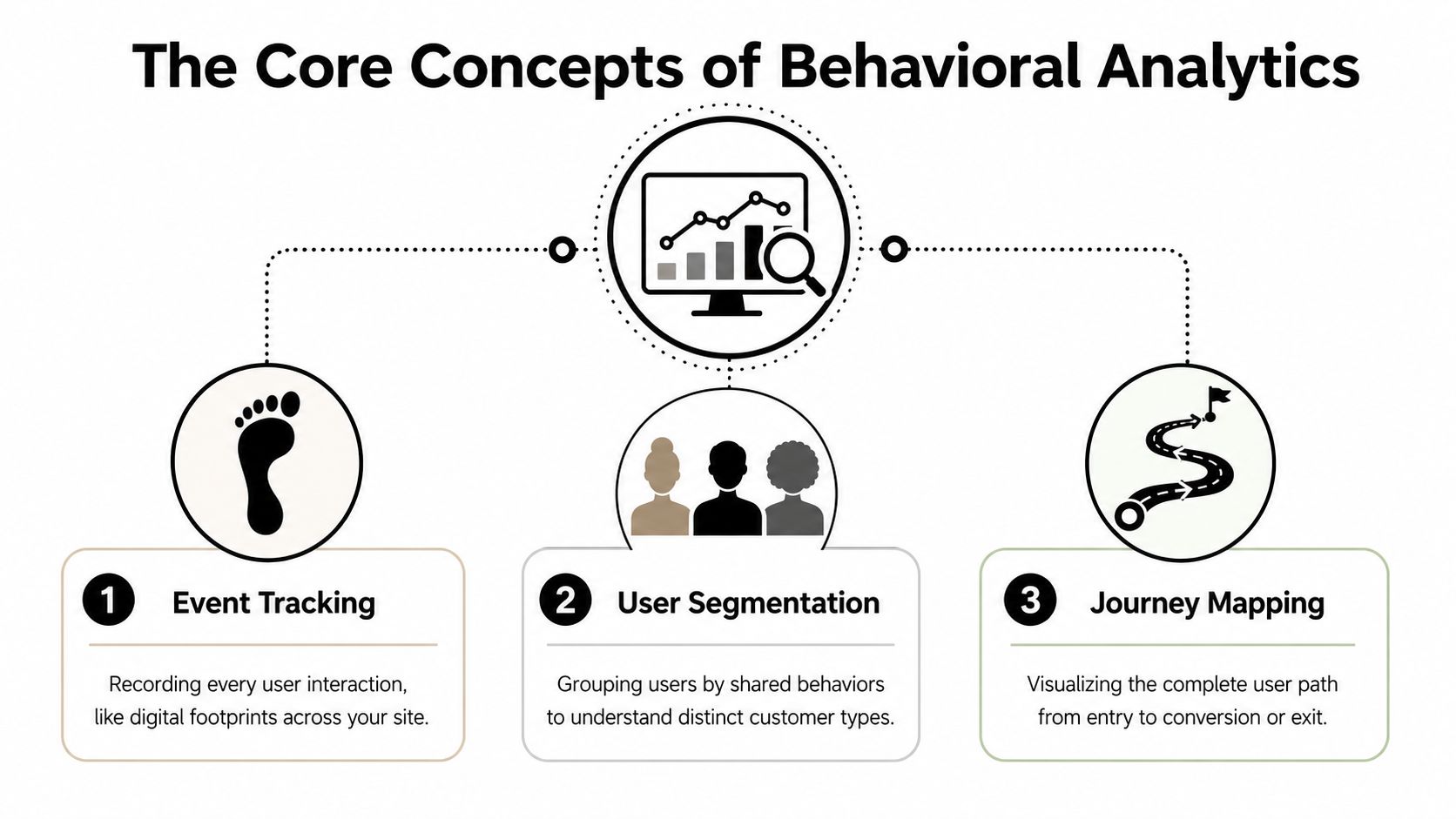
Event tracking is the digital trail
Behavioral analytics starts with event-level actions. Mixpanel describes it as using behavioral data generated by user engagement, such as page views, email sign-ups, clicks, and other important actions, to build cohorts and analyze engagement, conversion, and retention in its guide to behavioral analytics fundamentals.
For a store, think of event tracking as a digital diary:
- Page behavior: Which product pages a shopper viewed, how they moved between categories, and whether they returned to the same item.
- Checkout actions: Added to cart, removed from cart, retried payment, changed shipping details, or edited contact information.
- Session context: Device, browser, login state, referral source, and timing between actions.
A normal analytics dashboard may count the visit. Event tracking captures the sequence.
Behavior modeling means learning what normal looks like
The easiest analogy is a security guard in a building. After enough time, the guard knows what normal looks like. Who arrives when, which doors people use, and which patterns are routine. Suspicion starts when someone behaves outside that baseline.
Behavioral analytics works the same way. Splunk explains that it ties users or entities to time-ordered actions across pages, apps, sessions, and devices, then uses big-data analytics and AI or machine learning to establish baselines and detect anomalies in this breakdown of behavioral analytics.
That matters because fraud usually isn't a single bad event. It's a pattern that doesn't fit.
A fraud review gets stronger when you can show deviation, not just a bad feeling.
For merchants, that could mean a sudden device change before checkout, an unusual navigation sequence, or login timing that doesn't match the account's usual pattern. If you're trying to connect store behavior to payment risk, this is closely related to transaction monitoring for e-commerce payments.
Cohorts and journey maps turn noise into patterns
Once you have events, you group similar sessions together. That's where cohorts come in. A cohort might be repeat buyers, first-time buyers, guest checkouts, or customers who disputed previous orders. Looking at one session is useful. Looking at a pattern across similar sessions is better.
A short comparison helps:
| Concept | Simple meaning | Why it matters for fraud |
|---|---|---|
| Event tracking | Recording each user action | Shows what happened |
| Segmentation | Grouping users with shared behaviors | Shows who behaves similarly |
| Journey mapping | Viewing the path from entry to purchase or exit | Shows where the session felt normal or abnormal |
If you're also cleaning up engagement reporting, a useful side read is redefining bounce rate with GA4. Merchants often inherit old traffic metrics that don't reflect how customers move through a modern store. Fraud analysis has the same problem when teams rely on simplistic rules.
Key Signals That Help Uncover Fraud
A fraudster doesn't usually announce themselves. The useful signs are often small on their own and more convincing when they appear together.
Signals that deserve a second look
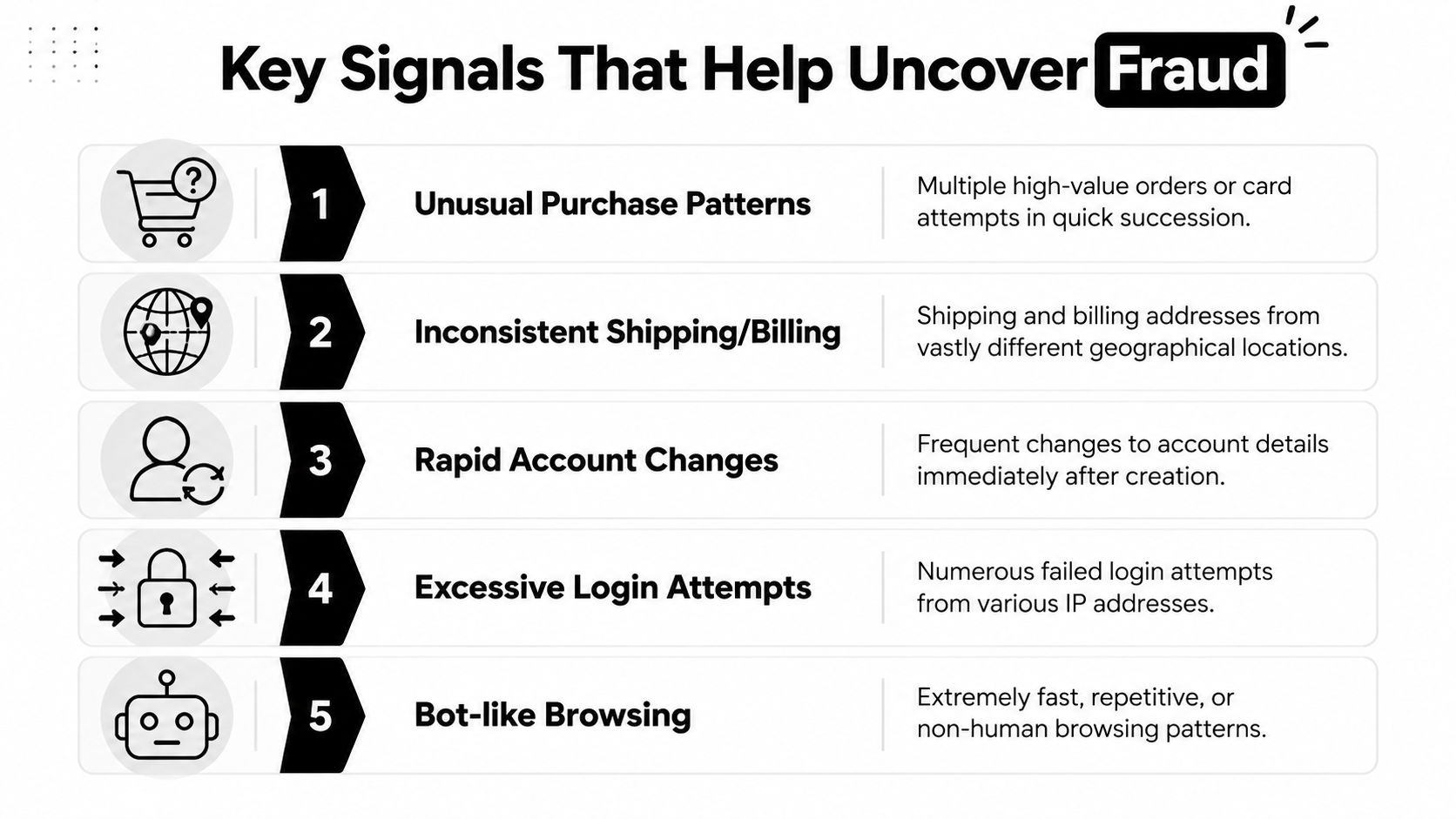
Some patterns show up repeatedly in disputed orders:
- Unnaturally fast navigation: A real buyer usually pauses, compares, scrolls, and checks details. A session that jumps through pages with almost no hesitation can suggest automation, scripted behavior, or a stolen card tester moving quickly.
- Shipping and billing inconsistency: A mismatch doesn't automatically equal fraud, but a large geographic gap combined with other unusual signals raises the review priority.
- New account, urgent buying behavior: Fresh account creation followed by multiple expensive purchases, repeated card attempts, or rushed checkout behavior is worth reviewing.
- Frequent account edits: Changes to email, password, shipping details, or contact information right around checkout can indicate account takeover.
- Device or session shifts: A customer who starts normally and then suddenly appears from a different device or behavior pattern before purchase may not be the same user throughout the flow.
Behavioral analytics isn't limited to website click reports. OpenText notes that it applies across e-commerce, banking, healthcare, insurance, and security, using data from web, app, email, chat, IoT, users, and devices to analyze patterns, trends, and anomalies in its overview of behavioral analytics across business contexts.
Normal behavior versus suspicious behavior
The point isn't to blacklist every unusual order. The point is to compare the session against the kind of path a legitimate buyer usually takes in your store.
What works: combining several weak signals into one review decision.
What doesn't: blocking orders because of one isolated mismatch.
A healthy fraud workflow asks questions like these:
- Did the shopper behave like someone making a considered purchase?
- Did the account history and session history fit together?
- Did the checkout path look human?
- Did the order behavior match the store's normal customer journey?
This short video gives a useful visual on e-commerce fraud patterns and why behavior matters during review:
If you're building a stronger review stack, ChargePay's article on e-commerce fraud prevention is a practical next read because prevention gets stronger when payment signals and session signals are evaluated together.
How Behavioral Data Solves Real E-commerce Problems
The value of behavioral analytics shows up when you stop treating it like a dashboard feature and start using it as evidence.

Friendly fraud gets harder to hide
Take a common dispute reason: “I didn't authorize this purchase.”
If the only records you have are order details and a shipment confirmation, your response is thin. But behavioral data can show that the same user spent time browsing products, viewed sizing or policy pages, added items deliberately, and moved through checkout in a way that looks like a real shopper. That doesn't guarantee a win, but it gives your dispute response a coherent narrative.
A weak case says, “The order was placed.”
A stronger case says, “The customer's session shows intentional shopping behavior before purchase.”
Dispute evidence becomes a timeline, not a pile of screenshots
Winning chargebacks usually comes down to proving legitimacy clearly and fast. Behavioral data helps because it organizes evidence into a sequence.
A useful evidence package may include:
- Session timeline: Product views, cart activity, checkout steps, and account activity in order.
- Identity consistency: Whether device, account, and interaction patterns stayed stable during the purchase flow.
- Purchase intent clues: Time spent on pages, repeat visits to the product, and interaction with shipping or return information.
- Order completion context: Whether the buyer passed routine checks and completed the purchase without signs of confusion or forced entry.
Merchants win more disputes when they can explain the customer's behavior, not just restate the order facts.
This is also where behavioral analytics reaches beyond web clicks. OpenText notes that these methods span web, app, email, and device interactions to infer user intent and risk, which is why the same approach works in e-commerce, banking, and security decisions. In practice, that means a merchant can combine customer journey evidence with account and device context instead of relying on one narrow source.
The same data also protects good customers
Behavioral data isn't only defensive. It can also stop you from treating normal shoppers like criminals.
For example, a repeat customer may check a product several times from different devices, come back through email, and take longer to buy because they're comparing options. A rigid rule engine might flag the order because the pattern looks inconsistent. Behavioral review gives you the missing context. The session still looks human, deliberate, and connected to a real shopping journey.
That balance matters. If your fraud system is too loose, losses rise. If it's too aggressive, you block good orders and create the exact frustration that sends customers to their bank later.
Your Shopify Implementation Checklist
Most Shopify merchants don't need a giant data project. They need a clear way to see behavior, flag suspicious patterns, and preserve useful evidence when an order turns into a dispute.
Ask these questions before you add another tool
Start with your blind spots:
Can you reconstruct a disputed order as a customer journey?
If all you can see is the payment result and fulfillment status, you're missing the most useful part of the story.Can you tell normal hesitation from suspicious speed?
Fraud review gets better when you understand your store's usual browsing and checkout rhythm.Can you connect account, device, and order behavior?
If those signals live in separate tools, your team will struggle to make confident decisions.Can you preserve evidence before it disappears into scattered logs?
Chargeback work often fails because the facts exist, but no one assembled them in time.
Keep the setup practical
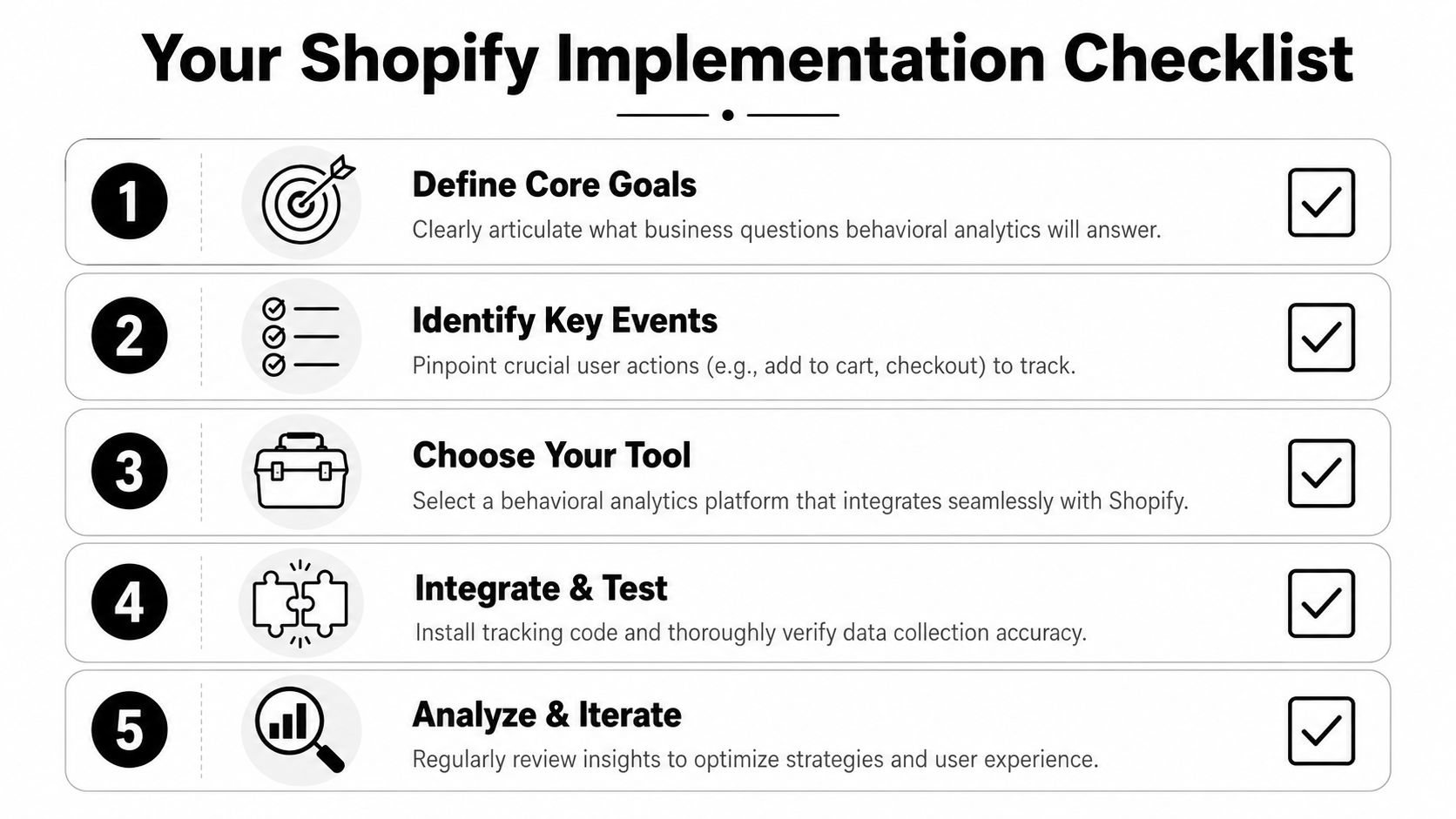
For most stores, implementation should focus on a small set of meaningful events:
- Core commerce events: Product view, add to cart, begin checkout, payment attempt, purchase.
- Account events: Login, password reset, account creation, profile edits, address changes.
- Risk context: Device changes, repeated payment attempts, unusual session paths.
You don't need to track everything. You need to track the events that explain intent.
If you're evaluating tools, look for systems that fit Shopify cleanly and help connect fraud prevention to dispute response. One option is ChargePay's chargeback prevention guide, which also points toward tooling choices for merchants that want to automate review and evidence handling. In practice, merchants often pair store analytics, payment fraud tools, and dispute automation rather than expecting one dashboard to do everything.
Don't ignore privacy and tuning
Behavioral analytics works better than static rules in many fraud situations, but there are trade-offs. CrowdStrike notes that modern behavioral analytics uses machine learning, baselines, anomaly detection, and feedback loops, but it also depends on quality baselines and ongoing tuning in its overview of behavioral analytics versus rule-based systems.
That matters on Shopify because bad implementation creates noise fast.
- Poor baselines create false alarms.
- Messy event tracking creates bad conclusions.
- Overreaction to one signal causes unnecessary declines and support headaches.
A practical setup is usually the one that wins. Clear event tracking, stable baselines, and a workflow for turning behavior into usable dispute evidence.
Stop Guessing and Start Winning Disputes
Manual fraud review breaks once order volume grows. No merchant has time to watch every session, compare every path, and package every dispute by hand. That's why surface-level rules eventually fall short.
Behavioral analytics gives you a better lens. Instead of relying only on fixed rules, modern systems use machine learning to establish baselines, detect anomalies, and catch subtle fraud patterns that static rules can miss while reducing false positives, as CrowdStrike explains in its overview of behavioral analytics. For chargebacks, that means fewer cases where you're left arguing from incomplete order details.
The primary advantage is operational. When a dispute comes in, you need evidence that's organized, credible, and ready before the deadline. If your team is still stitching together screenshots from multiple systems, you're already behind. A more durable workflow connects fraud signals, order context, and customer behavior early, then turns that record into representment material when needed. If you want to see what that process looks like, ChargePay's guide to chargeback representment is a useful place to start.
For Shopify merchants, the practical question isn't whether customer behavior matters. It does. The question is whether you're capturing enough of it to defend your revenue when an order turns into a chargeback.
If you want help turning customer behavior into dispute-ready evidence, ChargePay is a Shopify app built for chargeback management. It has a Built for Shopify badge, a 4.9-star rating, and uses a pay-per-win model, so you only pay when money is recovered. Install ChargePay from the Shopify App Store and let the system handle disputes with the evidence your orders are already creating.


.svg)



.svg)


.svg)
.svg)
.svg)