


A lot of Shopify owners treat returns as a cost of doing business. That's too soft a definition for what's happening. Some returns are normal. Some are customer service issues. Some are outright theft. And when a bad return turns into a payment dispute, it stops being a warehouse problem and becomes a revenue recovery problem too.
That distinction matters because what is return fraud isn't just a logistics question. It's a fraud operations question. If you only think about return fraud at the point of refund, you're already late. By then, the item may be gone, the refund may be out, and the same customer may be lining up a chargeback.
Your Store Is Leaking Money Through Returns
Retailers aren't dealing with a minor edge case. Return fraud accounted for 9% of all returns in 2025, and those returns sat inside a projected $849.9 billion in total returns. Online sales were even more exposed, with an estimated 19.3% return rate according to the NRF 2025 Retail Returns Landscape.
That should reframe the whole issue. If you run a Shopify store, returns aren't just customer experience overhead. They are one of the clearest places where margin slips out of the business.
Why this hits Shopify merchants harder
A growing store usually has three weak points at once. It wants fast approvals, a friendly return policy, and lean operations. Fraudsters know that combination well.
You approve a return quickly to keep support tickets down. Your team doesn't inspect every package the same day. Refund automation kicks in before someone notices the item inside isn't the one that was purchased. Then the customer disputes the original charge anyway.
That's the part many merchants miss. A bad return doesn't always end with the refund. It can become a return item chargeback, an unauthorized claim, or a product-not-as-described dispute after you've already absorbed the inventory loss.
Practical rule: If a return flow can be exploited, some customers will exploit it twice. First through the refund. Then through the dispute.
Returns aren't all bad, but blind trust is expensive
Healthy stores don't try to eliminate returns. They try to separate honest customers from abusive behavior fast. That means looking at return reasons, item condition, timing, and repeat patterns instead of treating every request as routine.
If your return queue feels messy, start by tightening your visibility. A simple review of your most frequent reasons customers ask for returns can show where normal fit-and-quality issues stop and suspicious behavior begins.
What works is controlled flexibility. What doesn't work is instant refunds with weak verification, no item-level checks, and no process for escalating suspicious cases. That's how stores leak money for months.
Understanding Return Fraud vs Policy Abuse
Not every harmful return is the same. Merchants often lump everything together, and that creates bad decisions. You either get too strict with honest buyers or too lenient with repeat abusers.
The useful split is this. Return fraud involves deliberate deception. Policy abuse uses your own rules against you.
Fraud is theft with a return label
A customer sends back a counterfeit version of your product. Or returns something stolen. Or uses a fake receipt to get money or store credit. That's fraud.
Policy abuse looks different. The customer may have bought the item through a real order. They just never intended to follow the spirit of your return policy. They wear the dress once and send it back. They order multiple versions knowing most will come back. They keep doing this because your store keeps allowing it.
According to Fraud.net's overview of return fraud, return fraud involves clear criminal deception like returning stolen goods, while policy abuse or friendly fraud exploits generous policies such as wardrobing. The same source notes that policy abuse often comprises 60-70% of illegitimate returns but is harder to detect.
Why the difference matters operationally
Think of fraud like a pickpocket. The intent is obvious once you spot it. Policy abuse is more like a diner who eats most of the meal, then complains to avoid paying. Both cost you money, but you don't handle them the same way.
For a Shopify merchant, the response should match the behavior:
- Clear fraud calls for strict documentation, account review, and evidence preservation in case the customer files a dispute later.
- Policy abuse calls for rule changes, exception controls, and customer-level restrictions.
- Normal returns should stay easy, because honest buyers shouldn't pay for someone else's behavior.
That middle bucket is where many stores lose control. They keep approving borderline returns because the customer technically followed a published process. Then they get hit again when those same customers move into disputes and friendly fraud. If you want a clean explanation of that overlap, this guide on what friendly fraud means for merchants is worth reading.
A weak return policy attracts abuse. An overly rigid one pushes honest customers away. The job is to separate intent, not punish everyone equally.
A simple way to classify a return
Use this quick lens when a return request comes in:
| Return type | What it usually looks like | Best response |
|---|---|---|
| Criminal fraud | Wrong item, fake item, stolen item, altered proof | Document everything and escalate |
| Policy abuse | Used item, repeated short-term use, chronic high-return behavior | Restrict, flag, and tighten rules |
| Legitimate return | Fits policy, item matches claim, customer history is clean | Process normally |
Stores get better results when they stop arguing about labels and start building workflows around intent.
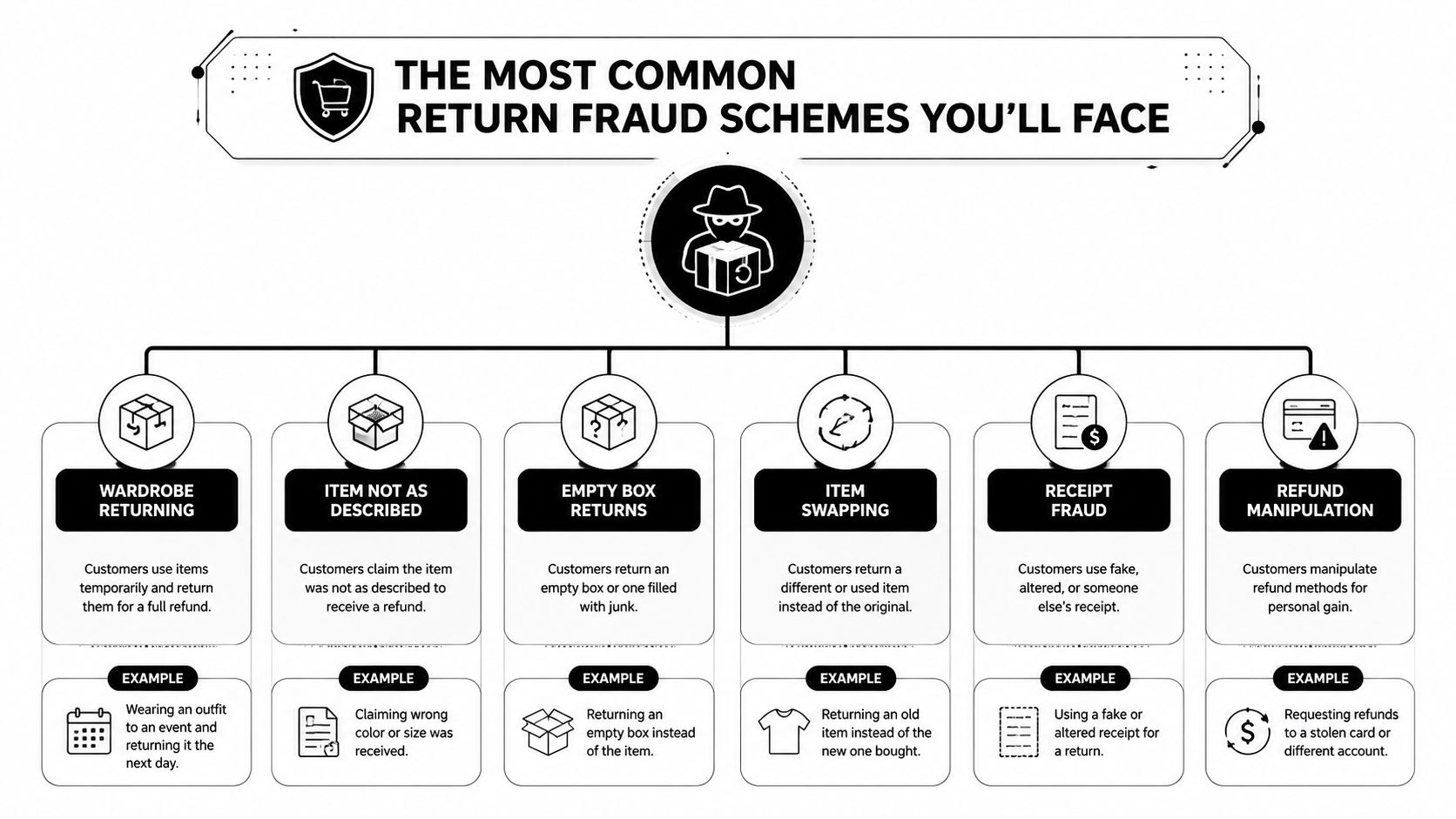
The Most Common Return Fraud Schemes You'll Face
Most return fraud doesn't look dramatic at first. It looks like routine customer service. A return request comes in. A tracking number appears. A package is marked delivered. Then your team opens the box and finds the problem.
Some schemes are old. Some are newer and built around automation gaps.
What these schemes look like in real life
You get a return notification, and the box that arrives contains filler instead of the item. That's the classic empty-box style scam.
Another order comes back with the right packaging but the wrong product inside. Maybe it's a cheaper model. Maybe it's the original shell with missing components. That kind of product swap is common with electronics, accessories, and any SKU your team won't inspect carefully.
Then there's the customer who doesn't even need the item to reach your warehouse. Riskified's breakdown of return fraud highlights emerging trends in 2025 and 2026, including Fake Tracking ID scams, where return labels are altered to fake a delivery, and cross-retailer arbitrage, where someone buys low from a discounter and returns to a higher-priced retailer for a fuller refund.
That's where automated systems become fragile. If your process trusts a delivery scan more than a verified item receipt, you're exposed.
The dangerous return isn't always the one with the loudest complaint. It's the one your system approves before a human checks the facts.
Common Return Fraud Schemes at a Glance
| Scheme Name | What the Fraudster Does | Key Red Flag for Merchants |
|---|---|---|
| Empty box return | Sends back packaging with no actual item inside | Delivery confirmed, but return weight or contents don't make sense |
| Product swap | Returns a cheaper, damaged, or different item in place of the original | SKU mismatch, serial mismatch, or visible tampering |
| Decoy return | Sends back a fake or counterfeit version of your product | Packaging looks right, item quality does not |
| Wardrobing | Uses an item briefly, then returns it as unused | Signs of wear that conflict with the return reason |
| Fake Tracking ID scam | Alters label or tracking flow to trigger refund without a valid return | Tracking says delivered, but warehouse can't match the return properly |
| Cross-retailer arbitrage | Buys from one seller and returns to another seller at a higher refund value | Product appears authentic but doesn't match your sale record cleanly |
If you're training staff or reviewing suspicious patterns, practical fraud examples outside the return context can help sharpen judgment. I like Digital Footprint Check's fraud insights for that reason. It shows how small identity, payment, and behavior clues often point to larger abuse patterns.
Where chargebacks enter the picture
A fraudulent return often has a second act. The customer claims the refund was mishandled, the item was never credited, or the order itself was unauthorized. That's when your returns data becomes dispute evidence.
If you deal with this often, it helps to understand the mechanics of a return item chargeback. The strongest merchants don't treat returns and chargebacks as separate systems. They treat them as one risk trail with two possible losses.
The Hidden Costs of Return Fraud on Your Business
The product loss is the obvious part. The bigger damage usually sits around it.
In 2025, return fraud and abuse resulted in $100 billion in preventable losses for retailers, representing 14.2% of all merchandise returns. Those losses were part of a broader $796 billion hit from total retail loss, according to this Retail Customer Experience coverage of the 2026 Total Retail Loss Benchmark Report.
That number matters because it shows how return abuse spills far beyond one refund.
The loss stack merchants often underestimate
When a fraudulent return lands, you may lose all of this in one chain of events:
- The original item gets kept, swapped, damaged, or made unsellable.
- Outbound and return shipping still get paid by you.
- Support time goes into emails, ticket handling, and manual review.
- Warehouse labor gets pulled into inspection, relabeling, and exception handling.
- Inventory accuracy gets worse when the wrong item is scanned back in.
- The dispute risk stays alive if the customer files a chargeback after the return.
The store owner usually notices the refund first because it's visible. The harder part to spot is the operational drag. Teams spend time chasing one bad return that should've been flagged earlier.
Financial risk doesn't stay in one department
This is why fraud control shouldn't sit only with support or only with ops. It affects cash flow, customer experience, stock integrity, and payments. If you want a broader view of how hidden risks spread through a business, Lighthouse Consultants' guide on financial risk is a useful read.
Key point: Return fraud is rarely one loss event. It's a chain of costs that keeps growing as more teams touch it.
The chargeback multiplier
The chargeback is often the most expensive part because it arrives after you've already taken another loss. By that point, you may be defending a transaction with messy notes, weak return documentation, and no clean timeline.
That's why the stores that perform better don't just ask, "Was this return fake?" They also ask, "If this turns into a dispute next week, what evidence will we have ready?" That question changes how you log photos, scan items, store communication, and approve exceptions.
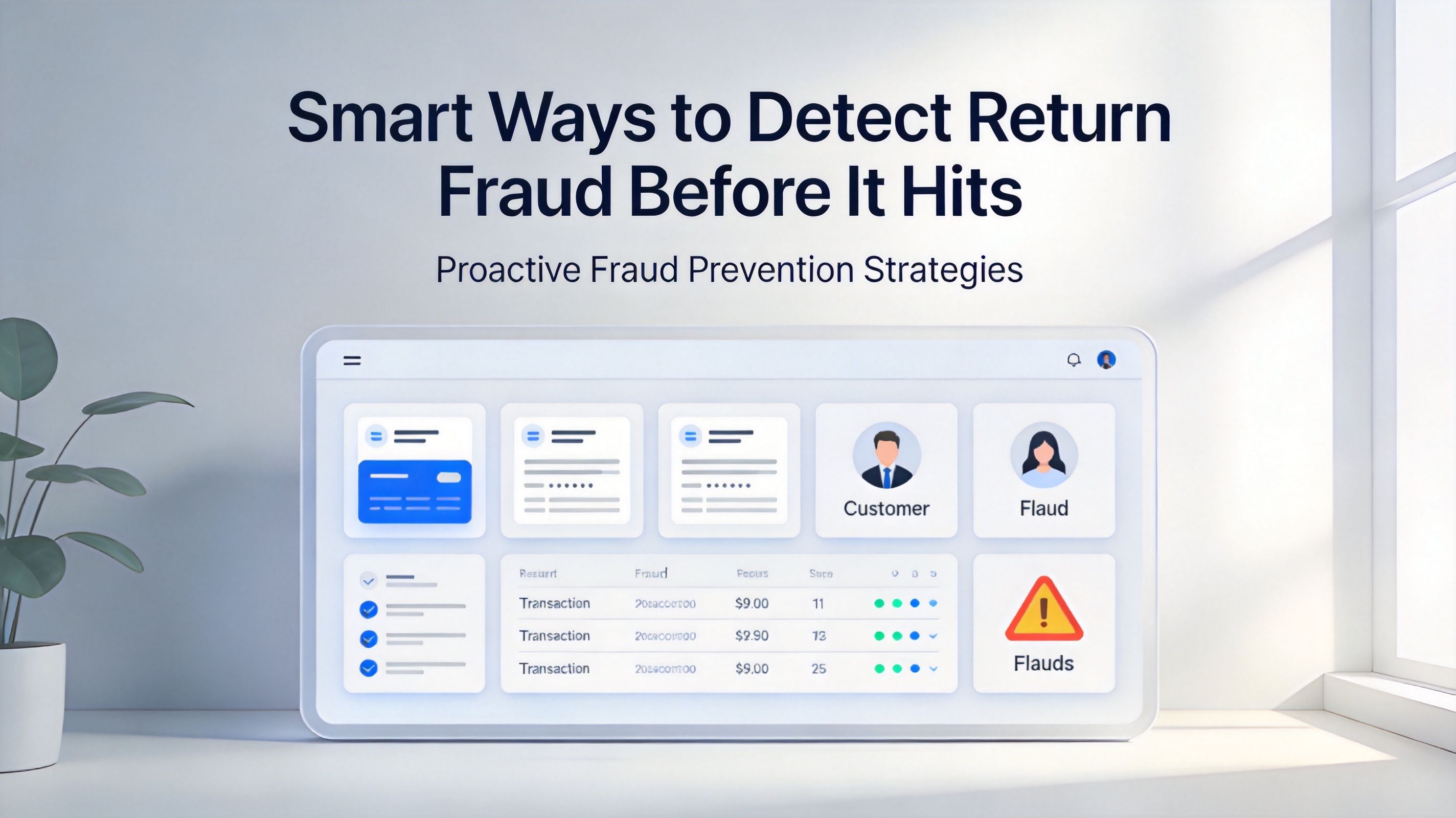
Smart Ways to Detect Return Fraud Before It Hits
The best return fraud workflow starts before the package comes back. Detection is mostly pattern recognition. A single suspicious return might mean nothing. A cluster of weird signals usually means something.
Modern fraud tools don't rely on one clue. According to SEON's guide to fighting return fraud, machine learning models analyze over 900 real-time signals, including IP geolocation, device patterns, and multi-account clustering, and have been shown to reduce return rates by 13% in e-commerce.
The signals that deserve attention
Some red flags are behavioral. Some are technical. The strongest review process combines both.
Behavior shifts
A customer who suddenly starts ordering expensive items, rushing shipping, and opening return requests fast deserves a closer look.Account inconsistency
Billing details, shipping behavior, device history, and prior return patterns should tell a coherent story. When they don't, dig deeper.Item-level mismatch risk
Electronics, collectibles, supplements, and fashion are all vulnerable in different ways. High-resale items need stricter checks than low-risk basics.Cross-account overlap
If multiple accounts appear connected through device use, payment behavior, or similar return claims, don't review them in isolation.
Build a fraud score, not a gut feeling
A lot of merchants still rely on instinct. That's useful, but only up to a point. Good detection turns suspicion into a repeatable decision process.
One practical method is to score returns based on a few weighted inputs:
| Signal type | What to look for | Why it matters |
|---|---|---|
| Customer history | Repeated returns, repeated claims, inconsistent explanations | Shows habit, not a one-off mistake |
| Order context | High-value basket, urgent shipping, promo-period purchase | Fraud often clusters around easy resale or busy periods |
| Technical footprint | Device reuse, location mismatch, linked accounts | Helps expose hidden connections |
| Return details | Vague reason, fast request, no clear supporting proof | Low-friction claims are easier to abuse |
Even your paperwork discipline matters. For stores that still struggle with order and refund record cleanliness, a simple process resource like this invoice number check guide can help tighten the administrative side. Clean records make suspicious patterns easier to spot.
Most bad returns aren't invisible. They're buried in signals your team doesn't have time to connect manually.
What works better than manual review alone
Manual review catches obvious scams. It does poorly against repeat low-grade abuse spread across multiple orders, names, or accounts.
That's where automated risk monitoring helps. If you're evaluating that part of your stack, this overview of transaction monitoring solutions for fraud detection is a useful next step. The goal isn't to reject more customers. It's to notice risky behavior early enough to slow down bad refunds and prepare better dispute evidence.
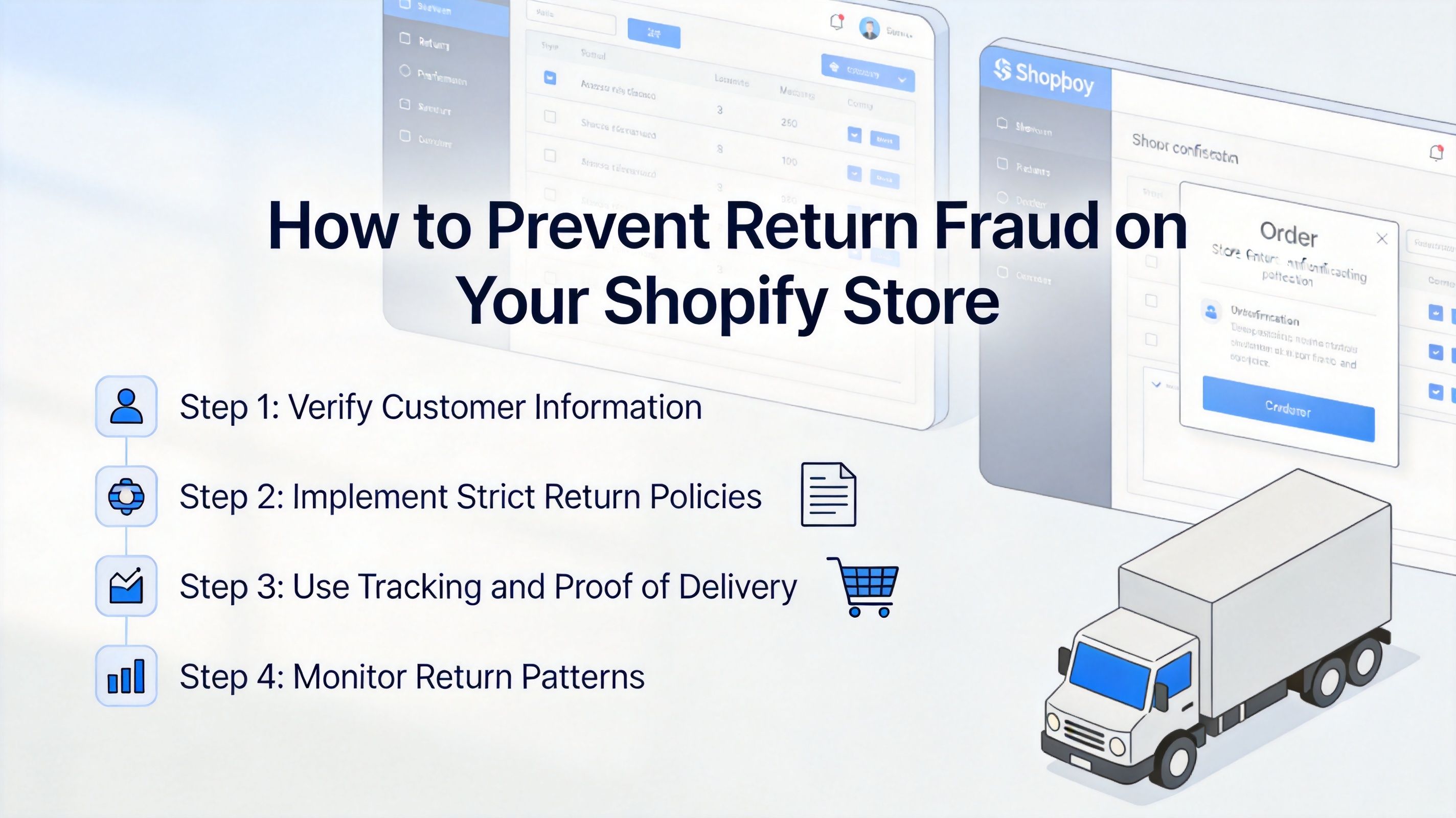
How to Prevent Return Fraud on Your Shopify Store
You won't stop return fraud with a single rule. Stores that reduce it usually do four things well. They write a return policy people can understand, they verify the right details before money goes out, they document exceptions, and they enforce rules consistently.
Retailers are already moving this direction. In response to rising fraud, 84% of retail executives have tightened return policies, such as implementing 30-day windows and requiring receipts. Those measures, guided by predictive modeling, have been shown to reduce fraud by up to 13%, according to Chargeflow's analysis of return fraud trends.
Tighten policy without scaring off good customers
Strict doesn't have to mean hostile. The best policies are plain, specific, and enforced the same way every time.
Here are the rules that tend to hold up well in practice:
State condition requirements clearly
If an item must be unused, define what that means. Original packaging, tags attached, no visible wear, all included parts.Require proof that matches the claim
Damage claims should include photos. Electronics returns should be checked against serial numbers or item identifiers where possible.Refund to the original payment method only when appropriate
Consistency matters. Exceptions create loopholes that repeat abusers learn fast.Use return authorization before warehouse intake
A controlled return flow beats surprise packages showing up with no context.
Add friction only where it counts
Blanket friction hurts conversion and annoys honest customers. Targeted friction works better.
A customer with clean history returning a low-risk item shouldn't face the same checks as a first-time buyer returning a high-value product with a vague complaint. Good prevention is selective.
That also applies to dispute readiness. Some return behaviors are an early warning for friendly fraud on Shopify, especially when the customer keeps the product, pushes for a refund, and then disputes the charge anyway.
Operational habits that save money
These habits don't look glamorous, but they prevent a lot of loss:
- Photograph returns at intake when condition disputes are common.
- Log package weight and contents for categories prone to swaps or empty-box scams.
- Separate normal returns from exception returns so your team doesn't rush the risky ones.
- Train support and warehouse teams on the same rules so one side doesn't approve what the other side can't verify.
Good fraud prevention isn't about being suspicious of everyone. It's about making bad behavior expensive and easy to prove.
Prevention and disputes should work together
This is the part many guides skip. Even the best return controls won't catch everything. Some customers will still file disputes after a refund issue, a denied return, or a fake claim. If your store doesn't have a reliable dispute process, prevention only solves half the problem.
That is why chargeback management belongs in the same conversation as returns. A strong store setup doesn't just reduce abusive returns. It also preserves the evidence needed when one slips through and becomes a dispute.
If return fraud is eating into your margins, don't fight the second loss manually. ChargePay helps Shopify merchants automatically fight chargebacks tied to friendly fraud, bad returns, and false claims. It has a 92.4% win rate, a 4.9-star Shopify App Store rating, and a Built for Shopify badge. ChargePay handles the dispute workflow for you, and pricing is pay-per-win, so you only pay when money is recovered. Install ChargePay from the Shopify App Store and stop letting return fraud turn into unrecovered chargebacks.


.svg)



.svg)


.svg)
.svg)
.svg)