


You're probably staring at a listing right now that looks clean, simple, and profitable. Nice theme. Decent product pages. Revenue screenshots that make the store feel like an easy shortcut.
That's exactly where buyers get burned.
When you buy shopify store assets, you're not buying a pretty storefront. You're buying the whole operating mess behind it: payment risk, fulfillment problems, refund habits, customer service load, weak analytics, and sometimes a chargeback history that starts draining cash the moment ownership changes.
Most buying guides spend too much time on valuation and not enough time on operational liability. That's backwards. A store can look profitable on paper and still be a bad deal if it attracts low-intent buyers, racks up disputes, and forces you into daily cleanup work just to keep payouts moving.
Why Buying a Store Is More Than a Numbers Game
The market is big enough to tempt almost anyone into buying. Multiple 2026 industry trackers estimate there are between 2.8 million and 6.8 million active Shopify stores globally, with the United States accounting for roughly 57% to 60% of that total according to Store Leads. That gives buyers plenty of options. It also means plenty of bad inventory.

Revenue is a lagging indicator
A seller can show you sales. That doesn't mean the business is healthy.
Some stores produce revenue because the owner keeps forcing traffic through paid ads, manually calming angry customers, and eating refund requests before they turn into disputes. You don't want to inherit a store that only works because someone is constantly patching leaks.
That's why I care more about operating quality than headline sales. I want to know how the store converts, how it fulfills, how it handles post-purchase friction, and whether customers dispute charges after the order lands.
Practical rule: If a store needs constant firefighting to preserve its numbers, the store is weaker than the listing suggests.
Chargebacks tell you what the screenshots don't
Chargebacks are one of the clearest signals that something is off. They can point to poor product expectations, shipping delays, weak support, misleading offers, or friendly fraud the business never learned to control.
A seller can hide a lot with screenshots. They can't easily hide the pattern created by unhappy buyers and payment disputes.
Here's what I'd rather buy:
- Lower revenue with cleaner operations. Less drama, more predictable cash flow.
- Boring products with repeatable fulfillment. Not glamorous, but easier to hold.
- A store with real conversion discipline. If you want to inspect that side of the business, review metrics that affect ecommerce conversion rate performance, not just top-line sales.
- A business with documented post-purchase processes. Support, refunds, tracking updates, and dispute handling should already exist.
What you're actually acquiring
Think of the purchase like this. You're taking over five systems at once:
| System | What matters |
|---|---|
| Traffic | Is it stable or dependent on one paid channel? |
| Conversion | Does the site turn visits into orders on mobile and desktop? |
| Fulfillment | Can suppliers and shipping operations keep promises? |
| Customer support | Are issues resolved early or pushed into refunds and disputes? |
| Payments | Does the store have a history of friction, chargebacks, or payout pressure? |
If you miss the last two, you can overpay fast.
Finding Listings and Running the Initial Numbers
You'll usually find stores through acquisition marketplaces, broker listings, private seller outreach, and founder communities. That part is easy. The harder part is refusing to get excited too early.
Most listings try to sell the dream of passive income. Ignore that language. Focus on what you can verify.
Use valuation as a filter, not a decision
Valuations are often based on a multiple of monthly profit, but Shopify acquisition experts advise buyers to heavily adjust that multiple based on factors like churn, traffic source dependency, and how “hands-off” the business is in guidance from Acquire.com's Shopify store acquisition material.
That last point matters more than most buyers admit.
A business that looks profitable but requires nonstop support tickets, ad babysitting, supplier chasing, and dispute handling is not really hands-off. It's under-managed stress wrapped in a nice multiple.
The first pass I use on every listing
I don't start with emotion. I start with elimination.
Ask these questions before you even request deeper access:
- Where do orders come from. SEO, direct, email, returning buyers, paid social, influencers, or marketplaces?
- How concentrated is traffic. If one channel disappears, does the business still stand?
- What does the product line look like. A focused catalog is easier to understand than a random pile of trend items.
- How much operator dependence exists. If the seller disappears for a week, does the business keep working?
- What's the payment setup. If processor issues, reserve pressure, or dispute cleanup are part of the weekly routine, reduce your interest immediately.
If the listing survives that pass, then move into numbers.
Run a simple buyer model
Build a quick sheet with these buckets:
| Input | Why it matters |
|---|---|
| Monthly profit | Starting point for valuation |
| Traffic sources | Tells you whether growth is durable |
| CAC | Helps you judge ad dependence |
| Refund behavior | Signals product and fulfillment quality |
| Support burden | Shows operational drag |
| Dispute exposure | Reveals hidden payment risk |
If you need a quick framework to calculate your customer acquisition cost, use that before you trust any paid traffic story from the seller.
Also review the store's payment economics early. Processing costs, gateway setup, and payout friction all affect the margin. This breakdown of Shopify payment processing fees is useful background when you're checking whether “net profit” is clean.
Don't pay a premium multiple for a store that only looks good before support load, refunds, and dispute drag are counted honestly.
The Real Due Diligence Checklist
Due diligence is where good buyers separate themselves from gamblers. Screenshots are marketing. Access is evidence.
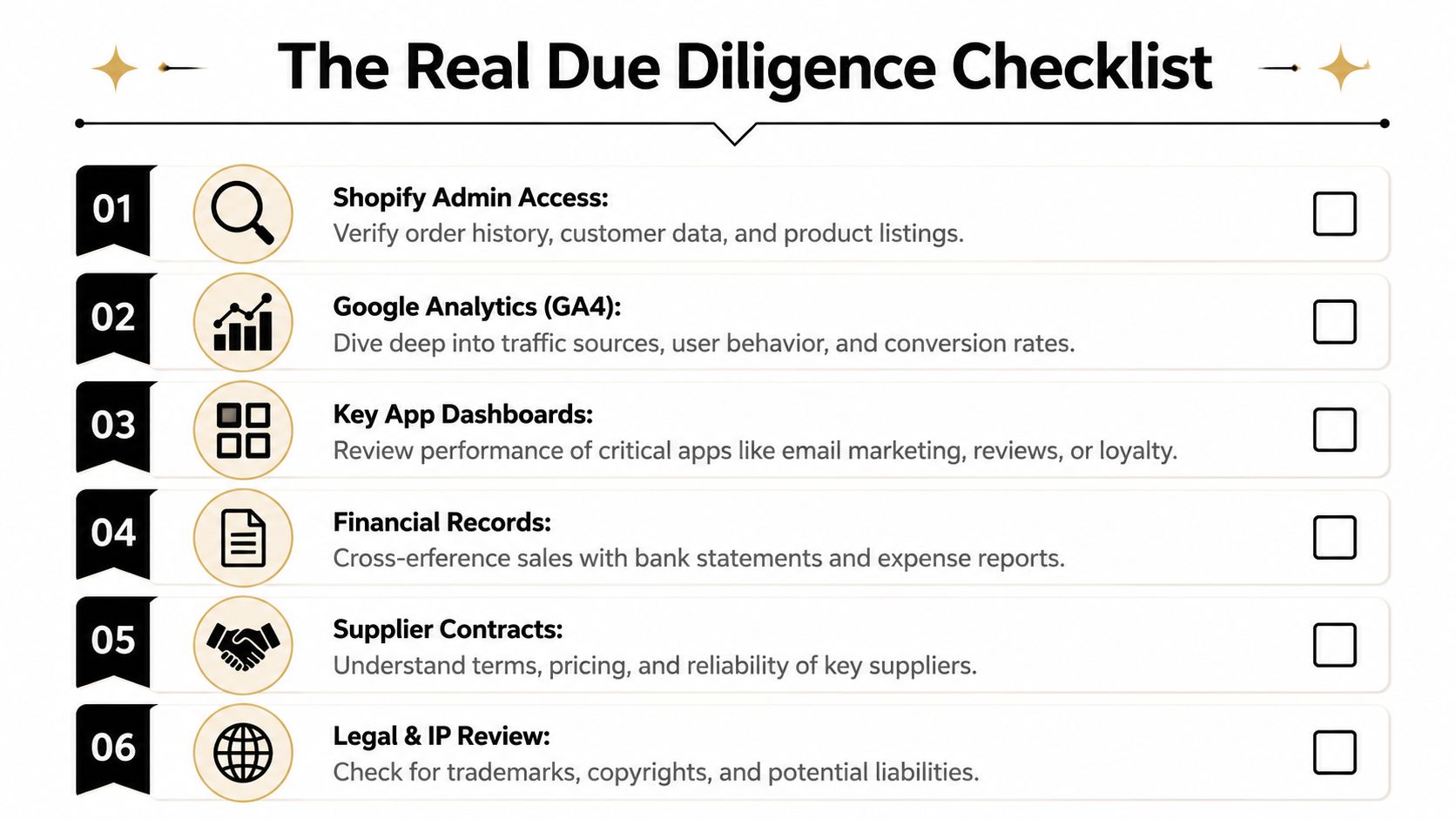
I want read-only access wherever possible. Shopify admin. GA4. Key apps. Payout records. Supplier documentation. Help desk history. If the seller gets cagey, slow down.
Verify the machine, not the story
Expert buyers request GA4 and Shopify Analytics access to verify technical benchmarks like conversion rate, mobile responsiveness, and checkout flow. A store with high traffic but a broken mobile checkout or confusing shipping logic can have suppressed profits and is a riskier acquisition based on guidance summarized from Untitled's Shopify marketing and optimization article.
That means you need to inspect the business from the customer side and the operator side.
Start here:
- Shopify admin. Look at order flow, product setup, customer profiles, discount usage, and refund patterns.
- GA4. Check where users come from, where they drop, and whether mobile behavior looks broken.
- Apps. Email, reviews, subscriptions, loyalty, upsells, support, and any fraud or returns tools.
- Financial records. Match store reports to actual deposits and major expenses.
- Operations. Supplier terms, lead times, and fulfillment consistency.
If you want a legal overview of what a broader review should include, this business due diligence guide is worth reading alongside the store-specific checks.
The chargeback deep dive most buyers skip
This is the part I care about most, because it exposes whether the store creates stable revenue or unstable revenue.
Ask the seller direct questions. Don't soften them.
- Can I see the dispute history in the payment setup you use most?
- Can I see payout records showing chargeback deductions and reversals?
- Who handles dispute responses today?
- What evidence is typically submitted?
- Are there certain SKUs, offers, or traffic sources tied to more disputes?
- What happens after a customer complains? Refund first, support first, or silence until the bank gets involved?
Then look for patterns:
| Signal | What it usually means |
|---|---|
| Repeated “item not received” issues | Weak shipping visibility or fulfillment delays |
| Product mismatch complaints | Offer pages oversell or product quality slips |
| Many disputes from one traffic source | Low-intent acquisition or misleading creative |
| Weak evidence on file | The store hasn't built a real dispute process |
| Heavy owner involvement | You're buying a job, not an asset |
A profitable store with poor dispute handling can become your full-time cleanup project in the first month.
Inspect customer friction before it becomes your problem
A lot of post-purchase pain starts earlier than the chargeback itself.
Review these areas closely:
- Shipping logic. Test rates, delivery estimates, and tracking communication.
- Mobile UX. Broken checkout on mobile can create abandoned carts and confused buyers.
- Refund policy clarity. Vague policy language turns simple complaints into bank disputes.
- Support speed. Slow replies push customers to their card issuer.
- Product pages. If sizing, ingredients, compatibility, or delivery expectations are unclear, disputes follow.
A store with clean ops usually looks boring under inspection. That's a good sign. You want predictable systems, not heroic effort.
If you're evaluating payment risk specifically, it also helps to review practical chargeback prevention steps for ecommerce stores so you know what mature dispute hygiene looks like.
Negotiating the Deal and Ensuring a Safe Transfer
Once the numbers and operations check out, your job changes. Now you need to use what you found to shape the deal.
Most buyers negotiate only on valuation. Smart buyers negotiate on risk transfer, documentation, and handoff quality.
Turn due diligence into deal terms
Use your findings plainly.
If the store depends too much on one ad channel, lower the multiple. If the support workflow is thin, lower the multiple. If payment operations are sloppy, lower the multiple and tighten the transition requirements.
Shopify's own guidance for new store owners emphasizes validating product-market fit before committing capital to inventory. For an acquisition, this principle applies to validating the seller's claims about the business's health and profitability before you commit capital through an escrow service based on the guidance summarized at Futurmedia's Shopify startup article.
That's the right mindset. Don't fund a story. Fund a verified asset.
Use escrow and document every asset
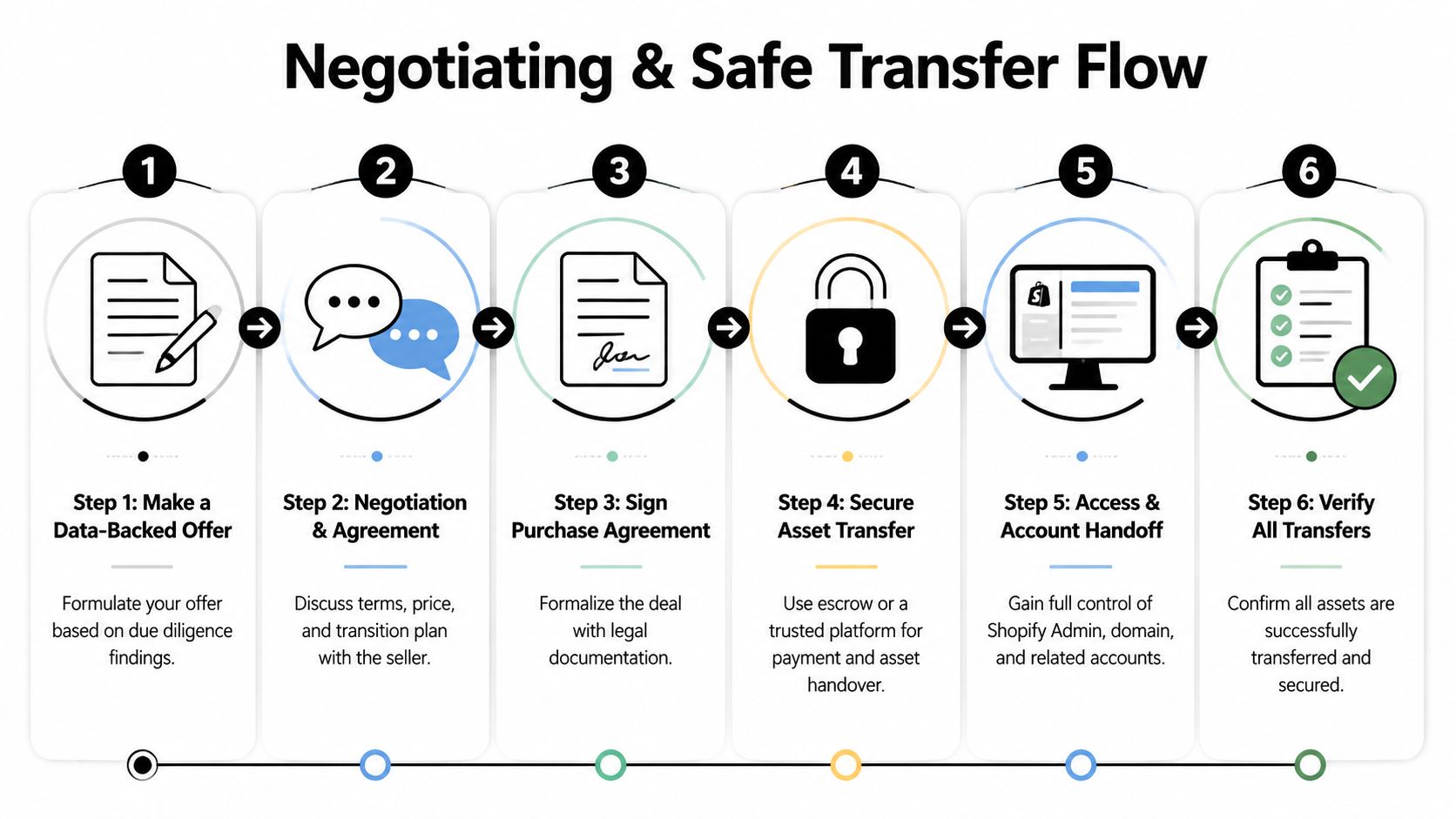
Never send money directly because the seller seems trustworthy. Use escrow.
The basic flow is simple:
- You deposit funds into escrow after the purchase agreement is signed.
- The seller transfers assets. Shopify ownership, domain, social accounts, creative files, supplier contacts, email platform, ad accounts if included, and app access.
- You verify everything before release.
- Escrow releases funds only after you confirm receipt.
That process protects you from partial transfer, missing accounts, or a seller who goes quiet after payment.
Here's a useful overview if you're comparing payment and gateway responsibility during transfer: merchant account vs payment gateway.
A quick explainer helps if you've never watched a proper handoff process before.
What the agreement should spell out
Your asset purchase agreement should be specific. No vague language.
Make sure it identifies:
| Asset or obligation | Why it matters |
|---|---|
| Shopify account ownership | Core business control |
| Domain transfer | Brand continuity and email integrity |
| Creative and product files | Needed for ads, listings, and support |
| Supplier relationships | Prevents fulfillment interruption |
| Customer data rights | Clarifies what's included |
| Transition support window | Gives you time to catch problems |
Get a lawyer to review the agreement. That cost is small compared with buying a broken handoff.
Your First 90 Days A Post-Purchase Survival Plan
The closing is not the finish line. It's the point where the hidden problems become yours.
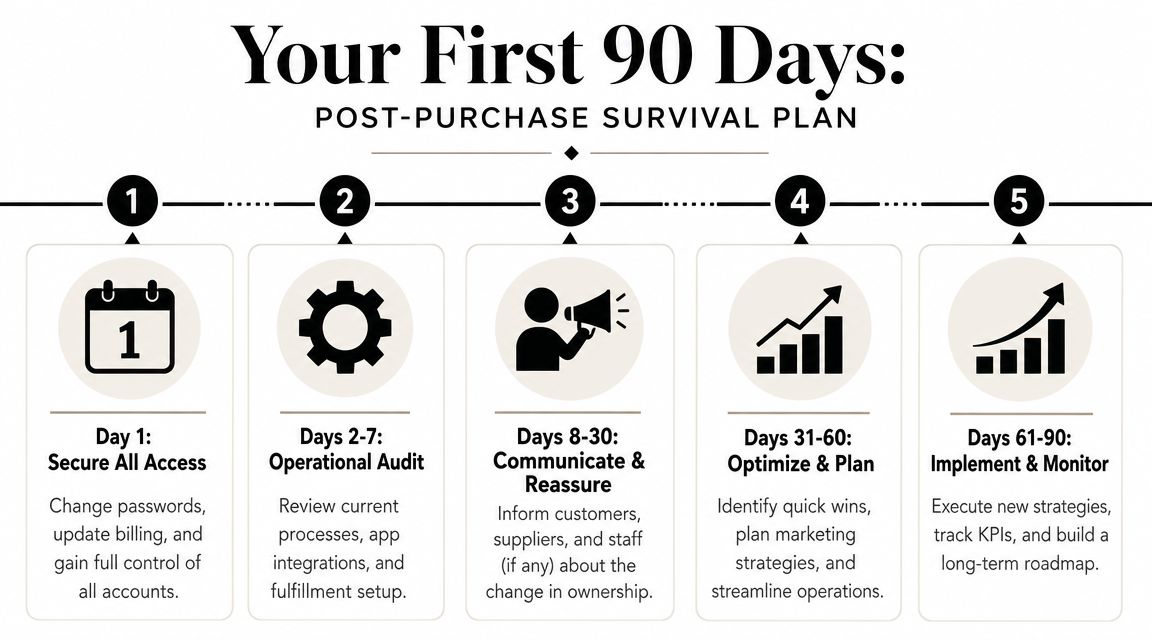
A lot of stores look stable until the new owner logs in, changes nothing, and learns the business was running on seller memory, fragile app connections, and reactive customer support. The first ninety days decide whether your purchase becomes an asset or a headache.
Days 1 to 7 lock down access and expose weak spots
Day one is security and control.
Change every password you can change. Transfer the domain. Confirm billing ownership for Shopify and every connected app. Check email accounts tied to support, order alerts, and admin recovery. Review who still has staff access and remove anyone who shouldn't.
Then audit the live customer journey yourself. Place test orders where appropriate. Read support macros. Review open tickets. Check returns flow. Look at tracking updates. You need to feel the business as a customer before you try to grow it.
Days 8 to 30 fix post-purchase risk first
Even with “launch-ready” stores, buyers must validate conversion, fulfillment, and dispute operations post-transfer. The critical question, “What operational data should I demand from the seller, especially around chargebacks, refund rates, and fulfillment SLAs?” is largely absent from existing coverage but is vital for post-acquisition survival according to Ecomency's discussion of launch-ready Shopify stores.
That's the right priority order. Not theme tweaks. Not logo changes. Not new ad experiments.
Start with the things that protect cash:
- Review open disputes and recent refunds
- Map the support workflow from complaint to resolution
- Identify products or campaigns creating the most friction
- Tighten delivery expectations on product and checkout pages
- Make sure payment and payout settings are under your control
The fastest way to damage a new acquisition is to chase growth before you fix the reasons customers ask for refunds and file disputes.
This is the point in the article where a tool recommendation makes sense. If the store has any real dispute volume, use automation instead of handling representments manually. ChargePay is one option for Shopify merchants. It handles the dispute workflow from evidence assembly to submission, and the publisher states it has a 92.4% win rate across 200K+ cases with $10.8M+ recovered on its platform.
Days 31 to 90 build on a stable base
Once operations are under control, then you can optimize.
Work through a prioritized list:
Fix conversion friction
Improve mobile clarity, shipping messaging, and product-page accuracy before spending more on traffic.Clean up retention basics
Email flows, repeat-purchase offers, review collection, and support follow-ups matter more than random growth hacks.Reassess traffic quality
Cut spend on weak sources. Keep sources that bring buyers who don't create support and dispute drag.Document the business
If the seller kept key knowledge in their head, replace that with SOPs.
If you need a few ideas once the store is stable, this roundup of tips to increase Shopify sales is more useful after the operational leaks are fixed, not before.
Secure Your Investment from Day One
If you want the short version, here it is.
When you buy shopify store assets, you're buying systems, not screenshots. The actual risk usually isn't the list price. It's the hidden operational mess you inherit after closing. Poor fulfillment discipline, weak support, bad mobile checkout, unclear offers, and unresolved chargeback habits can turn a “good deal” into a low-margin job fast.
That's why I'd rather buy a less exciting store with clean operations than a flashy store with fragile economics. Valuation matters. Transfer mechanics matter. But the business you keep is the business you can operate without daily payment friction and customer fallout.
Chargebacks sit right in the middle of that reality. They hit cash flow, consume staff time, expose weak customer experience, and create pressure with processors. If you ignore them during diligence, you're not being aggressive. You're being careless.
Before you scale anything, protect the revenue you already bought. Review the store's payment risk. Tighten support and fulfillment. Put a real dispute process in place. If you want a deeper look at the mechanics, this guide to ecommerce chargeback protection is a good place to start.
If you've bought a Shopify store, or you're about to, install ChargePay from the Shopify App Store early. It has a 4.9-star rating and a Built for Shopify badge, and it's built for one job: helping Shopify merchants recover disputed revenue without turning chargebacks into a manual time sink.


.svg)



.svg)


.svg)
.svg)
.svg)